Standing Scapular Rotation
Standing Scapular Rotation is a bodyweight control drill for the muscles that move and stabilize your shoulder blades. You stand tall, lift your upper arms out to shoulder height with the elbows bent to roughly 90 degrees, and then slowly rotate the forearms from a lowered position up until your hands point toward the ceiling, before lowering them back down with control. The elbows stay fixed in place the entire time, so all of the motion comes from the shoulders and the shoulder blades rather than from swinging the arms.
The main players here are the trapezius group, especially the lower and middle fibers that pull the shoulder blades down and together, along with the rotator cuff muscles that rotate the upper arm. The highlighted areas in the movement reflect how much work the upper back and shoulder region does, even though no external load is involved. Because the lever is your entire forearm and hand, the demand on these small stabilizing muscles is real, and most people feel a burn across the upper back within 10 to 15 controlled repetitions.
This drill is especially useful for anyone whose shoulder blades tend to ride up toward the ears — desk workers, people who carry tension in the upper traps, and lifters whose shoulders shrug during presses or pull-ups. It is also a common prehab choice before overhead work, and a frequent assignment in rehab-style programs for building scapular upward rotation, which is the natural motion that lets your arm travel overhead without pinching the structures around the shoulder joint.
Setup matters more than it looks like it would for a load-free exercise. Your stance should be about hip-width with soft knees, ribs stacked over the pelvis, and the elbows held exactly at shoulder height. If the elbows drift forward, drop toward your sides, or creep upward, the shoulder blades stop doing the rotating and the movement loses its point. A mirror or a training partner can help you confirm that the elbows stay level and that the shoulders stay away from the ears.
To execute it well, think of the forearms as windshield wipers pivoting around a fixed elbow hinge. Rotate up until the hands point at the ceiling, pause for a beat while you gently draw the shoulder blades down and slightly together, then take two to three seconds to rotate back down. Nothing about the rep should be rushed — the slow lowering phase is where most of the scapular control is built.
Because it requires no equipment and very little space, Standing Scapular Rotation fits easily into warm-ups, desk-break routines, and cooldowns. Keep the range within what feels smooth and pinch-free at the shoulder, and stop short of any position that provokes discomfort. If standing feels unstable or the shoulders fatigue too quickly to keep the elbows level, the same rotation can be performed lying face down or seated against a wall until standing control improves.
Fitwill
Log Workouts, Track Progress & Build Strength.
Achieve more with Fitwill: explore over 9600 exercises with images and videos, access built-in and custom workouts, perfect for both gym and home sessions, and see real results.
Start your journey. Download today!




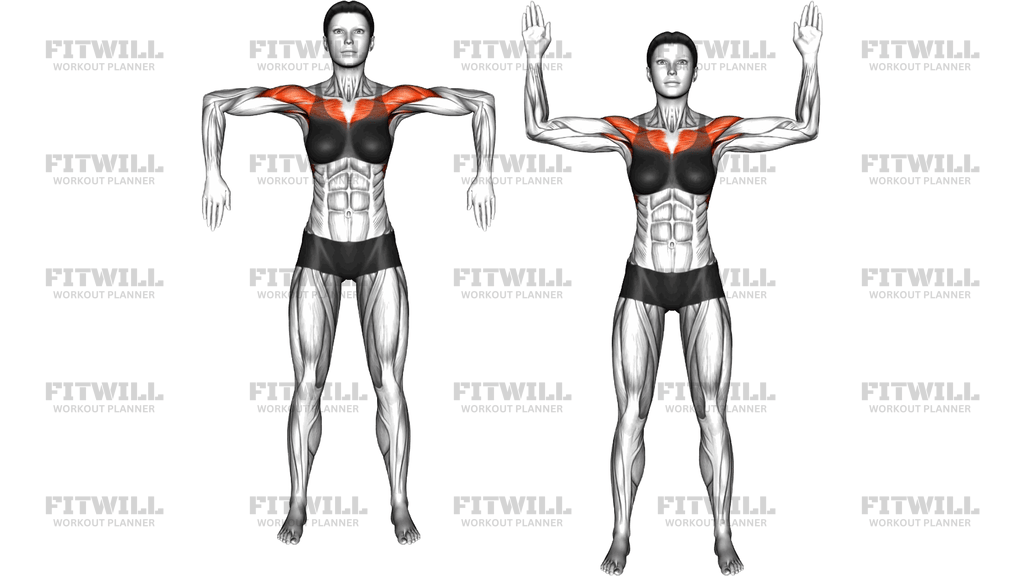
Instructions
- Stand with your feet about hip-width apart, knees soft, and your weight balanced evenly across both feet.
- Lift both upper arms out to the sides until they are level with your shoulders, then bend the elbows to 90 degrees so the forearms hang down toward the floor.
- Draw the shoulders down away from your ears and brace the torso lightly, keeping the ribs stacked over the hips.
- Keeping the elbows fixed at shoulder height, slowly rotate the forearms upward until your hands point toward the ceiling.
- At the top, pause for one to two seconds and gently squeeze the shoulder blades down and slightly together.
- Reverse the rotation under control, taking two to three seconds to lower the forearms back to the starting position with the hands pointing down.
- Exhale as you rotate the forearms up, and inhale as you lower them back down.
- Keep the head neutral and the neck relaxed throughout — do not jut the chin forward as the arms move.
- Complete the target number of repetitions, then shake out the shoulders and reset your posture before the next set.
Tips & Tricks
- The most common mistake is shrugging as the forearms rotate up. If you feel the neck muscles working hard, lower the elbows an inch and consciously press the shoulders toward the floor.
- Watch that the elbows do not drift forward as you fatigue. Once they leave the shoulder-height line, the shoulder blades stop rotating and the front of the shoulder takes over.
- If you cannot get the hands all the way to vertical without pinching at the front of the shoulder, rotate only to the point where the movement stays smooth and expand the range gradually over weeks.
- Move slower than feels necessary. A two-second rotation up and a three-second rotation down is a good standard for this drill — fast reps turn it into a momentum exercise.
- Imagine the elbows are pins and the forearms are the only parts that move. That image keeps the joint path honest and shifts the work onto the scapular muscles.
- Do not let the lower back arch as the arms travel overhead. Brace the torso lightly and keep the ribs down so the motion stays at the shoulders.
- If one side rotates further or smoother than the other, perform a few extra single-arm repetitions on the stiffer side to even out control.
- This drill works well as a primer before overhead presses or pull-ups — two light sets of 10 to 12 reps can help the shoulder blades set up before loading.
- Tension in the hands and forearms is unnecessary. Keep the fingers relaxed and open rather than clenched, which helps the shoulders stay quiet.
Frequently Asked Questions
Which muscles does Standing Scapular Rotation work?
The primary work comes from the trapezius group, particularly the lower and middle fibers that rotate and control the shoulder blades, with support from the rotator cuff and the muscles around the shoulder joint. You may feel it across the upper back and slightly in the shoulders themselves.
Why do my elbows have to stay at shoulder height during Standing Scapular Rotation?
With the upper arms level, the forearm rotation forces the shoulder blades to rotate upward, which is exactly the motion this drill trains. If the elbows drop or drift forward, the shoulder blades stop contributing and the exercise becomes a much easier arm movement.
Is Standing Scapular Rotation suitable for beginners?
Yes. Because it uses no load, beginners can learn the shoulder blade control pattern safely and usually pick it up within a few sessions. Start with a smaller rotation range and full control before chasing full vertical forearms.
Should I feel Standing Scapular Rotation in my neck?
No — neck tension usually means the upper traps are shrugging to compensate. Reset with the shoulders pressed down and away from the ears, reduce the range slightly, and slow the tempo until the work shifts back to the upper back.
How many reps of Standing Scapular Rotation should I do?
Two to three sets of 10 to 15 slow repetitions works well as a warm-up or control drill. Because the goal is precision rather than fatigue, stop a set once your elbows can no longer stay level.
Can I do Standing Scapular Rotation before overhead pressing?
Yes, it is a popular shoulder primer. A couple of light sets before presses or pull-ups helps rehearse the upward rotation pattern your shoulder blades use when the arms travel overhead.
What can I use instead of Standing Scapular Rotation if standing is uncomfortable?
The same rotation can be performed lying face down on a bench or seated with your back against a wall, which removes balance demands and gives feedback about elbow height. Wall slides are another reasonable substitute for training scapular upward rotation.
My hands cannot point straight up at the top — is that a problem?
Not immediately. Limited range often reflects tightness in the chest or shoulders, so rotate only as far as the motion stays smooth and gradually work toward vertical. Forcing the end range usually causes compensation rather than progress.
Is Standing Scapular Rotation safe if I have shoulder discomfort?
It is generally a low-load, low-risk drill, but any pinch, sharp pain, or catching sensation is a signal to reduce the range or stop. If shoulder pain persists across sessions, get it assessed before continuing any shoulder exercise.