Coner Wall Chest Stretch
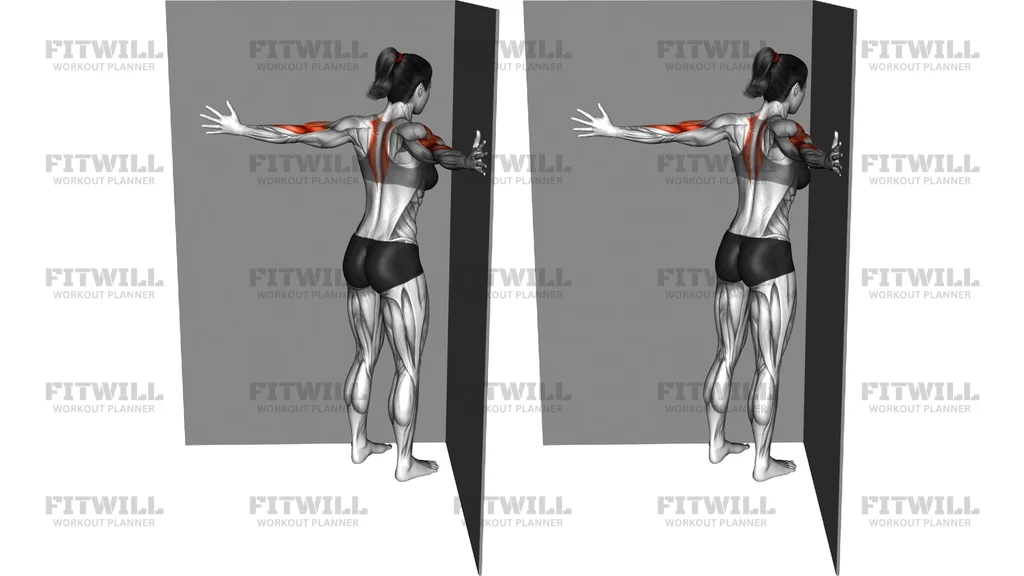
The Coner Wall Chest Stretch is a body-weight flexibility exercise performed in the corner of a room, where two walls meet at a right angle. You place one forearm or hand on each wall at roughly shoulder height, then lean your body gently forward into the corner to open the chest. It is one of the simplest ways to get a symmetrical stretch across both sides of the chest at the same time, because the walls act as fixed anchors for your arms while your body weight controls the intensity.
This stretch is especially useful for people who spend long hours sitting at a desk, driving, or working at a computer. Those habits tend to pull the shoulders forward and shorten the pectoral muscles, which contributes to rounded shoulders and a slouched upper back. Desk workers, office athletes, swimmers, and anyone who presses weights regularly can all benefit from opening the chest this way a few times per week.
The main muscles stretched are the pectorals across the front of the chest, with the front of the shoulders and the muscles between the shoulder blades also receiving attention as the chest opens. Because both arms are supported on the walls, the stretch is even from left to right, which makes it easier to notice and address side-to-side tightness.
The corner setup matters more than it might seem. Standing in a doorway or pressing against a single wall loads one side more than the other, while the corner lets you keep both arms at the same height and angle. Your distance from the corner determines how strong the stretch feels, so you can fine-tune it precisely by moving your feet a few inches closer or farther away.
To execute it well, keep your body in one straight line from head to heels as you lean in, and let the chest travel toward the corner rather than pushing the hips back or arching the lower back. The stretch should feel like a comfortable pull across the chest and the front of the shoulders, never a sharp pain in the shoulder joint. Breathe slowly and let each exhale allow a little more release.
Use this stretch as part of a warm-up before upper-body pressing, as a break during long workdays, or as a cool-down after chest training. Hold it for twenty to thirty seconds, release slowly, and repeat two to three rounds. If you have a current shoulder injury or a recent surgery, keep the arm angle lower and the lean shallow, or check with a qualified professional first.
[ Workout Log & Planner ]
Put your next workout in Fitwill
Keep your plan and training log ready when you are.


Instructions
- Stand facing the corner where two walls meet, about one to two feet away from the point of the corner.
- Raise both arms out to the sides and place one forearm or hand flat against each wall at shoulder height, with elbows slightly below or level with the shoulders.
- Stagger or split your stance slightly and soften your knees so you can shift your weight forward without locking your legs.
- Brace your trunk lightly and keep your ribs stacked over your pelvis so you lean as one straight line rather than hinging at the lower back.
- Slowly lean your chest toward the corner, letting the walls hold your arms in place until you feel an even stretch across both sides of the chest and the front of the shoulders.
- Hold the end position for twenty to thirty seconds, breathing slowly and letting the stretch deepen slightly with each exhale.
- If one side feels tighter, shift a small amount of weight toward the tighter arm while keeping both palms in contact with the walls.
- Push gently through both hands to return your body upright in a slow, controlled manner instead of snapping back.
- Step away from the wall, roll your shoulders a few times to reset, and repeat for two to three rounds as needed.
Tips & Tricks
- Adjust intensity with your feet, not your arms: stepping closer to the corner deepens the stretch, stepping back eases it off, so start farther away and work in.
- A common mistake is shrugging the shoulders up toward the ears as you lean in. Actively press your hands into the walls and draw the shoulder blades down before leaning.
- Avoid collapsing through the lower back. If you feel the stretch in your spine instead of your chest, tighten your trunk slightly and lean from the ankles as one block.
- Keep your elbows a touch below shoulder height if the front of the shoulder feels pinched; a lower arm angle shifts the emphasis to the chest and away from the joint.
- Do not bounce at the end range. The wall gives no feedback like a partner would, so a slow, steady lean is the safest way to find your edge.
- If one side is noticeably tighter, spend an extra fifteen to twenty seconds on that side by rotating your torso slightly toward the opposite wall while maintaining contact with both.
- Warm the area first with a few arm circles or light pressing movements, since a warm muscle lengthens more comfortably than a cold one.
- Finish each rep by standing tall and squeezing your shoulder blades together for a few seconds; this teaches your body to own the new range rather than just visiting it.
Frequently Asked Questions
Which muscles does the Coner Wall Chest Stretch target?
It primarily stretches the pectoral muscles across the front of the chest, with secondary stretch on the front of the shoulders and a gentle opening through the muscles of the upper back as the shoulder blades separate.
Why use a corner instead of a single wall or a doorway?
The corner lets you place both arms on two separate surfaces at the same height and angle, so the stretch is even on both sides. A doorway often forces an awkward grip, and a single wall loads one arm at a time.
How far from the corner should I stand?
Start about one to two feet away with a mild stretch, then move your feet incrementally closer only when the current position feels easy. Distance is your main tool for controlling intensity.
Is the Coner Wall Chest Stretch good for beginners?
Yes, it is very beginner-friendly because you control the depth with body position and there is no equipment. Just start conservative and keep the stretch at a comfortable pull rather than a strain.
How long should I hold the stretch?
Hold for twenty to thirty seconds per round and repeat two to three times. For a warm-up, shorter holds of ten to fifteen seconds work well; after training, use the longer holds.
My shoulders click or feel pinched when I raise my arms high. What should I change?
Lower your hands and forearms on the walls so your elbows sit slightly below shoulder height, and reduce how far you lean. The stretch should move back into the chest and away from the shoulder joint; if pinching persists, stop and consult a professional.
Can I do this stretch every day?
Yes, it is low-load and gentle enough for daily use, which makes it a good mid-workday reset for anyone with desk-related shoulder rounding. Just keep the intensity comfortable rather than aggressive.
What can I use instead if I have no corner available?
A doorway works as a substitute: place one forearm on each side of the frame and step forward into a lunge for a very similar single-sided chest stretch, or use a door frame with one arm at a time and switch sides.
Should I feel anything in my upper back during this stretch?
A mild opening sensation between the shoulder blades is normal because the shoulder blades are being spread apart as the chest widens. Sharp pain anywhere, especially in the neck or spine, means you should ease off and recheck your position.
When is the best time to do the Coner Wall Chest Stretch?
It fits well before upper-body pressing as a warm-up, after chest or shoulder training as a cool-down, and any time during the day when your shoulders feel rounded forward from sitting.