Lying Single Bent Leg Opposite Reach
Lying Single Bent Leg Opposite Reach is a prone body weight exercise performed face down on the floor. You start lying flat with one arm stretched out overhead in front of you and your legs extended behind you. From there, you lift the outstretched arm and the knee of the opposite leg at the same time, bending that knee so the foot points toward the ceiling, then lower back down with control. The working leg stays bent throughout, which shortens its lever and shifts more of the workload onto the glute of that hip rather than the hamstring.
Because one leg stays anchored to the floor, this movement challenges your ability to hold your hips square while one side of the body lifts. That anti-rotation demand quietly recruits the deep core and the muscles along the spine, on top of the obvious work happening in the lifted glute and shoulder. If you have ever done Superman raises or bird dogs, this sits in the same family, but the bent knee and the face-down position give it a distinct feel.
This exercise is a solid pick for people who want to strengthen the glutes and the muscles supporting the lower back without loading the spine with external weight. It is often used in warm-ups before squats or deadlifts, in rehab-style or general fitness routines, and by anyone who spends long hours sitting and needs to reawaken the hip extensors. Since it requires no equipment beyond a floor surface, it also works well for home training and travel workouts.
Setup matters more than it looks. Keep your forehead or nose hovering just off the floor with your neck in line with your spine, your working arm reaching long in front of you, and your hips pressed lightly toward the floor. The height of the lift is not the goal; a modest, controlled elevation of the arm and knee with the hips staying level does far more than a big arched swing.
To execute it well, exhale as you lift the arm and the opposite bent knee, squeeze the glute of the working leg at the top for a brief pause, then inhale as you lower both limbs back to the floor. Avoid twisting the torso, tilting the hips, or jamming the neck upward. Move slowly enough that you could stop at any point of the rep, and keep the non-working leg relaxed but in contact with the floor as a stabilizer.
A few practical safety points: keep the lift in a pain-free range, and if your lower back pinches, reduce the height of the arm and leg rather than pushing through discomfort. Because this is a repeated extension movement, one or two controlled sets per side is usually enough when it is used as an activation drill, and it can be scaled up with more reps or a longer pause at the top when you want more of a strength challenge.
Fitwill
Log Workouts, Track Progress & Build Strength.
Achieve more with Fitwill: explore over 9600 exercises with images and videos, access built-in and custom workouts, perfect for both gym and home sessions, and see real results.
Start your journey. Download today!




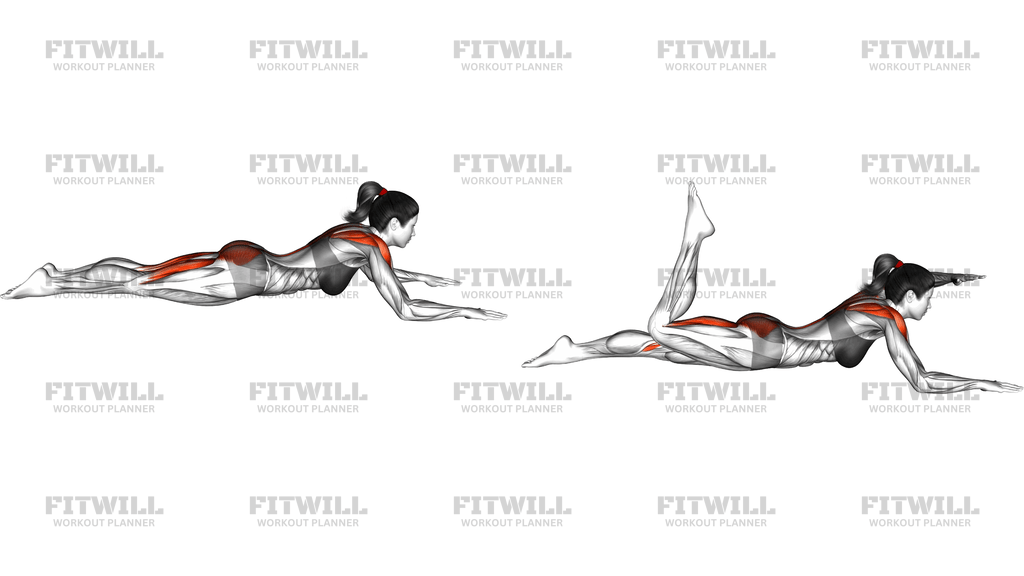
Instructions
- Lie face down on an exercise mat or firm floor with your legs extended straight behind you and your forehead hovering just above the ground.
- Extend your right arm straight out overhead in front of you with your palm facing down, and keep your left arm resting alongside your body.
- Lightly brace your abdominal muscles and press your hip bones gently into the floor so your pelvis is stable before you start moving.
- Exhale as you lift your right arm a few inches off the floor while simultaneously bending your left knee and raising it so your left foot travels up toward the ceiling.
- Pause briefly at the top with your glute squeezed, your arm reaching long, and your hips still flat against the floor.
- Lower the arm and the bent leg back to the floor together on an inhale, keeping the knee at the same bend angle the whole way down.
- Complete the desired number of repetitions on this side, keeping the right leg extended and in contact with the floor as your stabilizer.
- Switch sides by extending the left arm overhead and lifting the opposite bent knee, and perform the same number of reps.
- Reset your torso and neck position between sides if you feel your shoulders creeping up toward your ears.
Tips & Tricks
- A common mistake is arching hard through the lower back to lift the bent leg higher. If your lumbar spine feels like it is doing all the work, think about driving the lift from the glute instead of the waist.
- Watch for hip tilt: when the left knee lifts, the left hip bone tends to rise off the floor. Imagine a glass of water resting on your sacrum that you must not spill.
- Do not crank your chin up to look forward. Keep your neck long with your gaze down at the floor, or you will build unnecessary tension at the top of the spine.
- If your shoulder fatigues before your glute, lower the arm slightly and focus on reaching long rather than lifting high; the reach itself engages the muscles around the shoulder blade.
- The bent-knee position is the point of this exercise. If you straighten the leg as it rises, you turn it into a Superman raise and lose the glute emphasis.
- Keep the anchoring leg actively resting on the floor rather than letting it drift outward, which helps hold the pelvis level.
- Slow the lowering phase down to two or three seconds; most people rush the descent and skip the eccentric half of the work.
- Breathe on every rep. Holding your breath through the lift is common in prone exercises and makes the movement feel harder than it should.
Frequently Asked Questions
What muscles does Lying Single Bent Leg Opposite Reach work?
The main work comes from the glute of the lifting leg, with support from the hamstrings, the muscles along the lower back, and the rear of the shoulder on the reaching arm. The deep core also works to keep your hips from rotating as one side lifts.
Why is the working leg bent instead of straight?
Bending the knee shortens the leg, which reduces the load on the hamstring and lets the glute of that hip do more of the lifting. It also makes the movement easier to control, so it suits beginners and warm-up use.
Is Lying Single Bent Leg Opposite Reach suitable for beginners?
Yes. Because it uses only body weight on the floor and a short lever, most beginners can learn it quickly. Start with small lifts and one set of 8 to 10 reps per side before adding volume.
How high should I lift my arm and knee?
Only a few inches. The arm and knee should clear the floor while your hips stay level and your lower back stays comfortable; a large arched lift usually means you are compensating with spinal extension.
Can I do this exercise without a mat?
Yes, any firm surface works. A mat simply makes the prone position more comfortable on your hip bones and ribs, which matters once you are holding the position for multiple reps.
What is the most common mistake in this movement?
Letting the hip of the lifting leg rise and the torso rotate toward that side. Fix it by keeping both hip bones pressed toward the floor and imagining the knee traveling straight up rather than out to the side.
How is this different from a Superman raise?
A Superman raise lifts both arms and both legs together with straight limbs, which loads the lower back more heavily. Here one leg stays anchored, one knee stays bent, and only the opposite arm and knee lift, making it more of a single-side glute and stability exercise.
When should I include Lying Single Bent Leg Opposite Reach in my workout?
It works well as a glute activation drill before lower body training, or as a light strength finisher on lower back and core days. Doing it cold at the start of a session is fine too, since it requires no equipment or loading.
My lower back aches after this exercise. What should I change?
Lower the range of motion so the arm and knee barely clear the floor, and make sure you are squeezing the glute at the top rather than arching the spine. If discomfort continues, stop the exercise and check your position with a coach or professional.