Sitting Figure Four Rock
The Sitting Figure Four Rock is a floor-based mobility drill that combines a seated figure-four hip position with a gentle rocking motion. You sit with your hands planted on the floor behind you, cross one ankle over the opposite thigh just above the knee, and then rock the crossed leg back and forth to open up the outside of the hip. The support of your hands lets you stay tall through the chest while the legs do the work, which makes this version friendlier for tight hips than standing or lying variations.
This movement targets the glutes and the deep external rotators of the hip, with the muscles along the side of the waist working to control the rotation as you rock. It is especially useful for runners, cyclists, and anyone who sits for long stretches of the day, since prolonged sitting tends to leave the outer hips stiff and the glutes inactive. The rocking element adds a dynamic component that many people find easier to relax into than a long static hold.
Setup matters more than it looks. Your hands should be far enough behind you that your weight sits back into the heels of your palms, and the crossing ankle should rest on the thigh, not slide down toward the knee joint. Keeping the supporting foot planted and the torso long determines whether you actually feel the stretch in the back of the crossed hip or just strain your lower back.
Work with a slow, rhythmical rock rather than forcing range, letting the knee of the crossed leg gently travel toward and away from the opposite shoulder. Expect a deep sensation in the outer glute on the crossed-leg side; if you feel pinching in the groin or discomfort in the knee, back off the range and adjust the ankle placement. This drill fits well in warm-ups, cool-downs, or as a mid-day reset for stiff hips.
Fitwill
Log Workouts, Track Progress & Build Strength.
Achieve more with Fitwill: explore over 9600 exercises with images and videos, access built-in and custom workouts, perfect for both gym and home sessions, and see real results.
Start your journey. Download today!




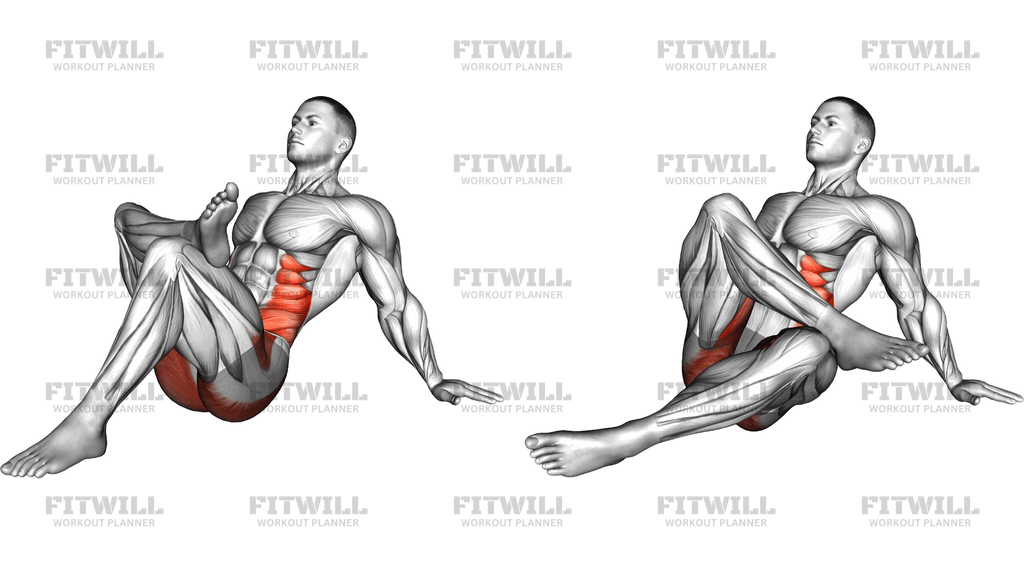
Instructions
- Sit on the floor with your legs extended, then plant both palms on the floor behind your hips with your fingers pointing away from your body.
- Cross one ankle over the opposite thigh so it rests just above the knee, forming a figure four, and let that knee fall open to the side.
- Bend the supporting leg so its foot stays flat on the floor, giving you a stable base to rock from.
- Sit tall through your chest and draw your shoulder blades gently back so your arms, not your spine, carry your weight.
- Rock your pelvis slowly forward and back so the crossed knee travels toward your chest and then away from it, keeping the ankle in place on the thigh.
- At the closest point of the rock, pause for a breath and let the outer glute of the crossed leg release before rocking back.
- Exhale as you rock the knee in, inhale as it drifts back out, keeping the rhythm smooth and continuous.
- Complete your reps, then switch legs by uncrossing the ankle, re-extending the legs, and setting up on the other side.
Tips & Tricks
- If the ankle keeps sliding down toward the knee, flex the crossed foot hard and actively press it into the supporting thigh throughout the rock.
- Sinking between the shoulder blades is the most common fault here; press the floor away and keep the chest lifted so the stretch stays in the hip instead of collapsing into the lower back.
- Narrow the rock if you feel a pinch at the front of the hip—smaller arcs with the ankle pressed firmly in place work better than chasing big range.
- Let the crossed knee open toward the floor as you rock back rather than forcing it down; the knee position is a symptom of hip range, not the goal.
- Try angling the crossed knee slightly toward the opposite shoulder to bias the upper glute, then straight out to the side to bias the deep rotators.
- Keep the supporting foot flat and rooted—if it lifts or rolls outward, you are losing the stable base that makes the rocking smooth.
- Warm hips respond far better than cold ones, so save this drill for after walking or light cardio if the sensation feels sharp when you start.
- Do not hold your breath during the pauses; an exhale at the deepest point of each rock helps the glute release.
Frequently Asked Questions
What muscles does the Sitting Figure Four Rock work?
It primarily stretches the glutes and the deep external rotators on the outside of the crossed-leg hip. The obliques and hip muscles on both sides work dynamically to control the rocking motion.
Is the Sitting Figure Four Rock a stretch or a strength exercise?
It is mainly a mobility and stretching drill. The muscles work isometrically to control the rock, but the goal is range and release in the hip, not building strength.
Where should my crossed ankle sit during the Sitting Figure Four Rock?
Rest it on the opposite thigh just above the knee, and keep it there for the whole set. If it slides down onto the knee joint, the pressure becomes uncomfortable and the hip loses the stretch.
Why do I feel the Sitting Figure Four Rock in my lower back instead of my hip?
That usually means your torso has collapsed and your spine is rounding to create the movement. Press your hands into the floor, sit taller, and use a smaller rocking arc until you feel it move back into the outer hip.
Is it safe to do the Sitting Figure Four Rock with knee problems?
The crossed-leg position places rotational stress on the knee, so approach it cautiously if you have a knee injury. Keep the ankle high on the thigh, limit the range, and stop if you feel any knee discomfort rather than hip stretch.
How is this different from a lying figure four stretch?
The seated version uses your hands behind you for support, so you can adjust the stretch angle by rocking your pelvis instead of pulling a leg toward your chest. Many people with tight hips find it easier to relax into because gravity, not arm strength, sets the intensity.
Can beginners do the Sitting Figure Four Rock?
Yes, and it is a good starting point for people with stiff hips because the range is self-selected. Begin with small, slow rocks and keep your hands firmly planted so you never have to load the position beyond what feels comfortable.
How many reps and how long should I do the Sitting Figure Four Rock?
Aim for 30 to 60 seconds of continuous rocking per side, or roughly 10 to 15 slow rocks each way. Switch legs and repeat once if both hips feel particularly tight.
When is the best time to use the Sitting Figure Four Rock?
It works well as part of a warm-up before lower body training or running, and as a cool-down after long sitting or hip-dominant lifts. Many people also use it as a midday break to loosen hips after desk work.