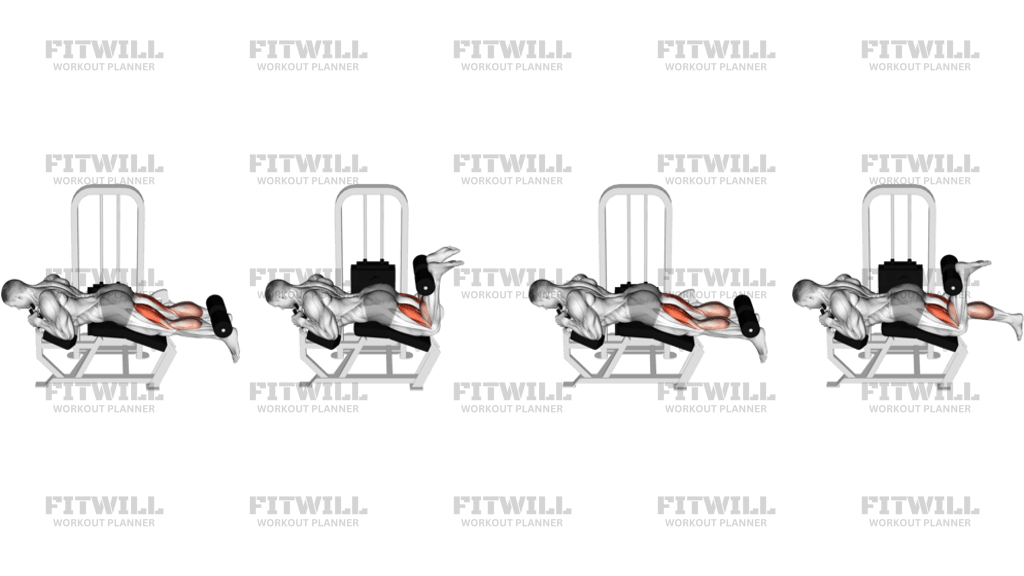
Lever Lying Knee Flexion
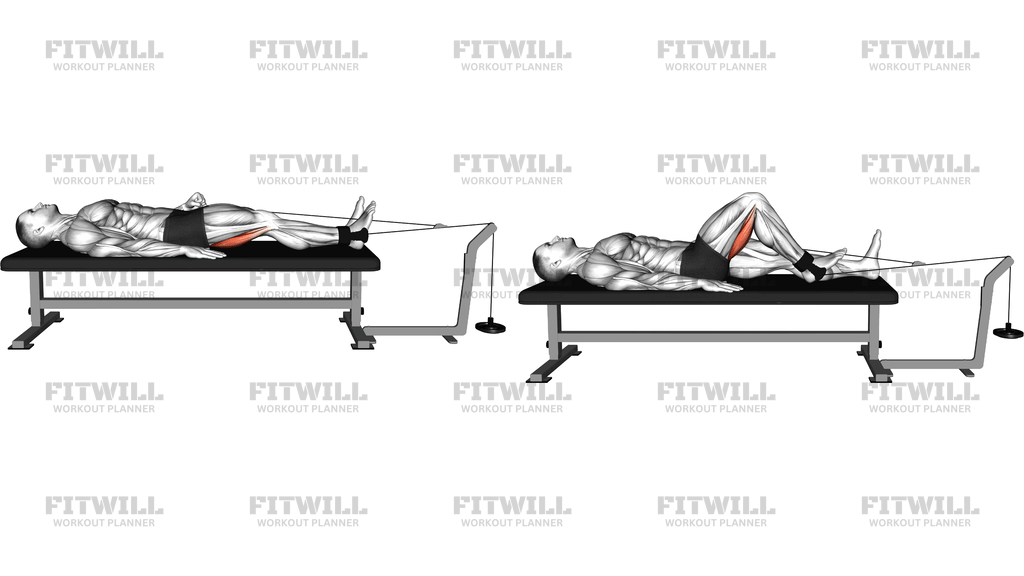
Lever Lying Knee Flexion is a single-leg hamstring exercise performed face up on a flat bench with an ankle strap attached to a low pulley or lever arm. Because you're lying on your back rather than face down on a leg curl machine, the hip stays in a neutral position and the resistance pulls your heel away from your body, forcing the hamstrings to work through knee flexion against a steady load. It's a simple setup, but it gives you a clean, joint-friendly hamstring stimulus that's easy to progress by adding weight to the stack.
The primary muscles at work are the hamstrings — the biceps femoris, semimembranosus, and semitendinosus — which bend the knee and control the leg as it returns to straight. The gastrocnemius in the calf assists with knee flexion, and the glutes and core work to keep your pelvis and torso anchored to the bench as the cable pulls. Because each leg works on its own, you can spot and correct left-to-right strength differences, which is hard to do on a two-leg curl machine.
This movement suits lifters who want direct hamstring work without a dedicated leg curl station, as well as anyone rehabilitating or reconditioning after a layoff, since the lying position and light starting loads keep stress on the lower back minimal. It's also a useful accessory lift for squat and deadlift training — strong hamstrings support knee stability and hip extension under heavy loads.
Setup matters here more than people expect. The bench should sit far enough from the pulley that the cable stays taut with your knee fully straight, but not so far that the strap or cable drags across the bench edge. Align the pulley roughly with your ankle so the resistance pulls in line with your lower leg rather than yanking your foot sideways. Keep your head and shoulders relaxed on the bench and your arms braced at your sides so your torso doesn't lift as you pull.
To execute it well, flex the knee smoothly, drawing your heel toward your glutes as far as the resistance allows without your hips rocking, then lower the heel back under control until the knee is nearly straight. The lowering phase is where most of the training effect lives — resist the cable instead of letting it snap your leg back. Two to four sets of eight to fifteen controlled reps per leg covers most goals.
A few practical points: start lighter than you think you need, since the strap changes your leverage and the single-leg format doubles the time under tension. If your lower back or hip flexors feel it instead of your hamstrings, check that your pelvis isn't tipping forward and that you aren't lifting your hips off the bench at the top of the rep.
[ Workout Log & Planner ]
Put your next workout in Fitwill
Keep your plan and training log ready when you are.


Instructions
- Lie face up on a flat bench with your head and shoulders supported and your working leg extended toward the low pulley.
- Wrap the ankle strap snugly around your working ankle, just above the joint, and clip it to the cable or lever attachment so the line of pull runs straight back toward the pulley.
- Grip the sides of the bench or rest your arms at your sides, and slide your body until the cable is taut with your knee fully straight.
- Brace your core lightly and press your upper back and hips into the bench so your torso stays flat throughout the set.
- Exhale and flex your knee, pulling your heel toward your glutes against the cable's resistance.
- Pause briefly at the fully bent position, keeping the strap tension constant rather than letting the weight stack rest.
- Inhale and slowly extend the knee, lowering your heel back until your leg is almost straight while resisting the pull of the cable.
- Complete all reps on one leg, then unclip the strap, switch it to the other ankle, and repeat on the second leg.
- After your final set, unclip the strap before sitting up so the cable doesn't tug your leg off the bench.
Tips & Tricks
- If the cable goes slack at the top of each rep, the weight is too light or the stack is resting — either add a small increment or shorten the rest pause so the hamstrings stay loaded.
- Watch your hips: if your pelvis lifts off the bench as you curl, you're borrowing from the lower back. Reduce the load and keep your hips pinned.
- Don't let the working leg drift sideways toward the pulley. Keep the knee tracking straight up so the strap pulls along the thigh, not across it.
- The most common mistake is bouncing the heel back out on the return. Take two to three seconds to extend the knee; the eccentric is where this exercise earns its keep.
- Your non-working leg should stay flat and still on the bench. If it keeps lifting, your torso is rotating — brace harder or lighten the weight.
- A strap placed over the ankle bone tends to slip; position it on the lower calf just above the ankle for a secure hold without pinching.
- Because you can't see your own leg from this position, do your first set in front of a mirror to check that the knee bends in a straight line.
- If your calf cramps at the top of the rep, that's the gastrocnemius assisting knee flexion. Point your toe slightly less and shorten the range a touch until it settles.
- Full extension at the bottom is the point of the exercise — stopping halfway shortchanges the hamstrings at their longest working length.
Frequently Asked Questions
Which muscles does Lever Lying Knee Flexion work?
The hamstrings are the prime movers, bending the knee against the cable's pull. The gastrocnemius in the calf assists with knee flexion, and the glutes and core stabilize your pelvis on the bench.
Why perform knee flexion lying face up instead of on a leg curl machine?
The supine position keeps the hip neutral, which isolates knee flexion cleanly and puts minimal stress on the lower back. It also works one leg at a time, so weaker sides can't hide behind the stronger one.
Where should the ankle strap sit during the Lever Lying Knee Flexion?
Just above the ankle bone on the lower calf. Too low and it pinches or slides; too high and the strap can interfere with the knee bending.
How far should I bend the knee on each rep?
Pull the heel as close to your glutes as the resistance allows without your hips lifting off the bench. If your pelvis rocks at full flexion, trim the top of the range slightly.
Is the lowering phase really that important in this exercise?
Yes. The cable actively pulls your leg back toward extension, so the hamstrings work eccentrically to control it. Rushing the return throws away a large share of the training stimulus.
Is the Lever Lying Knee Flexion suitable for beginners?
It's quite beginner-friendly because the bench supports your body and the weight stack offers small, precise load jumps. Start with light weight and focus on smooth, controlled reps before adding load.
What can I use if I don't have access to a low pulley and ankle strap?
A lying or seated leg curl machine trains the same movement, and a resistance band looped around the ankle and anchored low can replicate the setup at home. Glute-ham raises and Nordic curls are harder bodyweight alternatives.
Why does my calf cramp during the Lever Lying Knee Flexion?
The gastrocnemius crosses the knee and assists in flexion, so it can fatigue or cramp near full flexion. Ease off the top of the range, and make sure you're hydrated before training.
Is it safe for the knees and lower back?
The bench supports your spine and the cable loads the leg through a natural arc, so it's generally gentle on both areas when performed with controlled tempo. Avoid jerking the weight and keep your hips on the bench to protect the lower back.
How should I set up the distance between the bench and the pulley?
Position the bench so the cable is taut with your knee fully straight but your leg still lies flat along the bench. Too close and the first part of the rep has no resistance; too far and the strap or cable drags over the bench edge.