Kettlebell Z Press
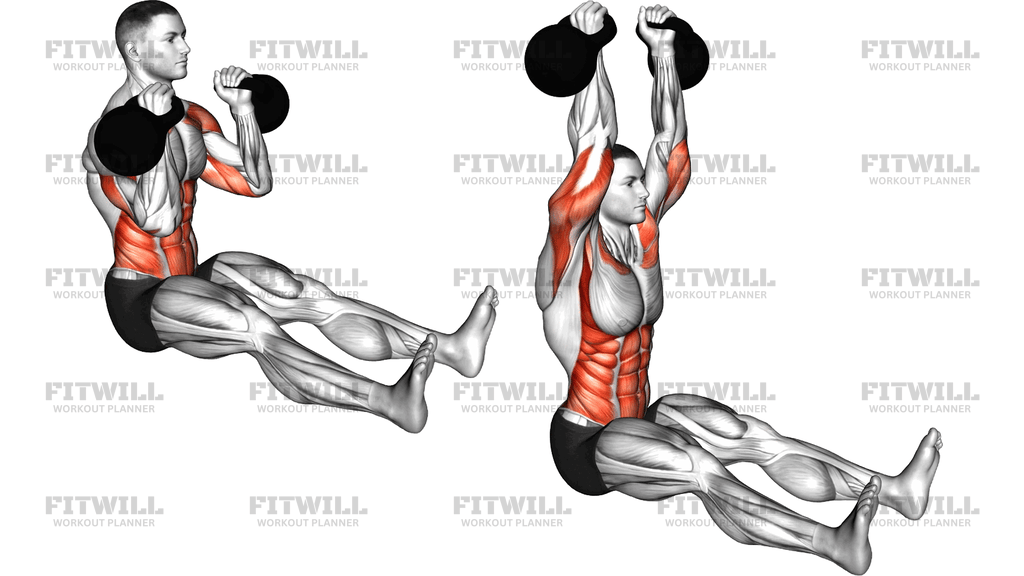
The Kettlebell Z Press is an overhead press performed while sitting on the floor with your legs extended straight in front of you. With no bench behind your back and no legs underneath you to help, the only thing holding your torso upright is your own core and hip strength, which is exactly what makes this press so demanding. You start with a kettlebell in each hand at shoulder height and press both weights straight up until your arms are locked overhead, then lower them back down under control.
This movement earns its reputation as a strict pressing exercise because it removes every cheat mechanism. When you press standing, you can lean back, drive through your legs, and use your lower back to finish the rep. Seated on the floor in an L-position, none of that is available. Your shoulders and triceps have to do the actual pressing work, while your abs, hip flexors, and spinal stabilizers work hard just to keep you from tipping backward as the weights travel overhead.
The Z Press is especially useful for lifters who struggle with overhead mechanics. If you tend to overarch your lower back when pressing, hang your ribcage open, or shrug and lean to get the bar up, this exercise exposes those habits immediately and gives you honest feedback. Strongman athletes use it to build pressing strength from a weak position, and general lifters use it as an accessory to make their standing barbell or dumbbell press stronger.
Setup quality matters more here than in almost any other press. Sit with your legs together and extended, plant your sitting bones firmly into the floor, and stack your ribcage over your pelvis before you lift the kettlebells into position. If your torso angle is off at the start, every rep gets harder and sloppier. A good cue is to feel like someone is pulling a string from the top of your head toward the ceiling.
Execute each rep by pressing both kettlebells up and slightly back so they finish directly over your shoulders, not out in front of your face. Keep your legs active, knees straight, and heels or toes lightly pressed into the floor. Lower the weights back to shoulder height with control rather than letting them drop, and reset your torso position between reps if you feel yourself leaning. Start light; most lifters need far less weight here than in a standing press, and ramping up too fast is the most common way to turn a good Z Press into a grinding, arching mess.
[ Workout Log & Planner ]
Put your next workout in Fitwill
Keep your plan and training log ready when you are.


Instructions
- Sit on the floor with your legs extended straight in front of you, knees together, and your sitting bones planted firmly into the ground.
- Clean two kettlebells to your shoulders, letting the backs of your hands or the handles rest against the fronts of your shoulders with elbows tucked fairly close to your body.
- Stack your ribcage directly over your pelvis, squeeze your legs straight, and press your heels or toes gently into the floor to lock in your torso angle.
- Brace your abs hard as if bracing for a light punch, and pull your chin back slightly so the kettlebells have a clear path past your face.
- Press both kettlebells straight up, moving your head slightly out of the way and letting the weights travel up and slightly back.
- Finish with your arms fully locked and the kettlebells positioned directly over your shoulders and midfoot line, biceps near your ears.
- Pause briefly at the top, keeping your torso upright and your legs straight rather than letting your hips slide or your back round.
- Lower both kettlebells back to shoulder height under control, keeping tension in your core the entire way down.
- Exhale as you press and inhale at the top or between reps; re-brace before each press if you're working heavier.
- Complete all reps or set the kettlebells down safely to your sides when your torso starts leaning backward to finish reps.
Tips & Tricks
- If you keep tipping backward, the weight is too heavy or your legs are too wide; narrow your stance, lighten the load, and squeeze your thighs together harder.
- Rounding or hunching at the start usually comes from trying to rest the kettlebells on a collapsed chest; lift your sternum and keep the weights stacked on your shoulders instead.
- Pressing the kettlebells out in front of your face instead of overhead means your head isn't moving out of the way; pull your chin back and let the weights travel up past your ears.
- Keep your kneecaps pulled up and quads engaged; floppy, lifeless legs make the whole seated position unstable and cost you pressing power.
- Most lifters should use roughly 30-50% less weight than their standing kettlebell press; the Z Press is a position test before it's a strength test.
- If your hamstrings are too tight to sit upright with straight legs, elevate your hips on a low step or plate until you can stack your torso without rounding.
- Bending the knees to shorten the lever is a common cheat; it reduces hip flexor demand but also lets you lean back, so only use it deliberately as a progression step.
- Stop the set the moment your lower back starts arching to finish presses; that arch is a sign your abs have given up, and continuing just trains the bad pattern.
- Single-arm versions are a great way to learn the movement, since you can place the free hand on the floor for balance while your torso learns the position.
Frequently Asked Questions
What muscles does the Kettlebell Z Press work?
The shoulders, particularly the front and side delts, do the main pressing work, supported by the triceps and upper back. Your abs, deep core, and hip flexors work hard throughout just to keep your torso upright with your legs extended on the floor.
Why is the Kettlebell Z Press so much harder than a standing press?
Sitting on the floor removes your legs and lower back from the lift, so there's no way to drive through the ground or arch to finish a rep. Every ounce of force has to come from your shoulders and triceps while your core holds the seated position.
Can beginners do the Kettlebell Z Press?
Yes, but they should start very light or even with no weight to learn the seated position first. A single light kettlebell pressed one arm at a time is the easiest entry point.
Should my legs be straight during the Kettlebell Z Press?
Yes, the classic setup is legs fully extended with knees together, which maximizes the core demand. If you can't sit upright with straight legs due to tight hamstrings, elevate your hips slightly or bend your knees temporarily while you build mobility.
How heavy should the kettlebells be for the Kettlebell Z Press?
Expect to use significantly less weight than your standing press, often a third to a half less. Choose a load you can press for clean reps without your torso leaning backward or your lower back arching.
Why do I keep falling backward when pressing?
Falling backward means your core and hip flexors can't counterbalance the weight as it travels overhead, or the load is too heavy. Narrow your legs, engage your quads, lighten the weight, and think about stacking the kettlebells directly over your shoulders rather than in front of them.
What can I substitute if I don't have kettlebells?
The Z Press works equally well with dumbbells, a barbell, or just your body weight. The seated leg-extended position is the defining feature; the kettlebell simply adds load and a comfortable rack position.
Where should the kettlebells be at the top of the rep?
At lockout, your arms should be straight with the kettlebells held directly over your shoulders, roughly in line with your hips and sitting bones. Finishing with the weights out in front of your face shifts load away from the shoulders and pulls you forward.
Is the Kettlebell Z Press safe for the lower back?
When done with an upright torso and honest weight, it places far less stress on the lower back than a standing press because arching isn't an option. Problems arise when lifters use too much weight and start arching or tipping to finish reps, so progress conservatively and stop sets when form breaks.
How does the Kettlebell Z Press improve my standing press?
It strengthens the exact weak points that standing presses let you hide: strict shoulder pressing strength, core stability under an overhead load, and an upright torso position. Lifters who overarch or lean during standing presses often see their form clean up after a block of Z Press work.