Kneeling Alternating Leg Lift Crossover
The Kneeling Alternating Leg Lift Crossover is a quadruped body weight movement that combines two actions into one rep: the working knee first draws across the body toward the opposite side, then swings back and up behind you into a leg lift with the knee bent and the foot traveling toward the ceiling. Because you work one leg at a time and alternate sides, each rep challenges the glutes of the moving leg while the trunk and support hip work hard to stop you from rocking side to side.
The setup matters more than people expect. Kneeling on all fours with hands under shoulders and knees under hips puts the pelvis in a neutral, weight-bearing position, which is exactly what the glutes need to extend the hip through a full, clean arc. If your hips shift or your lower back arches as the leg swings, the movement loses its target and turns into a momentum exercise. Staying square to the floor is the whole game here.
To perform it well, brace your core lightly before every rep, let the knee travel across the midline under control, and then drive the leg up and back by squeezing the glute rather than yanking with the lower back. The end position has the thigh roughly parallel to the floor or slightly above, with the heel pressing toward the ceiling. Lower the leg back through the same path before switching sides. Breathing should stay steady: exhale as the leg drives up, inhale on the return.
This exercise suits a wide range of people. Beginners use it to learn what a glute-dominant hip extension feels like without load, while more experienced lifters use it as a warm-up activation drill before squats, deadlifts, or hip thrusts. It is also a common choice in rehabilitation-style programs for wake up work on the gluteus maximus and gluteus medius after long periods of sitting, since the crossover component adds a small rotation and abduction element that a plain donkey kick misses.
Practically, you need nothing more than a mat and a patch of floor. Work in slow, deliberate reps, usually 8 to 15 per side, and stop the lift at the height your spine can keep neutral. A taller leg is not a better rep; a glute-driven leg is. If your back takes over or your hips twist, shorten the range instead of pushing higher.
[ Workout Log & Planner ]
Put your next workout in Fitwill
Keep your plan and training log ready when you are.


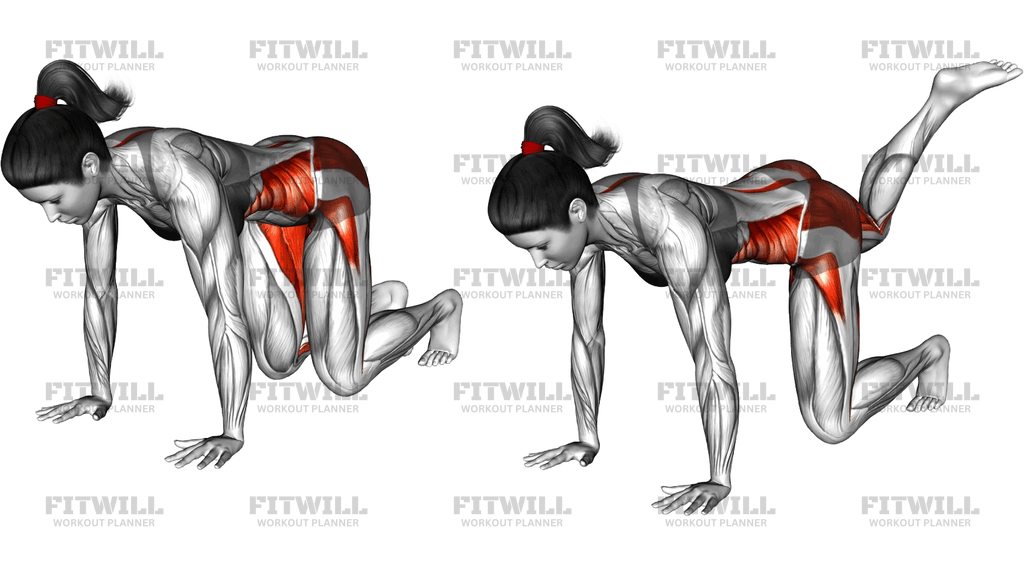
Instructions
- Kneel on an exercise mat and place your hands on the floor directly under your shoulders, knees under your hips, so you are in a stable all-fours position with fingers spread and weight spread evenly across both palms.
- Set your spine neutral: gaze down at the mat, gently draw the ribs in, and untuck or over-arch the tailbone until your back is flat from head to hips.
- Brace your abdominals lightly as if bracing for a light poke, and shift slightly more weight into the support-side hand and knee to prepare for the moving leg.
- Draw your working knee in and across your body toward the opposite knee, letting the hip rotate a few degrees without letting your pelvis tilt or your shoulders swing.
- From the crossed position, drive the leg back and up behind you, keeping the knee bent at roughly 90 degrees and squeezing the glute so the sole of your foot travels toward the ceiling.
- Stop the lift when your thigh is about level with your torso or slightly above, with your back still flat and your hips still square to the floor.
- Exhale as you lift the leg, and inhale slowly as you bring it back, reversing the exact path so the knee returns across the midline before extending down.
- Complete the repetitions on one side or alternate leg for leg, depending on your program, and reset your hand and knee position between sides if you have drifted.
- Finish the set by sitting back onto your heels and shaking out the hips before starting the next round.
Tips & Tricks
- The most common mistake is chasing height: as soon as the back arches to raise the foot higher, the load leaves the glutes. Cap the lift where your hips stay square, even if that means the thigh never passes parallel.
- If your torso rotates toward the lifting side, think about pressing the opposite-hand knuckles harder into the mat; that counter-pressure keeps the shoulders level.
- Keep the knee bent the whole time. Straightening the leg turns the move into a hamstring-dominant extension and reduces the glute squeeze at the top.
- Make the crossover deliberate. If the knee never actually crosses toward the opposite side, you are just doing a donkey kick and missing the hip rotation element that gives this variation its name.
- Slow the transition point. Most reps go wrong at the moment the knee switches from crossing under the body to driving back, so pause for a beat there instead of swinging through it.
- If your kneeling knee gets sore on a hard floor, fold a mat in half or place a towel under it rather than shifting your hips off-center to compensate.
- Squeeze the glute hard for a one-count at the top of each lift instead of pumping fast reps; the muscle response comes from the contraction, not the tempo.
- Watch for wrist fatigue if you have long sets. Spreading your fingers and gripping the mat slightly transfers some load out of the wrists and stabilizes the upper body.
- Pre-activating the working glute with a few slow squeezes before starting makes it easier to feel the right muscles take over once the reps begin.
Frequently Asked Questions
What muscles does the Kneeling Alternating Leg Lift Crossover work?
The gluteus maximus does most of the work during the leg lift, with the hamstrings assisting the hip extension. The crossover portion adds gluteus medius and outer hip involvement, while the core, especially the obliques and deep abdominals, stabilizes the trunk the entire time.
Why does the knee cross toward the opposite side before lifting?
The crossover adds hip rotation and a brief stretch of the glute before it contracts, which helps you feel the muscle working and trains the hip through a slightly different arc than a straight donkey kick. It also raises the stability demand on your trunk.
Is the Kneeling Alternating Leg Lift Crossover good for beginners?
Yes, it is one of the friendlier ways to learn glute-driven hip extension because your hands and knee give you a stable base and there is no external load. Start with a small range and prioritize keeping the hips square over lifting the leg high.
How high should I lift my leg at the top of the movement?
Lift only until your thigh is roughly level with your torso or a touch above. If your lower back arches or your hip opens to the side to gain height, you have gone past the range your glutes can control.
My lower back aches when I do this exercise. What am I doing wrong?
The usual culprit is arching the lumbar spine to chase the foot higher, or swinging the leg with momentum instead of squeezing the glute. Reduce the lift height, slow the tempo, and consciously keep the ribs down and tailbone neutral throughout.
Should I complete all reps on one leg or alternate sides each rep?
Both work. Alternating rep for rep keeps the workload even and gives each side a brief rest, while doing all reps on one side first makes it easier to focus on the feel of one hip. Choose whichever helps you hold better form.
Can I use the Kneeling Alternating Leg Lift Crossover as a warm-up before squats or deadlifts?
Absolutely. Ten to twelve controlled reps per side before lower body training primes the glutes and wakes up the hip stabilizers, which often makes your first working set feel stronger and better positioned.
What can I do if my wrists bother me in the all-fours position?
Spread your fingers and press through the base of the hand rather than collapsing into the wrist, or hold onto dumbbells placed on the floor to keep the wrists neutral. You can also shorten the set length and take brief wrist breaks between sides.
How is this different from a regular donkey kick?
A donkey kick only extends the hip straight back, while the Kneeling Alternating Leg Lift Crossover starts with the knee crossed toward the opposite side, adding rotation and abduction to the path. That makes it hit the glutes from a slightly broader angle and demands more trunk control.
How many sets and reps should I do?
Two to three sets of 8 to 15 controlled reps per side is a solid working range. If your hips start twisting or your back takes over before you reach the target number, end the set there rather than pushing through compromised reps.