Supported Split
The Supported Split is a flexibility exercise that takes you into a front split position while a yoga block or similar firm support rests under the front thigh or hip. Instead of lowering all the way to the floor and hanging on your joints, the block shortens the distance to the ground and lets you control exactly how deep the stretch goes. Hands stay planted on the floor on either side of the front leg, the front leg reaches long with the toes pulled back, and the back leg trails behind with the top of the foot resting down.
This movement is most useful for anyone working toward a full front split, but it is just as valuable for people with tight hamstrings, hip flexors, or adductors who have no interest in gymnastics or martial arts. Runners, cyclists, and desk workers tend to lose range in exactly the areas this stretch targets, and the support makes the position accessible long before the floor version is possible.
The primary targets are the hamstrings of the front leg and the hip flexors of the back leg, with the glutes and inner thighs working to keep the hips squared forward. The calves and ankles of both legs also feel the position, especially when you flex the front foot. Because the block carries part of your body weight, you can relax into the stretch rather than fighting to hold yourself up, which is what makes it more effective than an unsupported split attempt.
Setup matters more than depth here. The block height should match your current flexibility: high enough that you can breathe calmly and keep both hips facing forward, low enough that you actually feel the stretch. If the block is too low, the front hamstring pulls aggressively and the hips tend to twist open to escape it. If it is too high, you get no stimulus at all.
To execute it well, slide into the position gradually, walk your hands forward as the hips sink, and let the front thigh settle onto the block. Keep a long, neutral spine rather than rounding over the front leg, and press lightly through the palms to manage how much weight sinks down. Hold, breathe, and let the tension release over time instead of forcing the hips lower.
Use the Supported Split as a dedicated flexibility session on its own, after lower-body strength training when the muscles are warm, or as part of a progressive split-training routine. Move the block closer or swap in a taller support as your range improves, and expect steady progress over weeks rather than days. Sharp pain, numbness, or a pinching sensation at the front of the hip are signals to come out of the position and reduce the depth.
Fitwill
Log Workouts, Track Progress & Build Strength.
Achieve more with Fitwill: explore over 9600 exercises with images and videos, access built-in and custom workouts, perfect for both gym and home sessions, and see real results.
Start your journey. Download today!




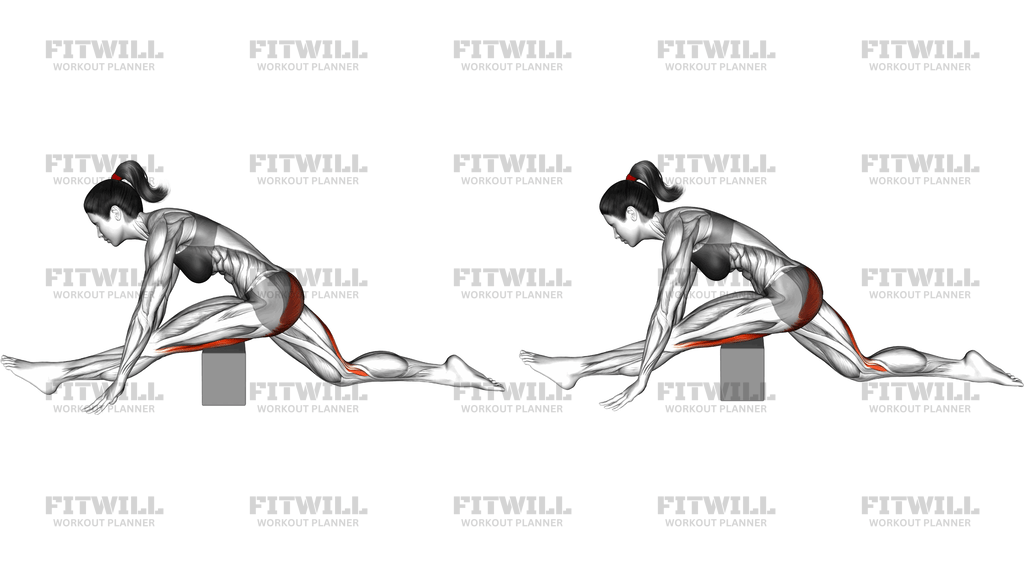
Instructions
- Place a yoga block or firm support on your mat, positioned where your front thigh or hip will land, and choose a height you can reach without straining.
- Stand facing forward, step one leg far ahead, and lower into a long lunge with your hands planted on the floor on either side of the front foot.
- Slide the front heel forward until the front leg is nearly straight, then lower the front thigh onto the block; extend the back leg behind you with the top of the foot resting on the floor.
- Square both hips to face forward and check that the back knee points down toward the floor rather than out to the side.
- Brace your core lightly, press through your palms, and keep your spine long instead of rounding over the front leg.
- Flex the front foot and pull the toes back to deepen the hamstring stretch, and let the hips sink toward the block as your range allows.
- Breathe slowly and deeply, exhaling as you allow the hips to settle a little closer to the block with each breath.
- Hold the position for 30 to 60 seconds, keeping the stretch at a strong but tolerable intensity.
- To come out, press firmly through the hands, bend the front knee, and slide the back leg forward to return to the lunge.
- Reset the block, switch legs, and repeat the same sequence on the other side.
Tips & Tricks
- If your hips twist open toward the front leg, the block is probably too low; raise the support until you can keep both hip bones facing forward.
- Place the block under the mid-thigh rather than the kneecap of the front leg so the hamstring lengthens without compressing the knee.
- Squeeze the glutes of the back leg gently to anchor the rear hip down and reduce strain at the front of that hip.
- Do not dump your weight into the shoulders; keep a slight press through the palms so the arms share the load and the neck stays relaxed.
- A pinching feeling at the front of the back hip usually means the hip flexor is being compressed rather than stretched; shift the back knee slightly behind the hip or reduce the depth.
- Warm up first with light leg swings, walking lunges, or a few minutes of cardio; stretching cold hamstrings in this position is a common cause of pulled muscles.
- Progress by lowering the block height gradually over weeks, or stacking a second block first and removing it later, rather than dropping straight to the floor.
- Keep the front toes pulled back toward the shin for the hamstring focus; letting the foot relax shifts emphasis toward the calf and calf-adjacent tissue.
- Rounding the lower back over the front leg fakes extra range; if you notice your chest collapsing, walk your hands back and keep the spine long.
Frequently Asked Questions
What does the block do in the Supported Split?
The block supports the weight of the front thigh and hip, shortening the distance to the floor so you control the depth of the split. This lets you relax into the stretch instead of straining to hold yourself up.
Which muscles does the Supported Split stretch?
It primarily targets the hamstrings of the front leg and the hip flexors of the back leg. The glutes, inner thighs, and calves of both legs also receive a meaningful stretch.
Can beginners do the Supported Split?
Yes, and it is one of the safest ways to start split training. Beginners should use a taller support, such as a stack of blocks or a low bench, so the hips stay higher and the stretch stays moderate.
How tall should the block be?
Choose the lowest height at which you can keep both hips squared forward and breathe calmly while still feeling the stretch. As flexibility improves, move to a lower support.
Why do my hips twist toward the front leg during the Supported Split?
That rotation is the body escaping a stretch that is too intense for the current range. Raise the block height and consciously turn both hip bones to face forward before sinking deeper.
How is the Supported Split different from a full front split?
In a full split the hips rest on the floor with no support, which demands significant hamstring and hip flexor range. The block-backed version lets you train the same position at a level your body can currently handle.
How long should I hold the Supported Split?
Hold each side for 30 to 60 seconds and repeat two to three times per leg. Longer, calm holds are more productive for this position than short, forceful ones.
Can I substitute anything if I do not have a block?
A rolled blanket, a firm cushion, a low step, or a stack of books can work as support. The key is a stable surface at a height that lets you hold the position without pain.
Is it safe to do the Supported Split every day?
Gentle daily practice is generally fine if you stay within a comfortable range and never stretch into sharp pain. If you feel lingering soreness in the hamstrings or hips, take a rest day between sessions.
When should I feel concerned during this stretch?
Stop if you notice sharp pain, tingling, numbness, or a pinching sensation in the front of either hip or deep in the groin. Those signals mean the position needs adjusting, not pushing through.