Bear Walk (Version 2)
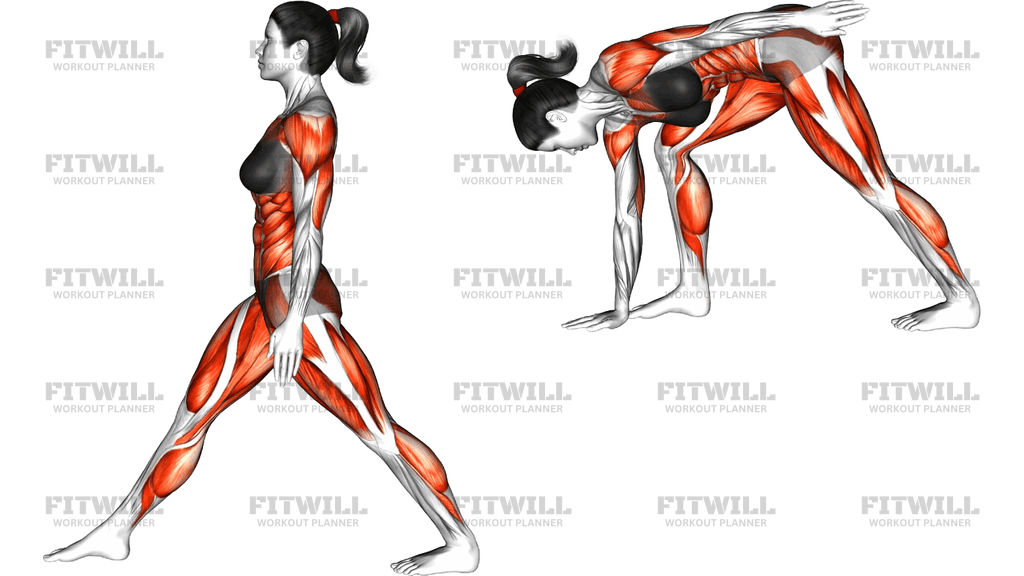
The Bear Walk (Version 2) is a bodyweight locomotion drill that starts from a standing position, folds you forward until your palms rest flat on the floor, and then has you travel across the floor on your hands and feet with your hips held high. Unlike the deep knee-bent bear crawl, this version keeps the legs much straighter, so every step lengthens the hamstrings and calves while your shoulders, forearms, and trunk handle the weight-bearing and coordination work.
This movement earns its place in warm-ups and conditioning circuits because it does two jobs at once. As you fold down and walk, the entire back line of the legs gets an active stretch under load, which is far more useful for most people than passive floor stretching. At the same time, the shoulders learn to support the body on locked-out arms, the wrists build tolerance, and the core has to brace against the diagonal forces created by opposite hand and foot moving together.
Setup quality decides how the whole drill feels. If you place your hands too close to your feet at the start, your hips are too low and the movement turns into a standard crawl with less hamstring involvement. If your hands are too far forward, your lower back rounds aggressively and walking becomes awkward. Aim for a folded position where your hips sit above or slightly behind your shoulders and your heels stay as close to the floor as your flexibility allows.
To execute it well, move with small, deliberate steps: one hand forward, then the opposite foot, keeping the hips high and the knees only softly bent. Keep your neck relaxed and let your head follow the line of your arms rather than craning it up. Breathe steadily throughout rather than holding your breath as you step.
The Bear Walk (Version 2) suits beginners building basic mobility, lifters warming up for deadlifts or squats, and anyone programming animal-movement conditioning. Because it is self-scaling, you can shorten the distance or add knee bend on days when your hamstrings feel tight, and lengthen the travel distance when you want more of a challenge.
For safety, keep the walking area clear of obstacles, use a surface with good grip, and stop if you feel pins-and-needles in your hands or any sharp pulling in the back of your knees. Slight hamstring tension is the point of the drill; pain is not.
[ Workout Log & Planner ]
Put your next workout in Fitwill
Keep your plan and training log ready when you are.


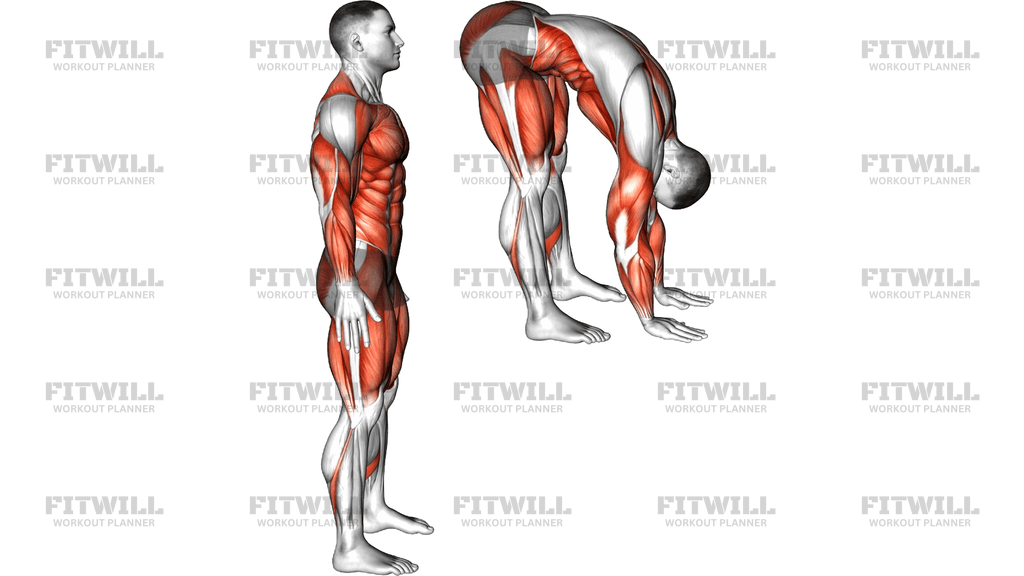
Instructions
- Stand tall with your feet roughly hip-width apart at one end of a clear walking space.
- Hinge forward from your hips and place both palms flat on the floor about 12 to 18 inches in front of your toes, fingers spread and pointing forward.
- Lift your hips toward the ceiling so your body forms an inverted V, with your legs nearly straight and heels pressing toward the floor.
- Brace your abdominal muscles lightly and soften your elbows almost to lockout so your arms support you without joint strain.
- Step one hand forward a short distance, then bring the opposite foot forward the same distance, keeping your hips high the entire time.
- Continue moving hand and opposite foot in an alternating rhythm, keeping each step small enough that your back stays rounded but not strained.
- Keep your head between your arms, eyes looking down toward the floor a few inches ahead of your hands.
- Exhale as you fold down at the start, then breathe in a steady, even rhythm while walking; do not hold your breath.
- Travel your target distance, then walk your feet back toward your hands or fold your knees down to exit the position.
- Roll up slowly through your spine to standing, pause, and reset your stance before starting the next set.
Tips & Tricks
- If your hamstrings shake or your hips drop as you walk, shorten your steps; long reaches are the most common reason this version collapses into a low crawl.
- Keep your weight shifted slightly back through your legs. If your shoulders burn first, your hands are set too far forward and you are loading them like a plank.
- Press evenly through the bases of your fingers rather than parking weight on your wrists, which prevents wrist discomfort as distances increase.
- Do not lock your knees backward into hyperextension; a soft, nearly straight knee keeps tension on the hamstrings without stressing the joint.
- If your heels cannot reach the floor, that is acceptable, but never force them down by rounding your lower back further.
- Walk in a straight line by keeping hand and foot steps equal in length; wandering usually means one arm is reaching farther than the other.
- A smooth, quiet gait is a good quality check — slapping feet or heavy hand plants mean you are rushing instead of stepping under control.
- If your hamstrings are very tight on a given day, bend the knees slightly more and keep the hips a touch lower rather than skipping the drill.
- Cap your sets at a distance you can finish with your hips high; once your hips sag, the hamstring benefit ends and your lower back takes over.
Frequently Asked Questions
Which muscles does the Bear Walk (Version 2) work the most?
The hamstrings and calves handle most of the work because your legs stay nearly straight while you step, while the shoulders, forearms, and core support your weight on the arms. The lower back and glutes stabilize your hips throughout the walk.
How is Bear Walk (Version 2) different from a regular bear crawl?
A regular bear crawl uses deeply bent knees held just off the floor, which shifts the emphasis toward the thighs, core, and shoulders. This version keeps the legs much straighter with the hips high, turning it into a walking hamstring and calf stretch combined with upper-body support work.
Is the Bear Walk (Version 2) suitable for beginners?
Yes, because it is self-scaling. Beginners can shorten the distance, take smaller steps, or bend the knees slightly more, and progress toward straighter legs and longer walks as flexibility improves.
How far should I walk per set?
Start with 10 to 20 yards or about 20 to 30 total steps, and only extend the distance once you can finish with your hips high and heels pressing toward the floor. Quality of position matters more than distance covered.
My wrists hurt when I place my hands on the floor — what should I change?
Spread your fingers and press through the bases of the index fingers and thumbs so less weight sits directly on the wrist joint. If discomfort persists, walk on fists or use a folded mat under your palms and build wrist tolerance gradually.
Can I use this instead of static hamstring stretching?
It is a good active alternative because the hamstrings lengthen repeatedly under light load while you step, which many people tolerate better than holding a static fold. It works well before lower-body lifting or as part of a warm-up.
Why do my shoulders fatigue before my legs feel anything?
Your hips are probably sitting too low or too far forward, turning the drill into an arm-supported plank. Reset with your hands closer to your feet and consciously shift your weight back through your legs with the hips high.
Should my knees be completely straight during the walk?
Keep them nearly straight but not jammed into hyperextension — a slight soft bend protects the knee joint while still lengthening the hamstrings. Forcing the knees fully back adds joint stress without improving the stretch.
What can I substitute if I have no open floor space?
Walk in place by stepping one hand and the opposite foot forward and then back, or perform slow hand-and-foot walks along the length of a hallway turning at the ends. Even 5 to 10 yards per length is enough for a useful set.