Deep Knee Bend
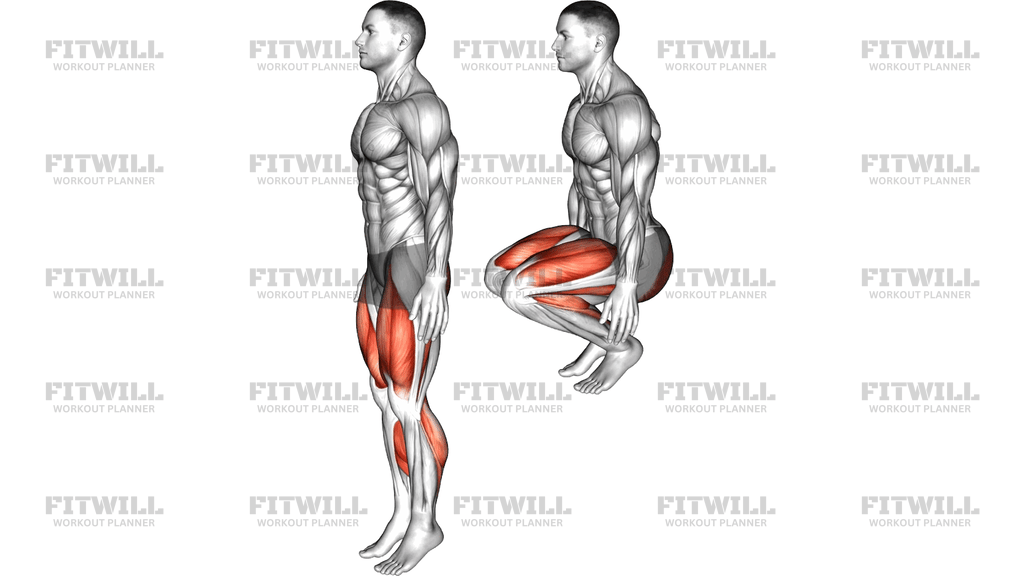
The Deep Knee Bend is a bodyweight lower-body exercise that takes the basic squat pattern and carries it all the way down into a full-depth position, with your hips sitting close to your heels and your thighs folded against your calves. From a tall standing start, you bend at the knees and hips simultaneously, sink as low as your mobility comfortably allows, and then drive back up to a complete stand. Because the range of motion is so large, the quadriceps do a heavy share of the work, while the glutes, hamstrings, and calves support and control the movement from start to finish.
This movement is especially useful for anyone building foundational leg strength without equipment, as well as for lifters who want to improve squat depth and confidence under their own body weight before adding load. It is a staple in general fitness routines, warm-up sequences, and home workouts, and it also serves as a practical screen: if you cannot reach a comfortable deep position with your heels down, that tells you exactly where your ankle, hip, or knee mobility needs attention.
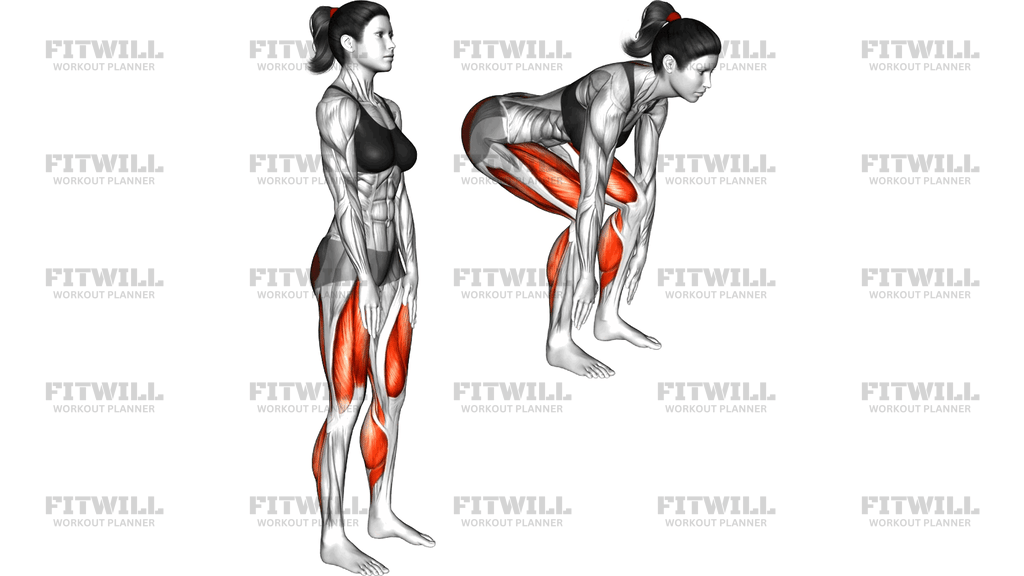
The setup is simple but matters more than most people expect. Feet stay roughly hip-width apart with toes turned out slightly, weight spread across the whole foot with the heels in contact with the floor throughout. Your torso stays upright enough that you are not pitching forward, and your arms hang naturally at your sides or drift slightly forward as you descend to counterbalance. That arm position matters at the bottom, where a small forward lean of the trunk is normal and often necessary to stay balanced.
Execution comes down to sequencing. Break at the hips and knees together rather than just folding forward or just dropping straight down, and let the knees travel forward over the toes as you sink. At the bottom, your thighs should be at or below parallel, hips stacked under or slightly behind you, and your weight still centered. Pause briefly if you can, then push the floor away through your mid-foot and stand all the way up, finishing with your hips and knees fully extended rather than stopping short at a half stand.
Common use cases include high-rep conditioning circuits, joint-friendly strength work for people avoiding external load, and mobility practice for those who want to reclaim a comfortable deep squat. Because the Deep Knee Bend loads the knees through a full range under body weight only, most healthy trainees can perform it frequently, but anyone with knee discomfort should limit depth to a range that feels stable and pain-free.
A few safety points go a long way. Keep the descent controlled instead of dropping into the bottom, since bouncing out of a deep position is where form usually breaks down. If your heels lift or you have to collapse your chest to reach depth, shorten the range and work on ankle and hip mobility separately. Progress gradually: start with partial depths, add full reps as control improves, and only then consider holding weight or pausing at the bottom.
[ Workout Log & Planner ]
Put your next workout in Fitwill
Keep your plan and training log ready when you are.


Instructions
- Stand tall with your feet about hip-width apart, toes turned out slightly, and let your arms hang relaxed at your sides.
- Spread your weight evenly across both feet, feeling pressure through the heel, mid-foot, and ball of the foot.
- Brace your stomach lightly and lift your chest so your spine is long before you start the descent.
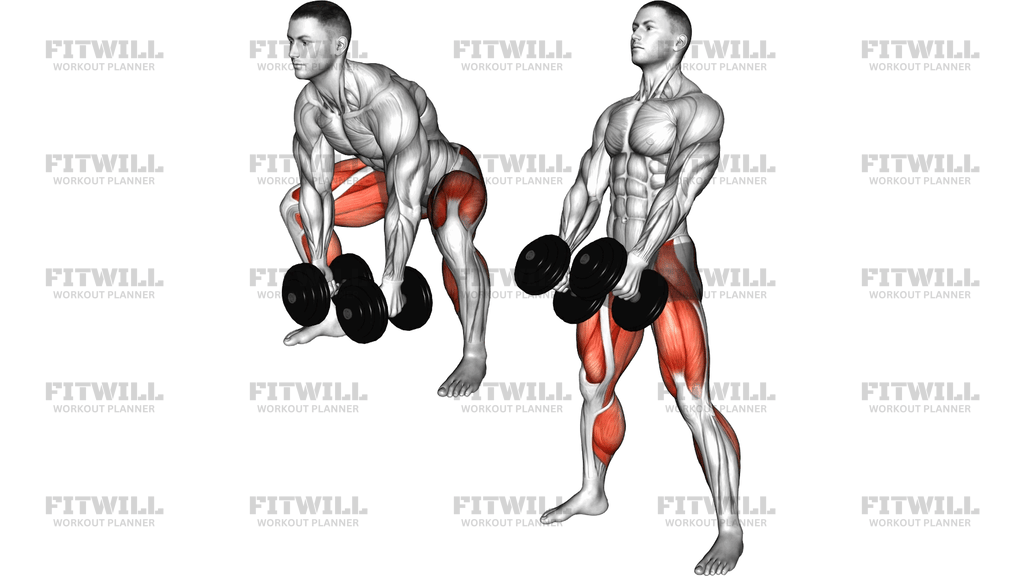
- Push your hips back and bend your knees at the same time, letting both knees travel forward over your toes.
- Keep your heels flat on the floor for the entire descent; if they want to lift, do not go as deep yet.
- Lower until your thighs are at or below parallel and your hips are sitting close to your heels, allowing your arms to drift slightly forward for balance.
- Pause for a beat at the bottom without letting your lower back round or your weight shift to your toes.
- Drive through your mid-foot and squeeze your glutes to stand back up in one controlled motion.
- Exhale as you push up and inhale on the way down, keeping your breathing steady throughout the set.
- Finish each rep with your hips and knees fully straight, reset your stance and brace, then begin the next repetition.
Tips & Tricks
- If your heels rise off the floor at the bottom, your ankles are likely the limiting factor — elevate your heels slightly on a thin board or hold a doorway for balance while you build ankle mobility.
- A common fault is dropping fast and bouncing out of the deep position; lower for two to three seconds so the muscles, not momentum, control the bottom.
- Watch for knees caving inward as you fatigue — actively think about spreading the floor apart with your feet as you descend and rise.
- Do not stop at parallel out of habit; the whole point of the Deep Knee Bend is the extra depth, so descend lower than a standard squat as long as your heels stay down and position stays controlled.
- Let your torso lean slightly forward at the bottom instead of forcing a perfectly vertical chest — trying to stay upright at depth often pushes your weight onto your toes.
- If your lower back rounds heavily at the bottom, shorten the range slightly and work hip mobility before chasing full depth.
- Rest briefly between reps at the top rather than rushing; a clean reset each rep keeps the knees tracking well deep into a set.
- Start with sets of five to eight controlled reps and only build volume once you can hit full depth without your heels lifting or form slipping.
Frequently Asked Questions
Which muscles does the Deep Knee Bend work the most?
The quadriceps are the primary movers because they straighten the knee through a very long range. The glutes extend your hips on the way up, and the calves and hamstrings help control and stabilize the deep position.
How deep should I go on the Deep Knee Bend?
Go as low as you can while keeping your heels flat and your back from rounding heavily. Full depth means your thighs meet your calves, but a slightly shallower range with good control beats forcing depth you cannot stabilize.
Why do my heels lift when I try the Deep Knee Bend?
Limited ankle mobility is the most common cause, so the weight shifts to your toes as your knees travel forward. Reduce your depth for now and work on ankle flexibility, or place a small heel wedge under your heels as a temporary aid.
Is the Deep Knee Bend bad for your knees?
Performed in a controlled way with your weight balanced and depth matched to your mobility, it is generally well tolerated and helps build resilience through the full knee range. If you have an existing knee issue, keep the range pain-free and progress depth gradually.
How is the Deep Knee Bend different from a regular bodyweight squat?
A regular squat typically stops at or just below parallel, while the Deep Knee Bend takes you all the way down until your hips sit near your heels. The added depth increases the demand on the quadriceps and requires more ankle and hip mobility.
Can beginners do the Deep Knee Bend?
Yes, but start by squatting to a sturdy chair or bench and standing back up, then gradually reduce the height. This lets you build control through progressively deeper ranges before attempting the full bottom position unsupported.
Where should my arms be during the Deep Knee Bend?
Let them hang at your sides at the top and allow them to drift forward as you descend to help counterbalance. Extending the arms straight ahead like a conventional squat also works if that keeps you balanced at depth.
What can I use instead of the Deep Knee Bend if I lack the mobility for it?
Chair squats, box squats, or supported squats holding a doorframe or rack let you train the same knee and hip pattern at a depth you can control. These are good stepping stones while you improve ankle and hip range.
How many reps and sets of the Deep Knee Bend should I do?
For strength and control, three to four sets of five to ten slow reps works well; for conditioning, higher reps of fifteen to twenty-five are common. Prioritize full-depth control over rep count, since sloppy deep reps have little training value.