Walking On Spot Sky Reach
Walking On Spot Sky Reach is a low-impact, standing cardio drill that combines marching in place with a full upward arm reach on every step. You stay in one spot, lifting each knee to roughly hip height while sweeping both arms from your sides all the way overhead, alternating the arm lead or reaching with both arms as you march. Because there is no jumping and no forward travel, it delivers many of the benefits of walking or marching drills without needing space, equipment, or hard impact on the knees and ankles.
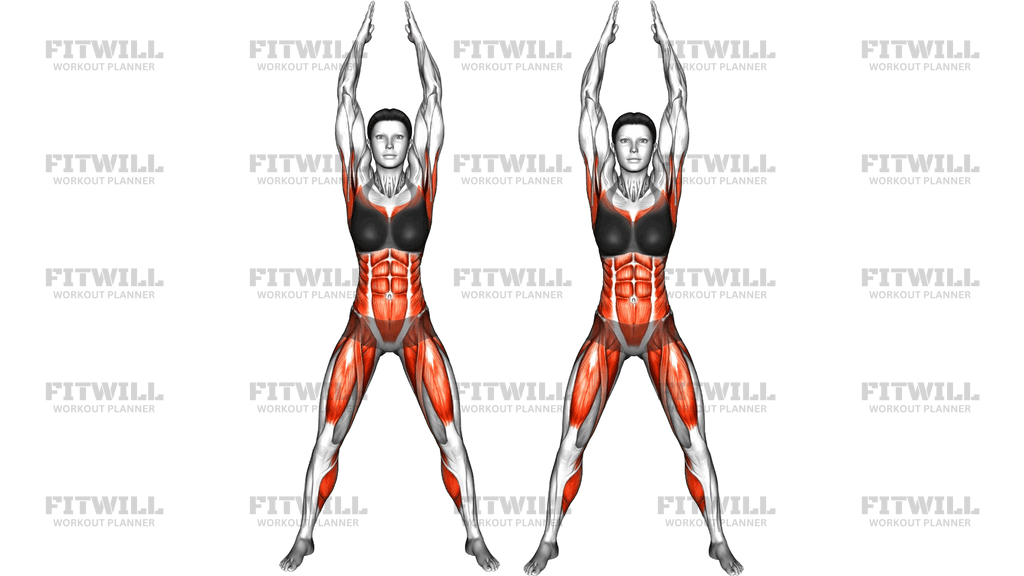
This movement works as a warm-up, a standalone cardio interval, or an active recovery option between heavier sets. It raises the heart rate quickly through the repeated knee lifts while the arm reach opens the chest, activates the shoulders and upper back, and encourages tall posture. The highlighted muscle groups are the quads and hip flexors driving each knee lift, the calves and ankles stabilizing each landing, and the deltoids and traps controlling the overhead reach.
Setup matters more than it might seem for a no-equipment drill. Stand tall with your feet hip-width apart, weight balanced over the whole foot, and your ribcage stacked over your pelvis. If you let your lower back arch or your torso lean back as the arms go up, you turn a clean reach into a spine-hinging motion that can leave your lower back irritated. Keep the core lightly braced so the reach comes from the shoulders, not from arching.
To execute well, march at a steady rhythm: drive one knee up to about hip height, press through the ball of the standing foot, and sweep your arms overhead as that knee peaks. Lower the leg with control, let the arms drift back down to your sides, and switch legs. The reach should feel long and deliberate, fingertips stretching toward the ceiling, with shoulders staying down away from the ears rather than shrugging up.
Common use cases include home cardio sessions with no equipment, desk-break movement snacks, warm-ups before lower body training, and low-impact conditioning for people who want to avoid jumping. Because the pace is fully self-controlled, beginners can march slowly and skip the full overhead reach, while fitter users can speed up, hold the arms overhead for longer stretches, or add light hand weights once the pattern feels automatic.
For safety, keep the working knee tracking forward over the toes, land softly on the standing leg, and stop the reach at whatever overhead range feels comfortable without straining the shoulders or neck. If balance is a challenge, start by holding a wall or the back of a sturdy chair until the rhythm feels stable.
[ Workout Log & Planner ]
Put your next workout in Fitwill
Keep your plan and training log ready when you are.


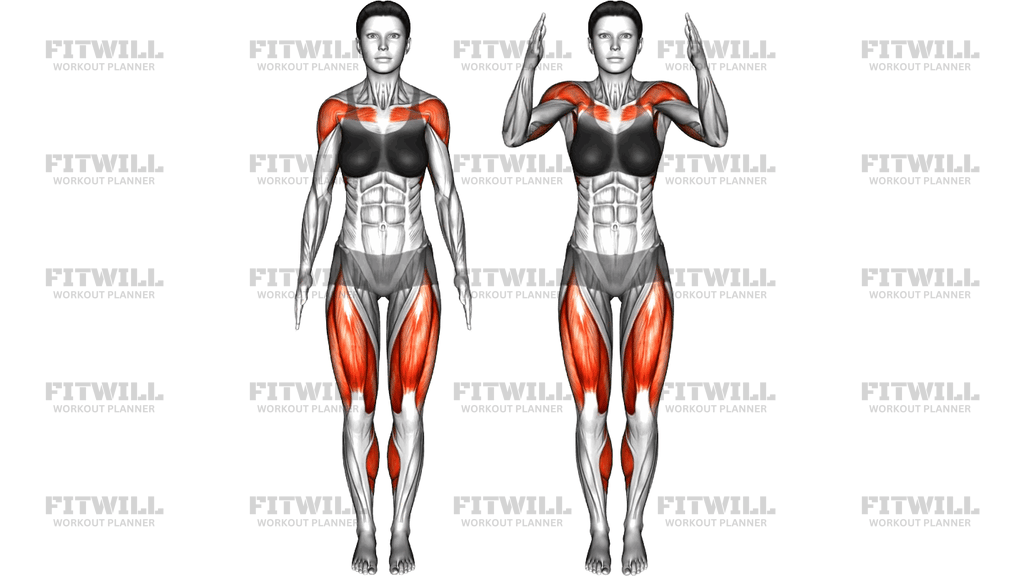
Instructions
- Stand tall with your feet hip-width apart, arms relaxed at your sides, and your weight spread evenly across both feet.
- Engage your core lightly and stack your ribs over your hips so your lower back is not already arched before you start moving.
- Begin marching in place: drive your right knee up toward hip height while pressing through the ball of your left foot.
- As the knee lifts, sweep both arms up and forward until they reach overhead, fingertips pointing toward the ceiling.
- Keep your shoulders pulled down away from your ears as you reach, and avoid letting your torso lean backward.
- Lower your right foot back to the floor under control and let your arms swing back down to your sides.
- Repeat the same knee lift and sky reach with your left leg, continuing to alternate legs in a smooth marching rhythm.
- Exhale as you lift the knee and reach up, inhale as the foot lowers and the arms come down.
- Maintain an even tempo for your target time or rep count, then finish by standing still for a few breaths before moving on.
Tips & Tricks
- If your lower back starts to ache, you are probably arching as the arms go overhead; tighten your abs slightly and stop the reach a little earlier.
- Shrugging the shoulders toward the ears during the reach is the most common fault; think of pushing the ceiling away with your fingertips instead of lifting your shoulders.
- Keep the lifted knee pointing straight ahead; if it drifts outward or inward, slow the pace and focus on lifting straight up.
- Land each step through the ball of the foot first, then settle the heel, so the calves and ankles absorb the landing quietly rather than with heavy stomps.
- If your rhythm turns choppy, count out loud, one count per knee lift, until the arms and legs sync up again.
- A slight forward lean of the torso is fine, but leaning back as you reach overhead shifts the work to the spine; check yourself sideways in a mirror if unsure.
- For a harder cardio effect, speed up the march while keeping the knee at hip height rather than raising the knee higher and losing form.
- If overhead shoulder mobility is limited, reach only to shoulder or ear height and gradually work higher over time.
- Use a wall or chair for fingertip balance if you wobble; remove it once you can march and reach without swaying.
Frequently Asked Questions
What muscles does Walking On Spot Sky Reach work?
It mainly targets the quads and hip flexors with each knee lift, while the deltoids and upper traps control the overhead reach. The calves and core stabilize you throughout the marching rhythm.
Is Walking On Spot Sky Reach cardio or strength training?
It is primarily a low-impact aerobic drill, since the repeated knee lifts and arm reaches elevate your heart rate. It also builds light muscular endurance in the legs and shoulders, but it is not a strength exercise in the traditional sense.
How high should I lift my knees during Walking On Spot Sky Reach?
Aim for roughly hip height, which is high enough to engage the hip flexors and quads without forcing you to lean back. If hip mobility limits you, lift to whatever height lets you keep an upright torso.
Should both arms reach overhead or just one?
The standard version reaches with both arms overhead as each knee lifts. Alternating single-arm reaches is a valid variation if the double reach feels uncoordinated or fatigues the shoulders too quickly.
Can beginners do Walking On Spot Sky Reach?
Yes, it is very beginner friendly because the pace, knee height, and reach range are all self-controlled. Start with slow marching and arms reaching only to shoulder height, then progress to the full overhead reach.
Why does my lower back feel tight when I reach overhead?
This usually means you are arching your spine to get your arms higher instead of extending through the shoulders. Brace your abs, tuck your ribs slightly, and stop the reach at the point where your back stays neutral.
How long should I perform Walking On Spot Sky Reach?
For a warm-up, 30 to 60 seconds is enough to raise your heart rate. As a cardio interval, march for 1 to 3 minutes and rest or walk slowly between rounds.
What can I use instead of Walking On Spot Sky Reach if I need a substitution?
Plain marching in place, high knees with a lower arm swing, or standing alternating overhead reaches all cover similar ground. Walking in place without the reach is the easiest swap if overhead mobility is an issue.
Is it safe to do this exercise every day?
Yes, since it is low impact and bodyweight only, most people can perform it daily as a movement break or warm-up. Reduce the volume or pace if your calves or hip flexors feel unusually sore.