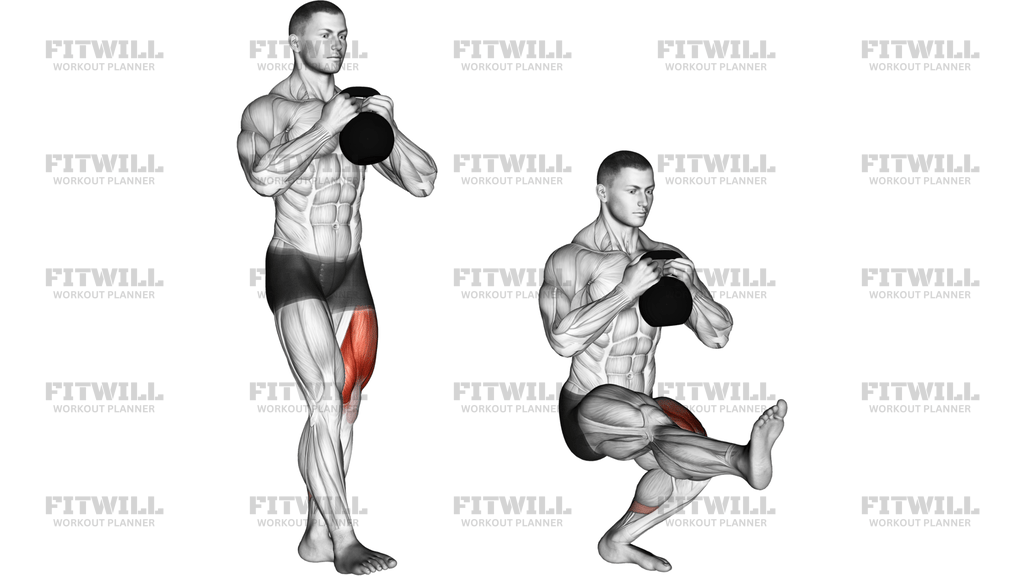
Kettlebell Double Rack Pistol Squat
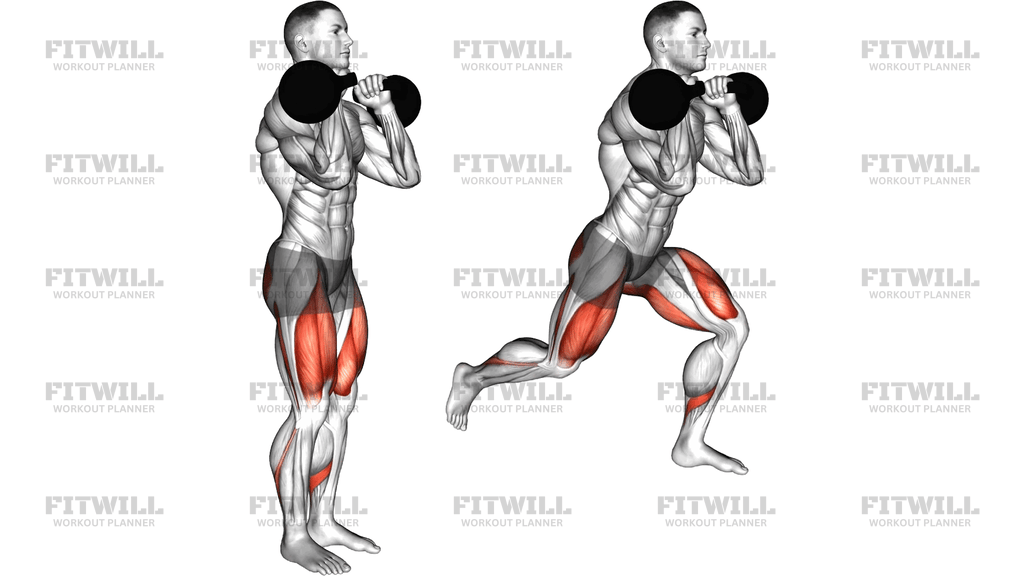
The Kettlebell Double Rack Pistol Squat is a single-leg squat performed while holding two kettlebells in the rack position at chest height. You balance on one leg, extend the other leg straight out in front of you, and descend until the working hip reaches at least parallel before driving back up to standing. The double rack setup is what separates this from a standard pistol: the load sits high on the chest and acts as a counterbalance, which many lifters find makes it easier to sit back into the squat than the unloaded version.
This is an advanced strength movement. It demands substantial unilateral leg strength, mobile ankles and hips, and serious trunk control, since you are resisting the pull of two kettlebells on one side-balanced body while balancing on a single foot. The quads take the brunt of the work, especially through the deep range where the knee bends well past 90 degrees, while the glutes handle hip extension on the way up and the calves and small foot muscles manage balance the entire time.
The rack position matters more than most people expect. Both kettlebells should rest against the forearms and chest with elbows tucked down toward the ribs rather than flared wide. This keeps the load close to your midline and lets you lean slightly forward into the descent without losing your balance. If the bells drift away from the body, the weight pulls you forward and the movement quickly turns into a fight instead of a squat.
To execute it well, keep the working foot flat and gripping the floor, hinge slightly at the hip, and sit straight down rather than letting the knee shoot far forward. The extended leg should stay relatively straight and lifted throughout, acting as a counterweight. Pause briefly at the bottom if you can control it, then drive the floor away through mid-foot to stand. Control on the way down is where most of the training value lives.
Use this exercise once you can already perform bodyweight or lightly loaded pistol squats for clean reps. It suits lifters building unilateral leg strength without heavy barbells, athletes who need single-leg capacity for running and jumping sports, and anyone who wants a demanding lower body and core stimulus with just a pair of kettlebells. Work in low rep ranges per side, and stop the set the moment your balance or knee tracking starts to break down. If your ankle mobility limits you, elevate the heels slightly on a small plate or board while you build the range.
[ Workout Log & Planner ]
Put your next workout in Fitwill
Keep your plan and training log ready when you are.


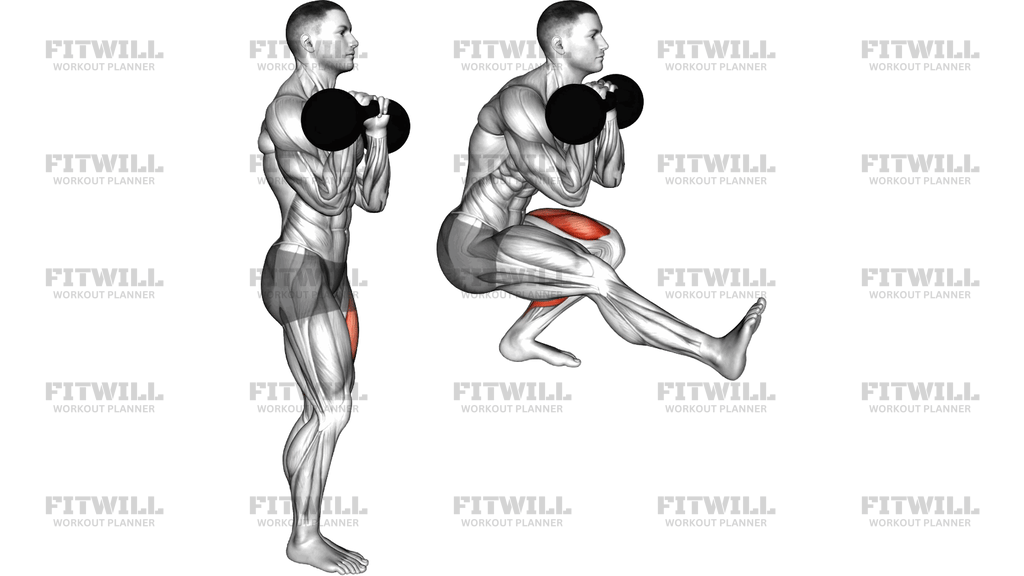
Instructions
- Clean two kettlebells to the rack position, one in each hand, with the bells resting on the outside of your forearms and your elbows tucked close to your ribs.
- Stand tall with feet roughly hip-width apart, then shift your weight fully onto one leg and extend the other leg straight forward with the foot flexed and a few inches off the floor.
- Brace your core and pull the kettlebells in toward your chest so the load sits close to your midline.
- Keeping the working foot flat and your knee tracking over your toes, hinge slightly at the hip and sit straight down as if lowering onto a low box behind you.
- Descend until your working hip is at or below knee height, maintaining contact between the kettlebells and your chest.
- Keep the extended leg lifted and fairly straight throughout so it acts as a counterbalance rather than dropping toward the floor.
- Pause for a beat at the bottom without bouncing, keeping tension in the working leg.
- Drive through your mid-foot and squeeze the glute to stand back up to a full, tall position on the single leg.
- Exhale on the way up and inhale at the top before the next rep; complete all reps on one side before switching legs.
- To finish the set, place the non-working foot down first, then re-rack or set the kettlebells down safely before resting.
Tips & Tricks
- If you keep losing balance backward, the kettlebells are probably too far from your chest—pull your elbows down and let the bells rest on your forearms so they counterbalance you instead of fighting you.
- A common fault is the working heel lifting off the floor at depth; work on ankle mobility separately or elevate the heel on a thin plate until the range improves.
- Watch for the working knee caving inward as you fatigue—cue yourself to spread the floor and keep the knee stacked over the middle of the foot.
- Do not let the extended leg drop and touch down mid-set; if it keeps falling, the load is too heavy or you are leaning too far forward at the bottom.
- Keep your torso from rounding forward under the weight—if your chest collapses, the kettlebells are drifting away from the body and pulling your spine into flexion.
- Grip the handles firmly but not deathly tight; excess grip tension fatigues the forearms before the legs get their training effect.
- Start with the double rack version only after you can do clean bodyweight pistol squats—adding load before you own the pattern just teaches bad positions.
- Practice the bottom position with a box or bench behind you set to parallel height so you can rehearse the depth safely without falling backward.
- Do these early in your session while fresh; balance-dependent single-leg work falls apart quickly when you are tired.
Frequently Asked Questions
What muscles does the Kettlebell Double Rack Pistol Squat work?
The quadriceps are the primary movers, working hardest through the deep knee bend. The glutes extend the hip on the way up, while the core, calves, and small stabilizing muscles of the foot handle balance and trunk control under the load.
Why use two kettlebells in the rack instead of one for pistol squats?
The double rack load sits close to your chest and acts as a counterweight, making it easier to sit back and reach depth than an unloaded pistol. It also lets you add meaningful load once the bodyweight version feels comfortable.
Is the Kettlebell Double Rack Pistol Squat suitable for beginners?
Not usually as a starting point. Beginners should first build single-leg strength with split squats, step-ups, and box pistol squats, then progress to unloaded pistols before adding the double rack load.
How deep should I go on the Kettlebell Double Rack Pistol Squat?
Aim for at least hip-crease-below-knee depth, which is the standard for a full pistol. Only go as deep as you can control with your heel flat and knee tracking straight over the foot.
My heel keeps lifting off the floor at the bottom—what should I do?
That is usually an ankle mobility limitation. Spend time on calf and ankle mobility work, and in the meantime elevate the working heel slightly on a thin plate or board so you can train the pattern through a full range.
How many reps should I do per side?
Because this is a demanding balance and strength movement, low reps work best—typically 3 to 6 per side for 3 to 4 sets. Stop the set as soon as your balance or knee position starts to waver.
Can I substitute a single kettlebell or a dumbbell for the double rack setup?
Yes. A single kettlebell held in the rack or a counterbalanced goblet-style hold changes the load distribution and the demand on your core, but both are valid progressions toward or alongside the double rack version.
Why does my torso keep rounding forward during the squat?
The kettlebells are most likely drifting away from your chest, pulling your upper body forward. Keep your elbows tucked to your ribs and the bells resting on your forearms, and cue yourself to stay tall as you descend.
Is the Kettlebell Double Rack Pistol Squat safe for the knees?
When performed with controlled tempo, a flat foot, and the knee tracking over the toes, it is a well-tolerated strength exercise for healthy knees. If you have a current knee issue, get clearance from a qualified professional before loading single-leg squats to full depth.