Kettlebell Single Rack Pistol Squat
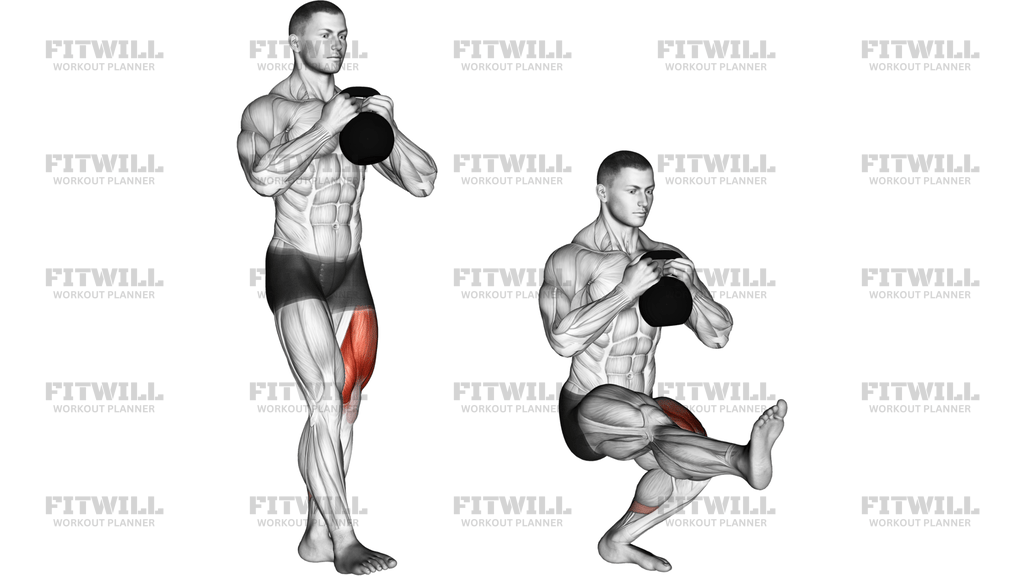
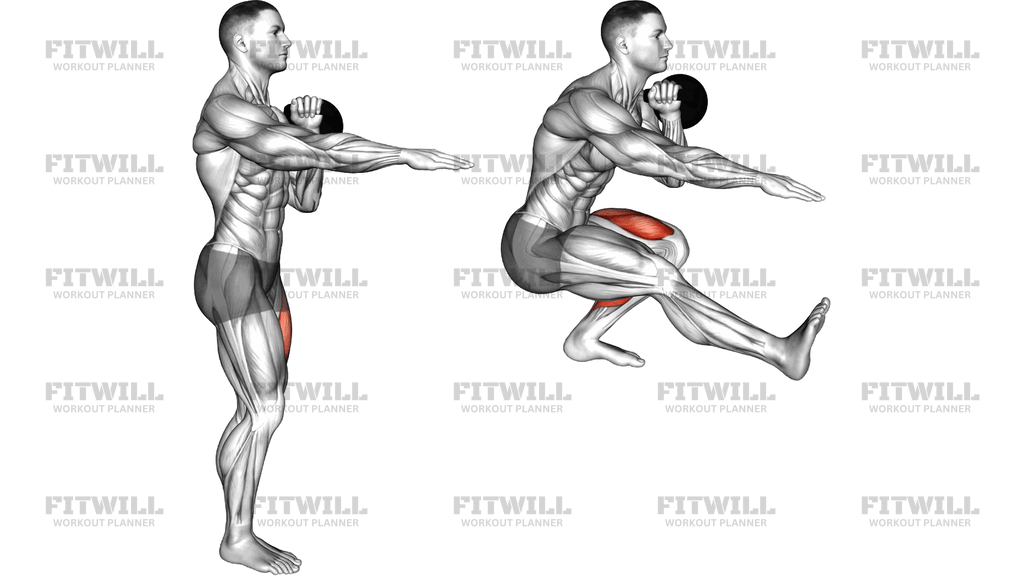
The Kettlebell Single Rack Pistol Squat is a single-leg squat performed with a kettlebell held in the rack position at one shoulder. You balance on one leg while the other leg extends straight out in front of you, lower down until the working hip reaches or passes knee depth, then drive back up to standing. The free arm reaches forward to counterbalance the load sitting on the opposite side of your body, which is one of the defining details of this variation.
This is an advanced unilateral leg exercise. Loading one side of the body with the kettlebell in the rack forces your core to resist rotation and side-bending at the same time your standing leg handles your full bodyweight plus the bell. That combination makes it useful for lifters who have already built a solid bodyweight pistol and want to add resistance without holding weight straight out in front, which becomes awkward and shoulder-fatiguing at heavier loads.
The main work comes from the quadriceps of the standing leg, with strong contributions from the glutes as you rise from the bottom, and from the ankle stabilizers and calf musculature as they control your balance over a small base of support. The obliques and deep core work hard to keep your torso square despite the off-center load, and the forearm and grip stay active holding the bell in the rack.
Setup matters a lot in this movement. Cleaning the kettlebell into a tight rack position, with the bell resting against your forearm and upper arm rather than held out in the hand, keeps the load close to your centerline and saves your shoulder. If the bell drifts away from the body, your torso will twist and the standing leg will follow it, which is where most reps go wrong.
To execute well, keep your weight stacked over the midfoot of the standing leg, hinge slightly at the hip as you descend, and let the extended leg stay lifted and reasonably straight. Reach the opposite arm forward at the start and keep it there, adjusting the reach slightly if you tip backward at the bottom. Descend under control, pause briefly at your deepest solid position, and drive the floor away without letting the heel lift.
Use this exercise when you can already perform several clean bodyweight pistol squats and want progressive loading for single-leg strength, or when you want a way to expose and fix side-to-side imbalances. Start with a light bell, even a very light one, because the rack position changes the balance demands more than most people expect.
[ Workout Log & Planner ]
Put your next workout in Fitwill
Keep your plan and training log ready when you are.


Instructions
- Clean a kettlebell into the rack position on one side, letting the bell rest against the back of your forearm and upper arm with your elbow tucked close to your ribs.
- Stand tall with your feet hip-width apart, then shift all your weight onto the leg opposite the kettlebell and lift the other foot fully off the floor.
- Extend the non-working leg straight out in front of you with the toes pulled up, and reach the free arm straight forward at shoulder height as a counterbalance.
- Brace your midsection firmly and pull your ribs down so your torso does not lean or twist toward the loaded side.
- Push your hips back slightly and bend the standing knee to lower yourself, keeping your weight over the midfoot and the extended leg off the floor the whole way down.
- Descend until your hip reaches or drops just below knee level, or as deep as you can go without your heel rising or your torso collapsing forward.
- Pause for a beat at the bottom, then drive through the midfoot and squeeze the glute of the working leg to stand back up to a full lockout.
- Exhale as you press up from the bottom and inhale at the top before starting the next rep.
- Complete all reps on one side, then re-clean the kettlebell into the rack on the other arm and work the opposite leg.
Tips & Tricks
- If the kettlebell pulls you sideways as you descend, you are letting the rack loosen. Squeeze the elbow against the ribs and actively press the bell into your body instead of merely holding it.
- Tipping backward at the bottom usually means the free arm is not doing its job. Reach it a little further forward early in the descent rather than trying to rescue the rep once you are already falling back.
- Keep the extended leg genuinely lifted. If that heel scrapes the floor mid-rep, your standing-leg knee is drifting forward and your hips are shooting back too far.
- A common mistake is letting the standing knee cave inward as fatigue builds. Think about spreading the floor with your foot and tracking the knee over the toes on every rep.
- Do not rush the descent. Lowering in one or two controlled seconds gives you time to find balance before the hardest part of the range.
- If your heel lifts, widen your attention to the whole foot and shift your hips back a touch more at the start rather than dropping straight down.
- Master the offset balance first: stand in the rack position on one leg for 10 to 15 seconds before adding full reps, since the load placement is unfamiliar even for strong squatters.
- Choose a kettlebell weight you can rack comfortably for the whole set. A bell that is too heavy forces you to lean away from it and turns the set into a torso battle.
- If you lose the extended-leg position at depth, sit slightly less deep with better alignment rather than sinking low with a collapsed posture.
Frequently Asked Questions
Which muscles does the Kettlebell Single Rack Pistol Squat work hardest?
The quadriceps of the standing leg do most of the work, supported by the glutes as you drive out of the bottom. The calves, ankle stabilizers, and obliques work hard to keep you balanced and square under the offset load.
Should the kettlebell be held on the same side as the working leg or the opposite side?
In this version the kettlebell sits in the rack on one shoulder while you squat on the opposite leg, with the free arm reaching forward. That offset is what makes the exercise demand so much anti-rotation work from the core, so keep the pairing consistent and train both sides.
Can beginners do the Kettlebell Single Rack Pistol Squat?
It is not a good starting point. Beginners should first build box pistols or assisted pistols and get comfortable holding a kettlebell in the rack on one leg before adding load. Attempting it too early usually produces depth faking and balance collapses.
Why does the free arm reach forward during this exercise?
The forward arm counterbalances the kettlebell sitting behind your shoulder line. Without it, most people tip backward at the bottom of the pistol because the load and the extended leg pull the center of mass out of position.
My heel lifts off the floor at the bottom. What should I change?
Shift your hips back slightly at the start of the descent and keep your weight spread across the whole midfoot rather than pushing into the toes. Limited ankle mobility is also a common cause, so spending time on calf and ankle mobility helps.
What can I substitute if I cannot do a full pistol yet?
Use a box or bench behind you and tap your hips to it at depth, or hold a suspension strap or door frame with the free hand for balance assistance. You can keep the same rack setup and gradually reduce the assistance as you improve.
How heavy should the kettlebell be for this movement?
Start lighter than you think you need, because the off-center rack position changes your balance even with a modest bell. Pick a weight you can control for five clean reps per side before progressing.
How do I keep my torso from twisting toward the kettlebell?
Keep your elbow pinned to your ribs so the bell stays tight against your body, brace your core before you descend, and keep the free arm reaching straight ahead. If the torso starts rotating, the rep is usually too heavy or you are rushing the descent.
Is it safe for the knees if I feel pressure in them during the Kettlebell Single Rack Pistol Squat?
Single-leg deep squats place high demand on the knee, so any sharp or one-sided discomfort is a signal to stop and reduce depth or load. Build up gradually with assisted versions, and keep the knee tracking over the toes rather than caving inward.