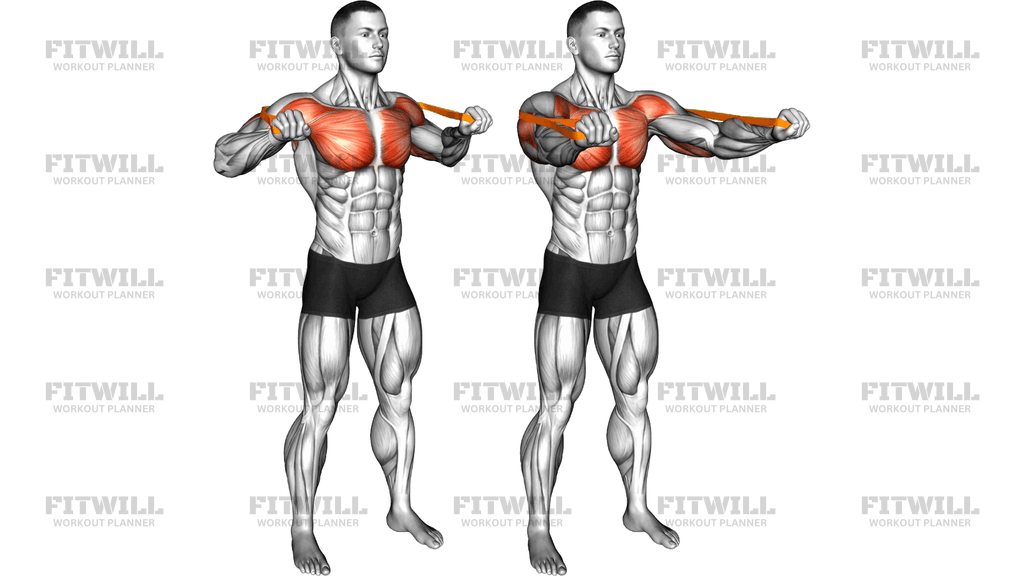
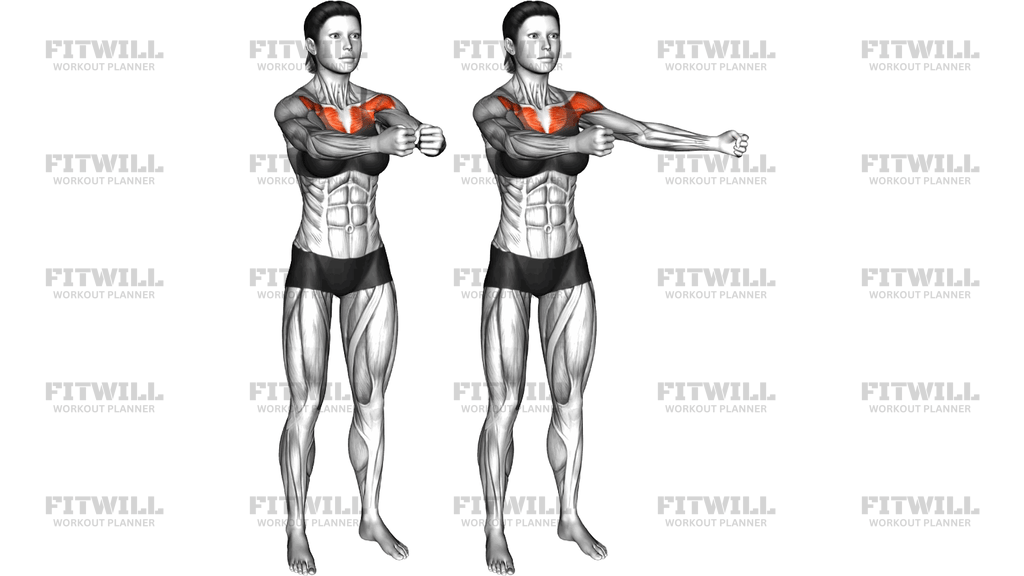
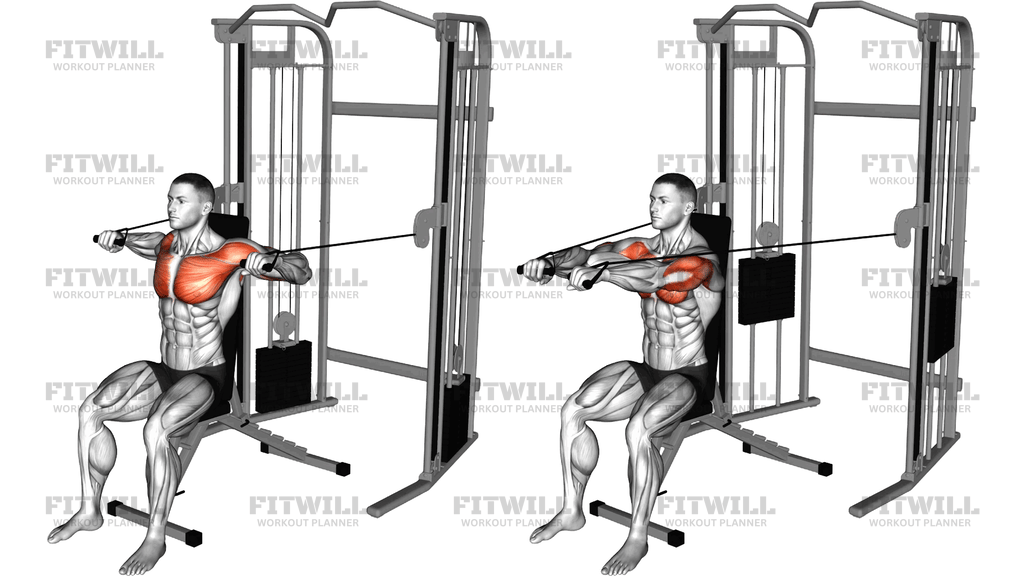
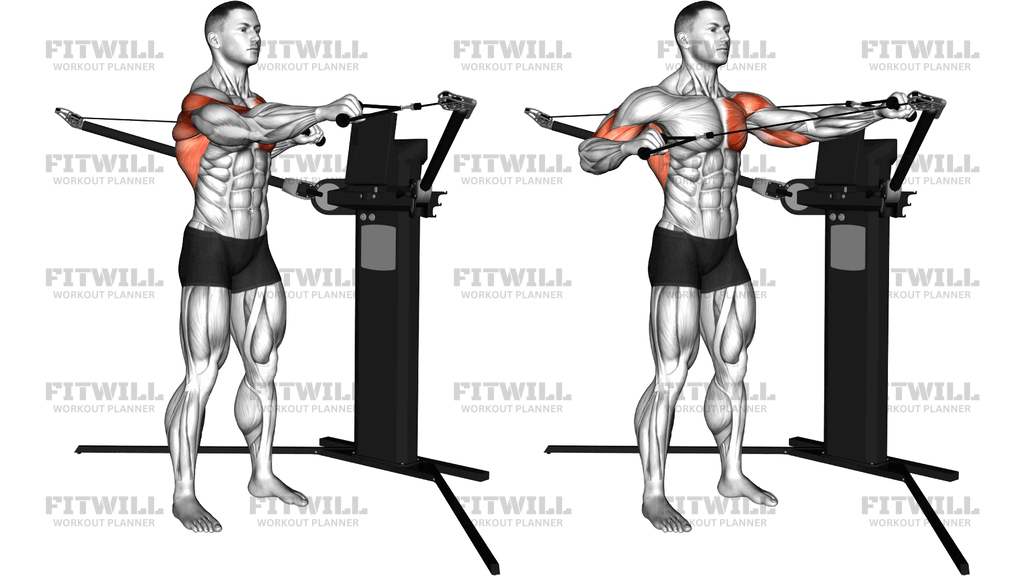
Cable Middle Fly
Cable Middle Fly is a mid-height cable chest fly that keeps the arm path roughly horizontal through the center of the chest. It is a good all-around fly position because the cable height lines up naturally with the midline of the chest, giving you steady tension without pushing the movement too far toward an upper-fly or low-fly angle.
The exercise primarily targets the pectoralis major, with the front shoulders and biceps assisting in a supporting role. It works best when the torso stays still, the elbows keep a fixed soft bend, and the chest controls the hands through a smooth hugging arc. That makes Cable Middle Fly useful for chest isolation, controlled hypertrophy work, and a cleaner alternative to pressing when you want more stretch and squeeze with less triceps involvement.
Set the pulleys around chest height, stand centered between them, and step into a stable staggered stance before the first rep. Hold the handles with a slight elbow bend and open the arms until the chest has tension without the shoulders rolling forward. Bring the handles together at chest line in a smooth arc, pause briefly at the squeeze, and return slowly to the open position while keeping the same elbow angle the entire time.
Cable Middle Fly works well as a chest accessory after pressing, as a lighter chest-building movement, or as the most neutral fly angle for lifters who want a balanced line of pull. Because the pulleys are at chest height, the cable path is usually easy to control and easy to repeat. Good reps are quiet, symmetrical, and deliberate, with no torso swing and no pressing action at the top.
If the shoulders start dominating or the chest stretch feels too aggressive, reduce the load and keep the hands a little closer to the front of the body. The goal is a clean midline chest fly, not a shoulder-heavy reach.
[ Workout Log & Planner ]
Put your next workout in Fitwill
Keep your plan and training log ready when you are.


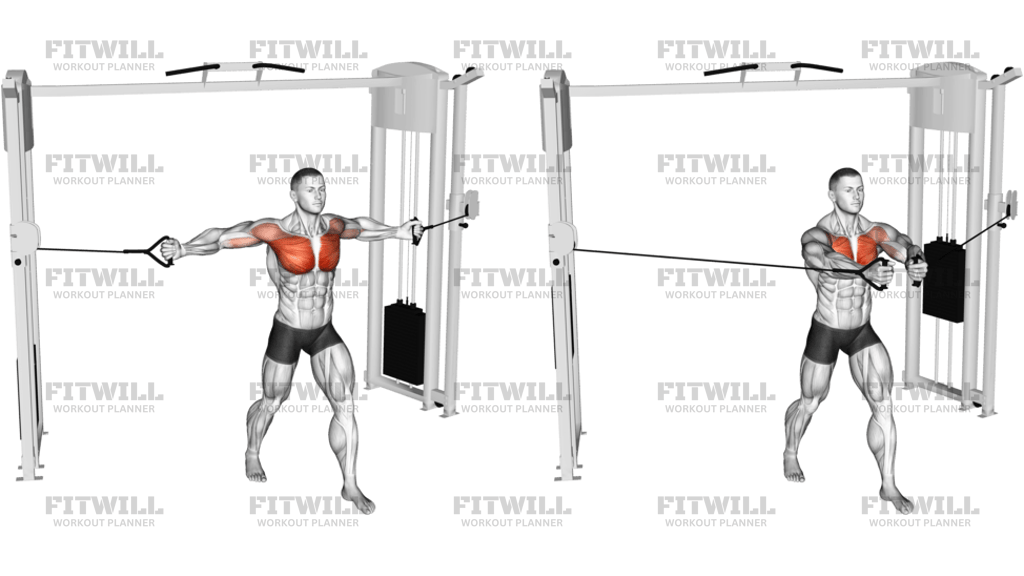
Instructions
- Set the pulleys around chest height and stand centered between them before you take the handles.
- Step into a stable staggered stance and keep your torso tall with your ribs stacked.
- Hold both handles with a slight, fixed bend in the elbows and start with the arms open enough to create tension.
- Keep the shoulders down and the chest open without leaning the body forward.
- Bring the handles together in a smooth arc at chest line.
- Pause briefly at the squeeze, then return under control to the open position with the same elbow angle.
- Keep the torso still and the path symmetrical from one side to the other.
- Repeat for the full set, then step back carefully before releasing the handles.
Tips & Tricks
- Keep the elbow bend fixed so the movement stays a fly instead of drifting into a press.
- If the shoulders roll forward at the bottom, shorten the stretch a little and lower the load.
- The handles should meet at chest height, not high above the shoulders or low at the waist.
- Use a load that lets both sides move together instead of one handle arriving early.
- A staggered stance helps keep the torso steady, especially when the cable gets heavier near the squeeze.
- Keep the neck relaxed so the traps do not take over the top of the rep.
- Breathing should stay even; if you are holding your breath to finish the rep, the load is too aggressive.
- The smoothest reps usually come from a moderate load and a controlled return instead of a hard squeeze alone.
Frequently Asked Questions
What muscles does Cable Middle Fly work?
It mainly works the chest, with the front shoulders and biceps helping stabilize the movement.
Is Cable Middle Fly different from low or high fly?
Yes, the pulley height changes the pull angle and the way the chest feels the rep.
Can beginners do Cable Middle Fly?
Yes, if they start light and keep the shoulders from drifting forward at the stretch.
Should the handles meet exactly in the center?
They can meet or cross slightly, as long as the shoulders stay stable and the chest stays in control.
What is the most common mistake in Cable Middle Fly?
Turning the fly into a press by changing the elbow angle too much.
What rep range works well for Cable Middle Fly?
Moderate to higher reps usually work well because it is a chest isolation movement.
Should I feel my shoulders more than my chest?
No, the chest should be primary; if the shoulders dominate, reduce the load and shorten the range.