Cable Decline Press
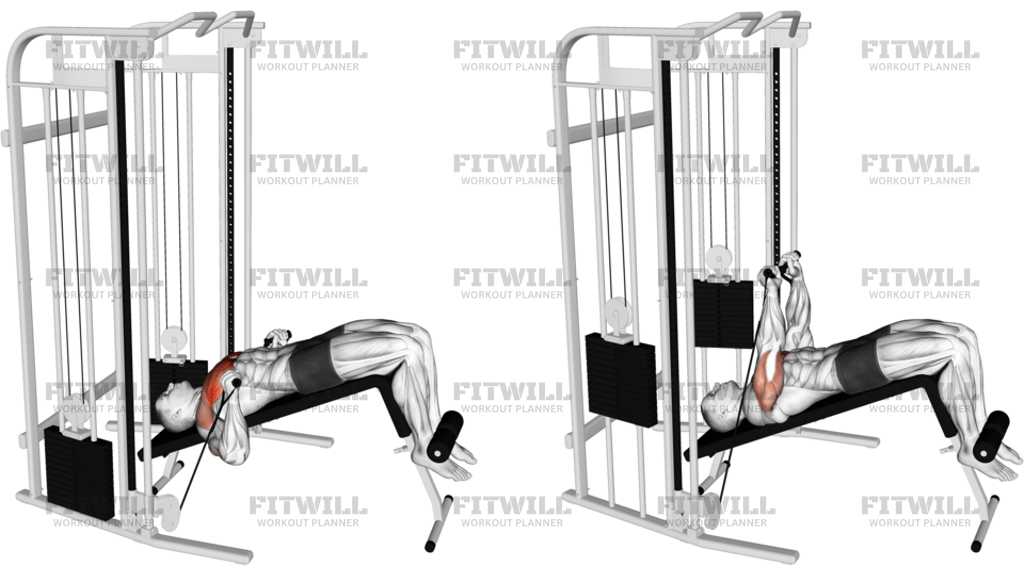
Cable Decline Press is a chest-focused pressing exercise performed on a decline bench between cable stacks. It keeps constant tension on the pecs while the cables also ask the shoulders, triceps, and trunk to stabilize the press path. Because the resistance does not rest at the top or bottom, every rep rewards good setup and smooth control.
The decline angle shifts the press slightly downward through the chest, which makes this a useful option when you want to train the lower portion of the pecs without relying on a barbell. The handles let each arm move independently, so you can press in a natural arc and keep the wrists and elbows in a more comfortable line. That also makes the exercise helpful if a fixed bar path feels too rigid.
The setup matters more than it does on many machine presses. Your shoulders should stay pinned to the bench, your chest should stay lifted, and your feet should be anchored so the bench does not slide or tip as you press. Once you have the bench, pulleys, and handles lined up, the goal is to keep the rib cage steady while the arms travel smoothly from the lower chest toward the upper chest line.
A good Cable Decline Press rep starts with the handles near the sides of the chest and ends with the arms extended without locking out aggressively. The press should feel strong but not jerky, with the handles traveling on the same path every time. Lowering the handles under control is just as important as driving them up, because the eccentric phase is where the chest and front shoulders stay loaded.
This exercise fits well in hypertrophy work, accessory pressing, or as a joint-friendlier chest movement when you want less bar path restriction and more constant tension. It is usually easier to learn than a heavy free bar decline press, but it still demands attention to bench angle, foot support, and shoulder position. If those details are sloppy, the press turns into a shoulder-dominant push instead of a clean chest movement.
[ Workout Log & Planner ]
Put your next workout in Fitwill
Keep your plan and training log ready when you are.


Instructions
- Set a decline bench between the cable stacks and attach a handle to each low pulley.
- Lie back on the bench with your head supported, your shoulders on the pad, and your feet secured under the rollers or foot support.
- Hold the handles near the lower chest with your palms facing forward and your wrists stacked over your forearms.
- Pin your shoulder blades to the bench, lift your chest, and keep your ribs from flaring as you prepare to press.
- Press the handles up and slightly inward until your arms are extended above the upper chest line.
- Keep the handles moving in a smooth arc instead of letting one arm drift higher than the other.
- Lower the handles slowly back to the sides of your chest until you feel a controlled stretch through the pecs.
- Exhale as you press, inhale as you lower, and keep the bench contact and foot position fixed for every rep.
- Finish the set by bringing the handles back to the starting position under control before sitting up.
Tips & Tricks
- Keep the decline angle moderate; a steep drop usually turns the press into an awkward shoulder-dominant movement.
- Start each rep with the handles just outside the lower chest so the first inch of the press comes from the pecs, not a bounce.
- Do not let the elbows flare straight out; a slight tuck keeps the front shoulders from taking over.
- If the cables pull your shoulders forward at the bottom, shorten the range until you can keep the shoulder blades planted.
- Press slightly inward as you rise so the handles finish over the upper chest line instead of drifting straight up.
- Use a lighter load if the bench shifts or your feet have to push hard to stay anchored.
- Keep the wrists straight; bent wrists usually show up when the handles are too heavy or the grip is too loose.
- Control the lowering phase for two to three seconds to keep tension on the pecs instead of dropping into the bottom.
- Stop the set when the handles start wobbling or one arm finishes noticeably higher than the other.
Frequently Asked Questions
What muscles does Cable Decline Press train most?
The main target is the chest, especially the lower and mid pecs, with the front deltoids and triceps helping to finish each press.
Is Cable Decline Press easier on the shoulders than a barbell decline press?
It often is, because the handles let each arm follow a more natural path. Keep the bench angle moderate and the shoulders pinned back so the press stays comfortable.
Where should the handles finish on Cable Decline Press?
They should end above the upper chest line with the arms extended, not jammed together over the face. The best finish is strong and controlled, not exaggerated.
How do I keep my shoulders from taking over this press?
Set your shoulder blades on the bench before the first rep, keep your chest lifted, and stop the lowering phase when the handles reach the sides of the chest rather than sinking too deep.
Can a beginner do Cable Decline Press?
Yes. Start light enough to keep the bench stable and the handles even, then learn the arc before increasing load.
What is the biggest form mistake on this exercise?
Letting the rib cage flare and the shoulders roll forward at the bottom. That usually shifts tension away from the chest and makes the rep feel unstable.
What can I use instead if I do not have a decline bench?
A flat cable press or a slight incline cable press is the closest substitute. The line of press changes a bit, but you still get the benefit of constant cable tension.
Should the handles touch at the top?
They can come close, but they do not need to collide. Focus on a clean finish over the chest and keep both sides moving together.