March Sit Wall
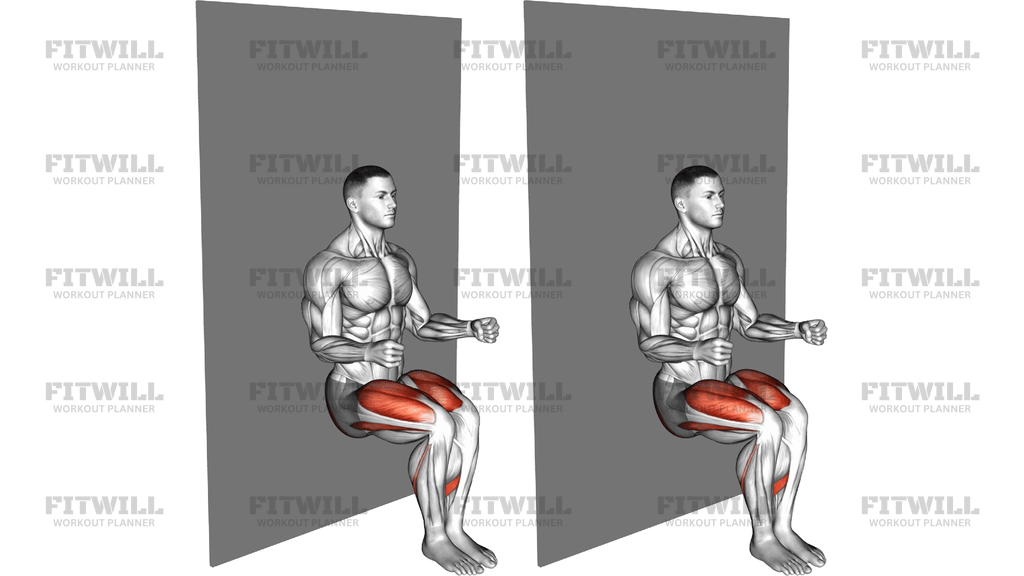
March Sit (wall) is a bodyweight wall-sit variation where you hold a seated position against the wall and alternate lifting one foot at a time. It trains thigh endurance, glute support, and trunk control at the same time, so the legs stay under tension while the pelvis and ribs have to stay quiet. That combination makes it useful when you want a squat pattern that feels demanding without needing external load.
The wall is not there just for balance. It gives you a fixed backrest so you can lock in a consistent squat depth, usually with knees and hips close to 90 degrees, then focus on the marching action. The working leg should keep pressing into the floor while the lifted leg comes only a few inches off the ground. If you stand up between marches or shift your torso, the exercise turns into a rest position instead of a controlled endurance drill.
The main effort should stay on the front of the thighs and the glutes, with the core and lower back helping you resist rotation and keep the torso stacked. In anatomy terms, the primary work centers on the Gluteus maximus, supported by the Biceps femoris, Rectus abdominis, and Erector spinae. The movement is simple, but the quality comes from holding position while one leg repeatedly leaves the floor without changing the shape of the wall sit.
Use a smaller march and a shallower hold if your knees cave inward, your low back peels off the wall, or your hips start bouncing side to side. Those are the signs that the set has become too aggressive for the current tempo or depth. Clean reps matter more than fast reps here, because the goal is to stay organized under fatigue rather than chase height or speed.
March Sit (wall) fits well in lower-body accessories, warmups, conditioning blocks, or knee-friendly strength work when you want a squat isometric with added single-leg control. It is usually beginner-friendly if you keep the march small and the hold short, but it still demands attention to posture, breathing, and knee tracking. Use it when you want a simple wall-supported drill that makes the thighs work hard without losing form.
[ Workout Log & Planner ]
Put your next workout in Fitwill
Keep your plan and training log ready when you are.


Instructions
- Stand with your back against a wall and walk your feet forward until you can slide down into a wall sit with your hips and knees close to 90 degrees.
- Set your feet about hip-width apart, keep your heels planted, and make sure your shoulders, upper back, and pelvis are supported by the wall.
- Press your lower ribs down, brace your core, and keep your chest relaxed instead of arching your low back.
- Shift your weight evenly into both feet, then lift one foot a few inches off the floor without letting your hips rise.
- Lower that foot quietly, then lift the other foot to the same height, keeping the marching motion small and controlled.
- Keep your planted knee tracking over the middle toes as you alternate legs and resist twisting through the torso.
- Breathe steadily through the hold, exhaling on each march or switch instead of holding your breath.
- Finish the set by placing both feet back on the floor and standing up from the wall slowly when the planned time or reps are complete.
Tips & Tricks
- The lower you sit, the harder the hold becomes, so use a depth you can keep without your hips sliding below knee level.
- Lift each foot only a few inches; a big knee drive usually makes the pelvis rock and turns the set into a balance drill.
- Keep pressure through the heel and midfoot of the standing leg so the thigh stays loaded instead of letting the toes do the work.
- If one knee collapses inward, shorten the march and reset the foot so the knee points over the second or third toe.
- Do not bounce off the wall or use your hands on your thighs to push yourself higher between marches.
- A slower march exposes weak points sooner, so use a controlled tempo when you want more thigh and glute endurance.
- If your low back starts to arch, bring the ribs down and move the feet slightly farther from the wall to reduce strain.
- Stop the set when you can no longer keep the torso still, even if the legs still have more work left.
Frequently Asked Questions
What does March Sit (wall) train most?
It mainly trains the quads and glutes, with the core working hard to keep the body from twisting while you march.
Is this just a wall sit with leg lifts?
It is a wall sit held at a fixed squat depth, but each rep adds an alternating foot lift that increases trunk and single-leg demand.
How high should I lift my foot during the march?
Only a few inches is enough. The goal is to unweight the foot, not to drive the knee high or stand up out of the wall sit.
Where should I feel this exercise?
You should feel a strong burn in the front of the thighs and a steady effort in the glutes, with the abs helping you stay square to the wall.
What is the most common mistake?
The most common mistake is letting the hips bounce up and down or leaning away from the wall instead of holding one fixed sit position.
Can beginners do March Sit (wall)?
Yes. Beginners should use a shorter hold, a smaller march, and a shallower squat depth until they can keep the pelvis level.
Does this exercise bother knees?
It should be pain-free. If the knees feel irritated, reduce the depth, lower the march height, or stop before fatigue changes your alignment.
How do I make it harder without weights?
Hold the sit longer, march more slowly, or keep each foot lifted for a brief pause before placing it back down.