Stability Ball Sitting Balance Knee Extension
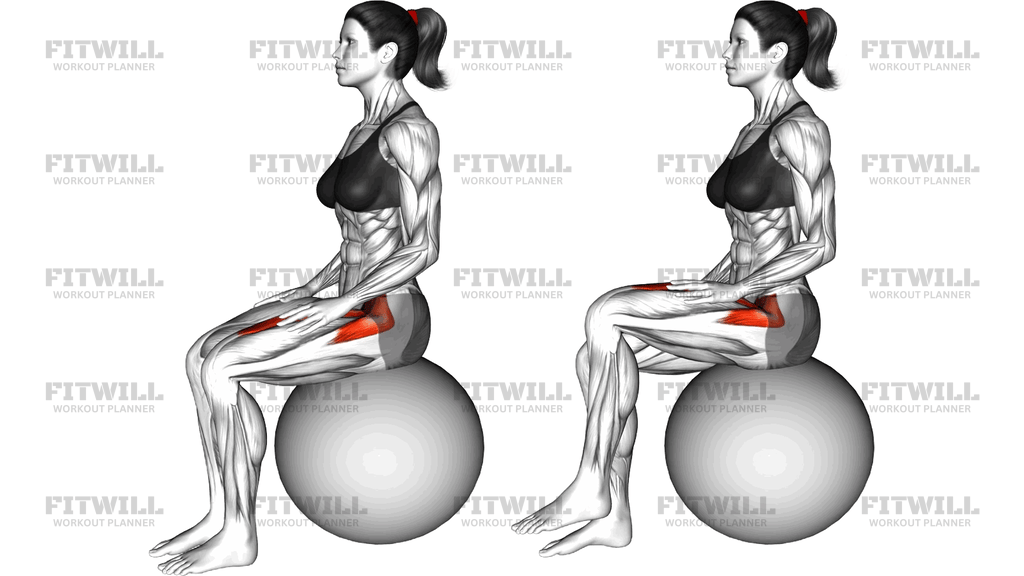
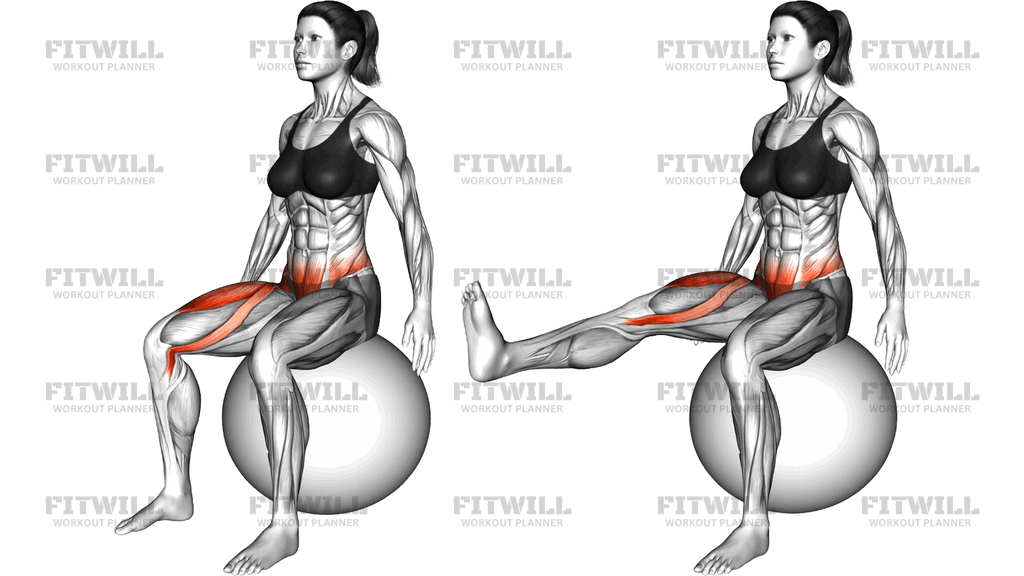
Stability Ball Sitting Balance Knee Extension is a seated balance drill performed on a stability ball. You sit upright on top of the ball with both feet flat on the floor, then slowly straighten one knee to lift that leg out in front of you while your torso stays tall and your base of support shrinks from two feet to one. The ball adds constant micro-movement underneath you, so your trunk has to work the entire time your leg is moving.
This movement trains two things at once: the quadriceps extend the knee, while the deep core and hip stabilizers keep your pelvis level and your spine neutral as the support point shifts. Because you are seated rather than standing, the balance demand is gentler than a standing single-leg drill, but the soft, rolling surface of the ball still forces continuous small corrections through your abdominals, obliques, and hips.
It is especially useful for people rebuilding stability after time away from training, older adults working on fall-proofing, and lifters who want a low-load way to wake up their trunk before squats or hinge work. It also suits rehab-style programming where the knee needs controlled, body-weight extension without impact or external load.
Setup matters more than it looks. The ball height should let your knees sit roughly at hip level with both feet planted, and your sitting bones should rest on the crown of the ball rather than sliding toward the front or back. If the ball is too soft or too small, you sink and lose the upright posture; too firm or too large, and your hips sit above your knees and the roll becomes hard to manage.
To execute it well, brace your midsection lightly, extend one knee until the leg is nearly parallel to the floor, pause briefly, then lower the foot back down with the same control. Avoid bouncing off the ball or leaning your torso backward to cheat the leg up. Keep your arms relaxed at your sides or hover them just off your thighs if you want more of a balance challenge.
Program it for time or reps: 6 to 10 controlled extensions per side, or 20 to 40 seconds of alternating legs. Stop the set when your posture starts to slump or your foot placement gets sloppy, since the value of the exercise comes from a stable trunk, not the number of reps.
[ Workout Log & Planner ]
Put your next workout in Fitwill
Keep your plan and training log ready when you are.


Instructions
- Sit centered on a stability ball sized so your knees bend about 90 degrees with both feet flat on the floor.
- Walk your feet to hip-width apart and settle your sitting bones on the top of the ball so it feels level, not tilted toward the front or back.
- Sit tall through your spine, relax your shoulders down, and let your arms hang at your sides with your palms facing your thighs.
- Brace your midsection lightly, as if preparing for a gentle nudge, and keep your ribcage stacked over your pelvis.
- Slowly straighten one knee, lifting that leg forward until it is roughly parallel to the floor, with the toes pulled slightly back.
- Hold the extended position for one to two seconds while keeping your torso upright and your hips square, resisting the urge to lean back.
- Bend the knee again and lower the foot to the floor under control, letting the ball settle before the next rep.
- Breathe steadily throughout: exhale as you extend the leg, inhale as you lower it back down.
- Complete all repetitions on one side, then switch legs, or alternate legs rep by rep if you prefer an alternating rhythm.
- Between sets, re-center yourself on the ball and reset your posture before starting the next set.
Tips & Tricks
- If you find yourself sliding forward on the ball, your hips are likely sitting too low; check that your knees are at or slightly below hip height before starting.
- Leaning the torso back as the leg rises is the most common cheat, because it shortens the hip flexors' work. Keep your chest proud and imagine a string lifting the crown of your head.
- Deflate the ball slightly if it feels unstable at first. A softer ball rolls less and makes the balance task much more manageable for beginners.
- Keep the working foot relaxed rather than pointing hard; a pointed toe tends to make people swing the leg up instead of extending the knee with control.
- Watch your supporting foot. It should stay flat and quiet on the floor. Gripping the floor with curling toes usually means the trunk is wobbling more than you think.
- Do not rush the lowering phase. The eccentric part of the knee extension is where much of the quad control is built, so take a full count to bring the foot down.
- If one side feels noticeably wobblier, start every set with that side while you are fresh.
- Progress by hovering your hands off your thighs, crossing your arms over your chest, or adding a brief pause at the top before you add more reps.
Frequently Asked Questions
What muscles does Stability Ball Sitting Balance Knee Extension work?
The quadriceps extend the knee and are the prime mover, while the deep core, obliques, and hip stabilizers work continuously to keep you centered on the ball. The hip flexors also assist as the straightened leg holds out in front of you.
Is Stability Ball Sitting Balance Knee Extension suitable for beginners?
Yes, it is one of the more accessible balance ball drills because you are seated and can keep both hands near your thighs for support. Beginners should use a slightly softer ball and start with shorter holds before extending to full repetitions.
How high should the stability ball be for this exercise?
Sit on the ball and check that your knees are roughly level with your hips or just below them, with both feet flat on the floor. This height keeps your torso easy to hold upright and stops you from sinking into the ball.
Why do I wobble sideways when I extend my leg on the ball?
Lifting one leg shifts your weight off-center, and the ball rolls toward the grounded side. Slow the movement down, brace your midsection before the leg moves, and keep your hips level rather than letting one side drop.
Should I extend one leg at a time or alternate legs?
Start with one leg at a time so you can focus on keeping your torso tall and your hips square. Alternating legs is a useful progression once single-leg reps feel steady, because it removes the reset between reps.
How is this different from a seated knee extension on a bench or machine?
On a bench or machine the surface is fixed, so only the quadriceps do meaningful work. On the ball, the support moves under you, so your trunk and hip stabilizers share the load, making it a balance and core exercise as much as a leg exercise.
Can I do Stability Ball Sitting Balance Knee Extension if my balance is poor?
Yes, but set up near a wall, counter, or sturdy chair so you can place a hand out for support if needed. As your control improves, use the support less until you can perform the reps unassisted.
How many reps and sets should I do?
A practical starting point is 2 to 3 sets of 6 to 10 controlled extensions per side, resting about 45 to 60 seconds between sets. Once that feels easy, add a pause at the top or move to alternating legs before adding volume.
Is it safe for my knees?
The movement is body-weight knee extension with no external load, which most people tolerate well when done slowly. If you have a current knee issue, work within a pain-free range and check with a qualified professional before adding it to your routine.