Dumbbell Goblet Marching On Spot
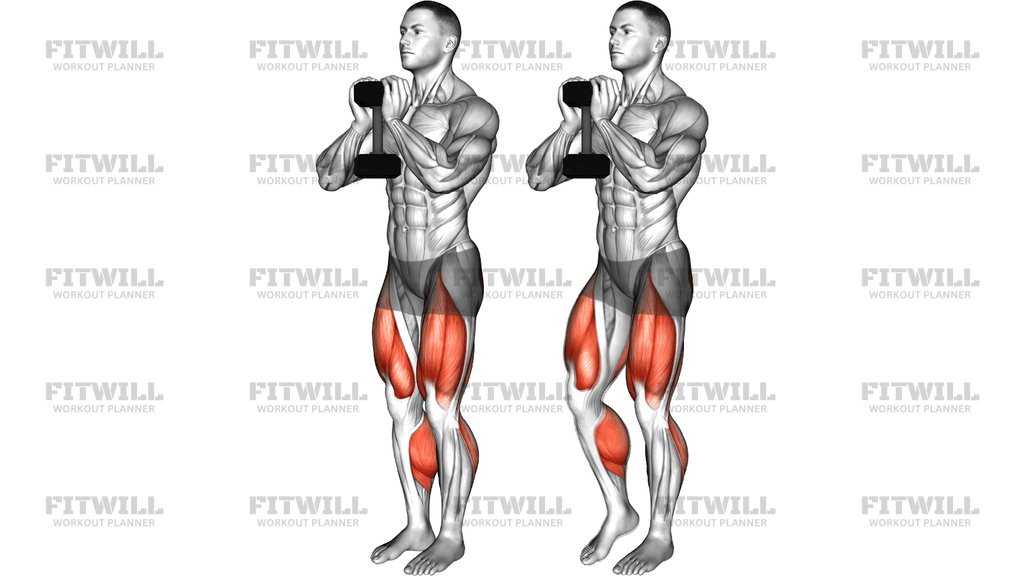
The Dumbbell Goblet Marching On Spot combines two simple ideas into one demanding exercise: holding a dumbbell in the goblet position at chest height while driving one knee up at a time, as if marching in place. The weight is cradled vertically with both hands tucked against the sternum, elbows pointing down, which turns every lifted knee into a full-body balance challenge. Each repetition asks the standing leg to produce force and stay stable while the opposite hip flexors pull the knee up toward waist height.
This movement earns its place in a workout because it trains more than just the legs. The quads and calves of the supporting leg work hard every time you shift your weight onto one foot, the hip flexors power the knee drive, and the core has to brace continuously to keep your torso upright with a load pressed against the chest. Because you stay on the spot rather than traveling, it fits well in small spaces and works nicely as a warm-up primer, a conditioning interval, or a finishing burnout after squats.
The goblet position is what makes this variation so accessible. Holding the dumbbell at the chest counterbalances a slight forward lean, which helps most people find an upright torso naturally, and the front-loaded load gives you constant feedback about posture. If the weight drifts away from your body or your shoulders round forward, you feel it immediately and can correct it mid-set.
Setup matters more than it might seem. Stand with feet about hip-width apart, squeeze the dumbbell with both hands, and keep the elbows drawn down rather than flared out wide. Shift your weight onto one leg with a soft knee, brace the abdomen as if bracing for a light punch, and only then start the knee drive. Rushing into the march without establishing that stable base is the most common cause of wobbling and leaning.
To execute well, lift one knee until the thigh is roughly parallel to the floor or slightly lower, pause for a beat at the top, then lower the foot back to the floor under control before switching legs. Keep the movement quiet: landing softly and placing the foot down deliberately beats stomping through reps. Breathe steadily throughout, inhaling on the lower and exhaling as you drive the knee up.
Choose a dumbbell you could comfortably hold at your chest for thirty to sixty seconds. The limiting factor in this exercise should be your legs and balance, not your grip or arms. If you find yourself hunching over the weight or letting the elbows creep up, drop to a lighter dumbbell and rebuild the pattern before adding load.
[ Workout Log & Planner ]
Put your next workout in Fitwill
Keep your plan and training log ready when you are.


Instructions
- Stand tall with feet hip-width apart and hold one dumbbell vertically with both hands at chest height, cupping the top head with one hand and supporting the bottom head with the other.
- Draw your elbows down so they point toward the floor and press the dumbbell lightly against your sternum rather than letting it drift forward.
- Brace your abdomen, pull your shoulders back, and set your gaze on a fixed point ahead of you to steady your balance.
- Shift your weight onto your left foot with a soft, slightly bent knee so the leg is loaded but not locked.
- Drive your right knee up until the thigh is roughly parallel to the floor, keeping your torso tall and the dumbbell anchored at the chest.
- Pause briefly at the top of the knee lift, then lower your right foot back to the floor with control, placing it quietly rather than dropping it.
- Shift your weight onto the right leg and repeat the knee drive with the left leg to complete one full repetition.
- Continue alternating legs at a steady, controlled rhythm, keeping the dumbbell in contact with your chest on every rep.
- Exhale as you drive each knee up and inhale as you lower the foot back down.
- Once you finish the set, set the dumbbell down before shaking out your legs and resetting your stance for the next set.
Tips & Tricks
- If you sway side to side, shorten the range of the knee lift slightly and think about pushing the floor away with the standing leg instead of just lifting the other knee.
- Keep the elbows pointed down the entire set. When they flare outward, the shoulders fatigue early and the dumbbell slides away from the chest, wrecking your balance.
- Do not let the standing knee lock out at the bottom. A soft knee keeps the quads engaged and protects the joint through each weight shift.
- Avoid rocking the dumbbell for momentum. If the weight is swinging, the pace is too fast; slow the tempo so the hip flexors do the lifting, not momentum.
- A common mistake is turning the march into a calf hop. Keep the standing foot flat on the floor; the heel should not rise with each knee drive.
- If you lean back as the knee comes up, exaggerate the opposite cue: tuck the ribs down slightly and feel the abs holding the torso still over the hips.
- Start with a lighter dumbbell than you would use for goblet squats. The single-leg balance demands are the real challenge here, not the load.
- Perform the exercise barefoot or in flat shoes if balance is your weak point; extra foot contact with the floor makes the weight shift easier to feel.
- Beginners can hold the goblet position with no weight or a very light dumbbell and simply master the alternating knee drive before adding load.
Frequently Asked Questions
What muscles does the Dumbbell Goblet Marching On Spot work?
The quads and calves of the supporting leg do most of the stabilizing work, while the hip flexors drive each knee upward. The core, especially the deep abdominal muscles, stays engaged throughout to keep your torso upright with the dumbbell pressed against the chest.
Is the Dumbbell Goblet Marching On Spot good for beginners?
Yes, provided you start light. The goblet hold is one of the most beginner-friendly ways to carry a weight, and the marching pattern can be practiced with no dumbbell at all until the single-leg balance feels steady.
How high should I lift my knee during the Dumbbell Goblet Marching On Spot?
Aim for the thigh to reach roughly parallel to the floor, but stop a bit lower if your torso starts to lean back or the dumbbell drifts from your chest. A slightly shorter, controlled lift beats a high lift that breaks your posture.
Why do I keep losing my balance during this exercise?
Balance usually breaks down for one of three reasons: the weight drifts away from the sternum, the standing knee is locked straight, or the reps are moving too fast. Reconnect the dumbbell to the chest, soften the standing knee, and slow the tempo.
How heavy should the dumbbell be for the Dumbbell Goblet Marching On Spot?
Pick a weight you can hold at your chest for the entire set without your upper back rounding or your elbows rising. For most people this is noticeably lighter than what they would use for goblet squats, because one leg carries all the stabilizing demand.
Can I do the Dumbbell Goblet Marching On Spot as a warm-up?
Absolutely. With a light dumbbell it raises your heart rate, activates the quads, hip flexors, and core, and rehearses single-leg stability before squats or lunges. Keep the pace moderate and the reps higher, around twenty to thirty total knee drives.
What can I substitute if I only have a kettlebell?
A kettlebell held by the horns at the chest replicates the goblet position almost exactly, so the substitution is seamless. You can also hold a single weight plate pressed between both palms if that is what you have available.
How does the Dumbbell Goblet Marching On Spot differ from a high-knee run with a weight?
The march is deliberate and controlled, with a pause at the top of each knee lift and a full foot placement on every step, while a high-knee run is rhythmic and includes flight time. The march builds balance and control; the run version is a conditioning tool.
Should my heel stay down on the standing leg?
Yes. Keep the entire standing foot, including the heel, in contact with the floor throughout the rep. Rising onto the ball of the foot turns the exercise into a calf hop and makes side-to-side wobble far more likely.
Is it safe for my knees to do this exercise?
For most people, yes, as long as the standing knee stays softly bent and tracks over the foot rather than caving inward. If a knee injury is currently painful, march with body weight only or check with a qualified professional before adding load.