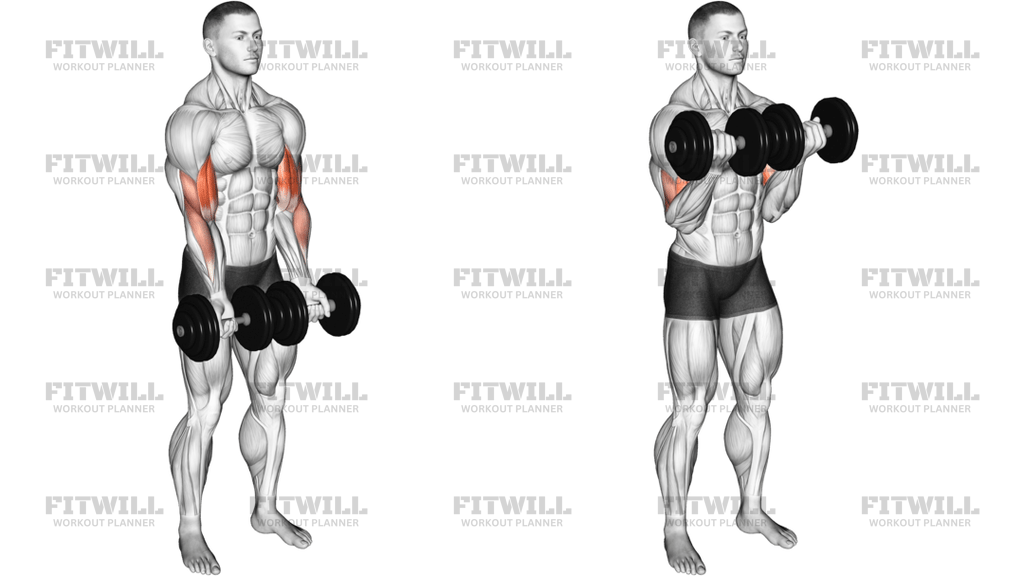
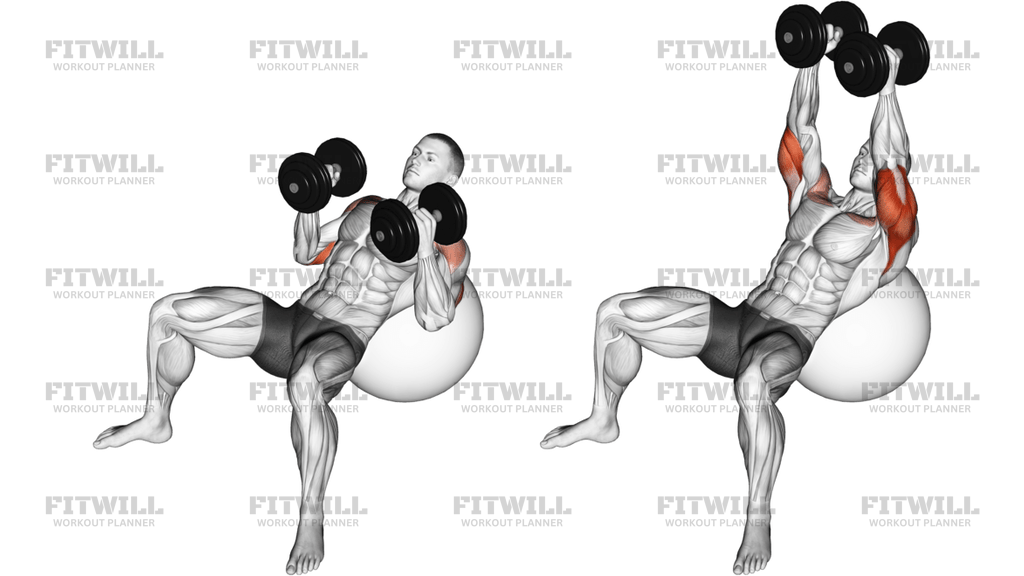
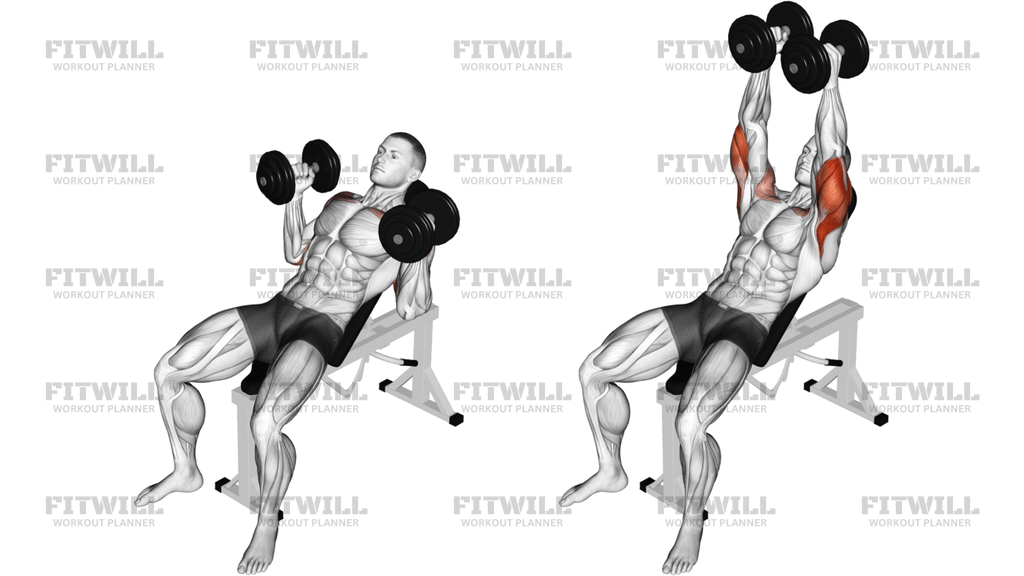
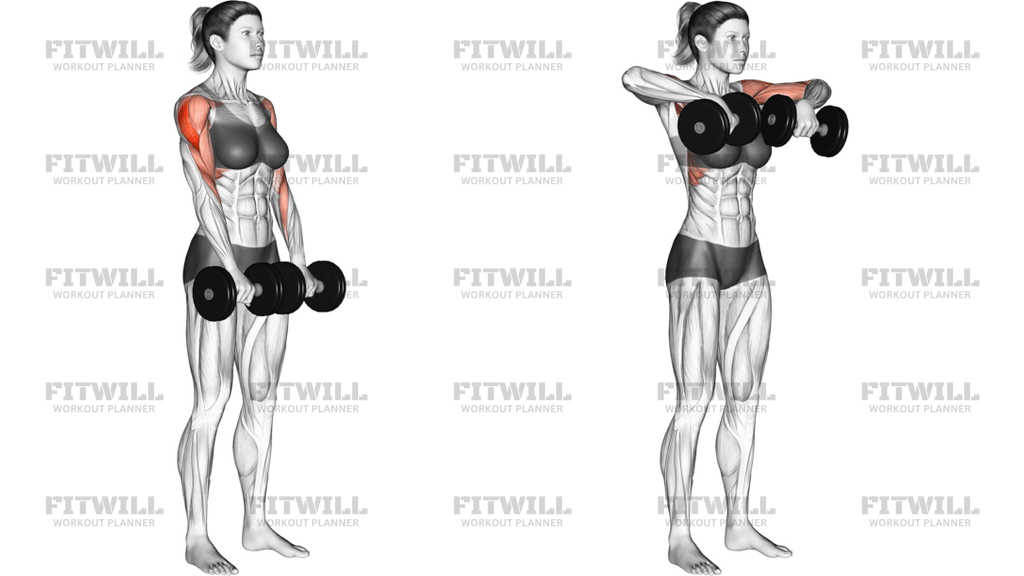
Dumbbell Standing Alternating Cross Raise
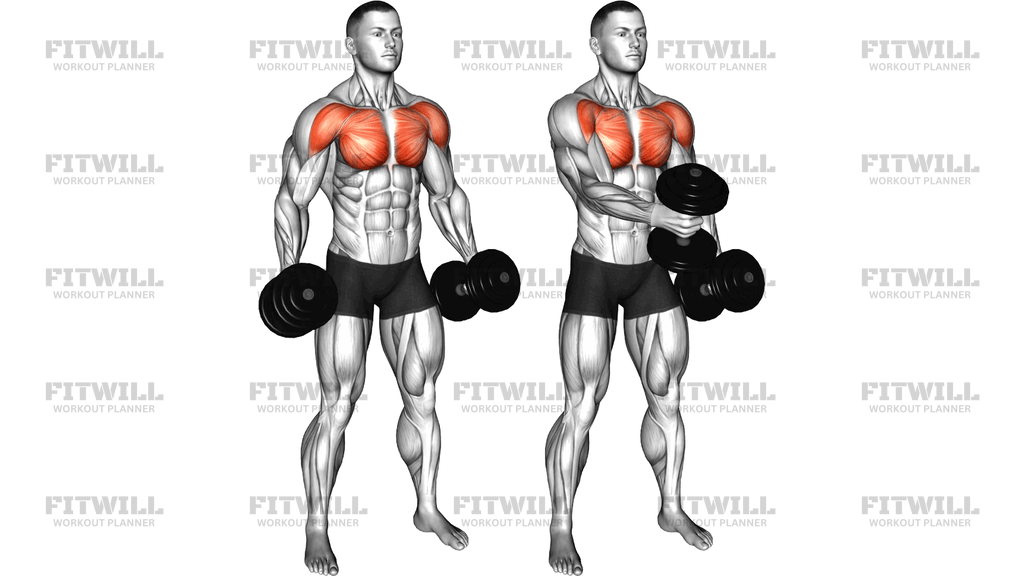
The Dumbbell Standing Alternating Cross Raise is a front raise variation where you lift one dumbbell at a time across the front of your body toward the opposite shoulder, following an upward diagonal path instead of the straight-ahead line of a standard front raise. The angled path shifts more of the work into the clavicular head of the chest — the upper chest fibers that run diagonally from the collarbone toward the arm — while the front delts still contribute heavily to the lift.
This movement suits lifters who want to emphasize the upper chest without a bench or an incline setup, and it works well as a finisher after presses or as a standalone accessory on shoulder days. Because you're standing and raising one arm at a time, your core has to resist the rotation and side-bending that the off-center weight naturally creates, so you get a modest but real anti-rotation demand on top of the shoulder work.
Setup matters more than it might seem. Stand tall with feet about hip-width apart, a dumbbell in each hand at your sides with a neutral grip, and your ribs stacked over your pelvis. If you arch your lower back or lean away from the working side, you turn a targeted raise into a momentum-driven swing, and the upper chest stops being the limiting factor. A braced trunk and a still torso are what make the cross path effective.
To perform it, raise one dumbbell up and across your body so it travels toward the opposite shoulder, keeping the arm nearly straight with a soft elbow. The dumbbell should end at roughly eye or forehead height, slightly across your midline. Pause briefly, lower along the same diagonal path with control, and then repeat with the other arm. That alternating rhythm lets each side recover slightly, which helps you keep the path clean on every rep.
Common use cases include upper-chest isolation work at home, adding variety to push days, and addressing left-right differences, since each arm works on its own and you can spot imbalances easily. Because it trains the shoulder flexion pattern at an angle most pressing doesn't cover, it pairs nicely with incline presses rather than replacing them.
For safety, choose lighter weights than you'd use for standard front raises — the crossed path gives you less mechanical advantage, and ego lifting shows up immediately as torso swing. Keep the wrist neutral and the raise pain-free; if you feel pinching at the front of the shoulder, reduce the range or the load before changing anything else.
[ Workout Log & Planner ]
Put your next workout in Fitwill
Keep your plan and training log ready when you are.


Instructions
- Stand with your feet hip-width apart, holding a dumbbell in each hand at your sides with a neutral grip, palms facing your thighs.
- Roll your shoulders back and down, brace your abdominal wall as if preparing for a light push, and keep your gaze straight ahead.
- Shift your weight evenly across both feet and stiffen your legs slightly so your torso stays still throughout the set.
- Exhale and raise the dumbbell in your right hand up and across your body toward your left shoulder, keeping your elbow slightly bent and your palm facing down or slightly inward.
- Continue along the diagonal until the dumbbell reaches about eye height, slightly past the midpoint of your body, without twisting your torso.
- Pause for a beat at the top and feel the contraction across the front of the shoulder and upper chest.
- Inhale and lower the dumbbell back down along the same diagonal path to your side without letting it drop or touch your thigh.
- Repeat the raise with the left dumbbell toward your right shoulder — that completes one full alternating rep.
- Keep alternating sides for the desired number of reps, maintaining the same torso position and the same peak height on both arms.
- At the end of the set, set both dumbbells down with control, shake out your shoulders, and reset your brace before the next set.
Tips & Tricks
- The most common mistake is swinging the dumbbell up with a hip drive or a torso lean — if your body rotates toward the lifting arm, drop the weight by a couple of kilograms until the trunk stays square.
- Think of the dumbbell moving toward the opposite shoulder's pocket, not straight up; if your arm travels in a vertical line, you've drifted into a standard front raise and lost the cross-body angle.
- Keep the wrist straight and the back of your hand in line with your forearm. Letting the wrist curl back under the dumbbell at the top shifts tension away from the chest and strains the joint.
- Control the lowering phase for two to three seconds. The eccentric is where the upper chest fibers get most of their stimulus in this exercise, and a fast drop wastes it.
- Don't raise the arm past forehead height. Going higher tends to pull the traps and upper back into the lift and can compress the front of the shoulder.
- If you feel a pinching sensation at the front of the shoulder, try turning your palm slightly upward (supinating a few degrees) as you lift, or shorten the range to chest height.
- Stand close to a mirror initially to check that your shoulders stay level — one shoulder hiking up as you raise is a sign the weight is too heavy or you're shrugging instead of lifting with the arm.
- Because the cross path is unfamiliar, start with one or two lighter warm-up sets per side before your working weight to groove the diagonal groove.
- Keep a small bend in the working elbow and hold it constant; straightening and bending the arm repeatedly turns the raise into a half front raise, half triceps movement.
Frequently Asked Questions
Which muscles does the Dumbbell Standing Alternating Cross Raise work?
The primary target is the upper chest, specifically the clavicular head of the pectoralis major, with strong assistance from the front delts. The side delts, upper traps, and core stabilizers work to control the arm and keep the torso from twisting.
Why cross the dumbbell toward the opposite shoulder instead of raising it straight up?
The upper chest fibers run diagonally from the collarbone toward the arm, so lifting across the body follows that fiber direction more closely than a vertical raise. It also adds a horizontal adduction component that a straight front raise lacks.
Is the Dumbbell Standing Alternating Cross Raise suitable for beginners?
Yes, provided the weight is kept light and the torso stays still. Beginners often benefit from it because the slow, diagonal path builds shoulder control and body awareness that transfers to pressing movements later.
How heavy should the dumbbells be for this exercise?
Use noticeably less weight than you would for standard dumbbell front raises — the crossed position shortens your leverage. A weight you can lift for 10 to 15 clean reps per side with no torso swing is a sensible starting point.
Should my elbow stay bent or straight during the cross raise?
Keep a small, fixed bend of roughly 10 to 20 degrees. Fully locking the elbow is harsh on the joint, and actively bending the arm during the rep shifts work toward the biceps and away from the chest and shoulders.
Can I do this exercise seated instead of standing?
You can, but standing is the intended setup because the trunk must stabilize against the off-center load. Seated versions remove much of that core demand, so choose standing whenever balance and lower back tolerance allow.
How is this different from a cable cross raise or crossover?
A cable version provides constant tension along the whole path, while dumbbells load the movement hardest near the top as the arm works against gravity. Dumbbells are simpler and take no setup; cables offer smoother resistance if that's available.
Where should I feel the Dumbbell Standing Alternating Cross Raise working?
You should feel it across the front of the working shoulder and the upper portion of the chest near the collarbone. Feeling it mostly in the front of the neck or traps means you're shrugging or lifting too high.
What can I substitute if I only have one dumbbell?
Simply perform the same cross-body raise holding a single dumbbell, completing all reps on one side before switching. Because the load is one-sided, brace your core extra firmly to avoid leaning away from the weight.
Are there any safety concerns with this movement?
The main risks are shoulder impingement from lifting too high or too heavy, and lower back strain from arching to swing the weight up. Stay below eye height, control the descent, and stop if you feel sharp pinching at the front of the shoulder.