Dumbbell Good Morning (Version 2)
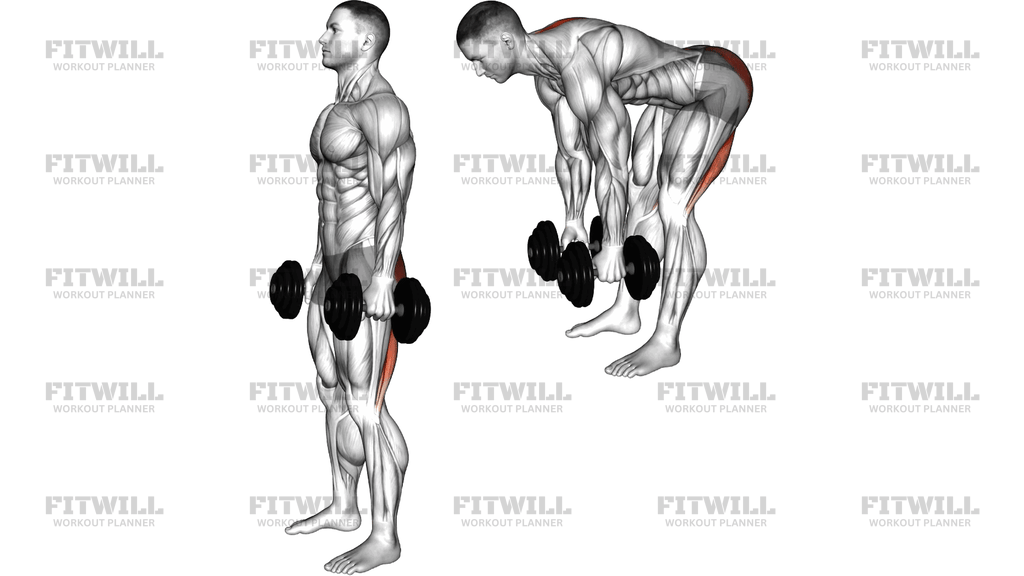
The Dumbbell Good Morning (Version 2) is a hip hinge performed with a dumbbell in each hand, held at your sides at arm's length rather than resting on your shoulders. From a tall standing position, you push your hips back and fold your torso forward until it approaches parallel with the floor, then drive through your heels to stand back up. Because the weight hangs from your arms instead of sitting on your traps, the lever arm changes and the load on your spine feels different from the barbell version, which makes this a useful variation for lifters who want the hinge pattern without a bar across their back.
The movement primarily trains the erector spinae along the lower back, which works hard to keep your spine neutral as your torso tilts forward. Your hamstrings and glutes act as the main engines of the hinge, stretching under load as you descend and contracting to bring you upright. Holding dumbbells at your sides also challenges your grip, your mid-back, and the stabilizers around your shoulder blades, since they must keep the weights tracking smoothly beside your legs throughout the rep.
Setup matters more here than in most hinge variations. With the dumbbells hanging free, any sway in your arms or rounding in your upper back lets the weights drift forward, lengthening the lever and loading your lumbar spine in a weaker position. A braced core, retracted shoulder blades, and a deliberate push of the hips back keep the dumbbells close to your legs and the stress on the muscles you are actually trying to train.
This version suits lifters who find the barbell placement uncomfortable, home gym users working with dumbbells only, and anyone using the good morning as a lower-load teaching tool for the hip hinge before progressing to heavier barbell work. It is also a sensible choice for lifters who want extra hamstring and lower back volume after deadlifts without maxing out spinal compression.
To execute it well, move slowly and think of the descent as a backward weight shift, not a forward bend. Your knees should soften slightly but stay mostly still, your chest should travel forward over your toes, and your hips should travel backward. Stop at the point where your torso is just above parallel or your hamstrings signal a strong stretch, then squeeze your glutes to return. The range does not need to be extreme; a controlled hinge to a comfortable depth beats forcing depth with a rounded back every time.
Treat this as a moderate-load, higher-control exercise. Because the lower back fatigues faster than the hamstrings, keep reps in the eight to fifteen range, stop the set when your torso position starts to change, and build weight gradually over weeks rather than sessions.
[ Workout Log & Planner ]
Put your next workout in Fitwill
Keep your plan and training log ready when you are.


Instructions
- Stand with your feet about hip-width apart, toes pointing forward, with a dumbbell in each hand held at your sides at full arm's length, palms facing your thighs.
- Set your posture tall: squeeze your shoulder blades gently together, lift your chest, and stack your ribs over your hips so your spine starts in a neutral position.
- Brace your core as if preparing for a light punch to the stomach, and keep that brace active for the entire rep.
- Soften your knees slightly, then push your hips straight back behind you, letting your torso tilt forward while the dumbbells slide down along the front of your thighs and shins.
- Keep the dumbbells in close to your legs the whole way down; if they swing away from your body, your hips are not shifting back far enough.
- Hinge until your torso is just above parallel with the floor or until you feel a strong stretch in your hamstrings, whichever comes first, with your back staying flat.
- Drive your hips forward and press your feet into the floor, squeezing your glutes to bring your torso back up to a full standing position.
- Exhale as you stand up, then inhale and re-brace at the top before starting the next rep.
- Finish each set by standing fully upright, setting the dumbbells down on the floor with a bend at your hips and knees rather than rounding over to reach them.
Tips & Tricks
- The most common fault is turning the hinge into a squat: if your knees travel forward and your heels lift, reset and exaggerate the backward hip shift until you feel your hamstrings load.
- Watch for the dumbbells drifting away from your legs as you descend. That drift lengthens the lever and strains your lower back, so cue yourself to 'zip' the weights up and down your shins.
- If your upper back rounds at the bottom, reduce the range before reducing the weight. A short, flat-backed hinge builds the position; a deep, rounded one does not.
- Keep a slight bend in the knees the entire time. Locking the knees straight shifts all the stretch into the hamstrings and the back of the knee joint rather than sharing it with the glutes.
- Start lighter than you think you need. The hanging dumbbell position makes the weight feel manageable at the top but demanding at the bottom of the hinge.
- Film yourself from the side once in a while. From the front or without feedback, a subtle lumbar round at the bottom is almost impossible to feel.
- Use lifting straps for heavy sets if your grip gives out before your hamstrings do, so a failing grip does not pull your shoulders forward mid-rep.
- Place the exercise early in your session while your lower back is fresh, or pair it with rows and pull-ups rather than immediately after heavy deadlifts.
- Breathe in at the top, hold that brace through the descent, and exhale on the way up. Re-breathing mid-hinge tends to deflate your torso position.
Frequently Asked Questions
Which muscles does the Dumbbell Good Morning (Version 2) work the most?
The lower back erector spinae work hardest to hold your spine neutral, while the hamstrings and glutes power the hinge up and down. Your upper back and grip also contribute because the dumbbells hang from your arms throughout.
How is Version 2 different from a regular Dumbbell Good Morning?
In this version the dumbbells are held at your sides at arm's length, similar to the bottom of a deadlift setup, instead of being supported on your shoulders or upper back. This shortens the load on your spine but demands more from your grip and shoulder stabilizers.
Is the Dumbbell Good Morning (Version 2) safe for beginners?
Yes, with light dumbbells and a short range, it is actually a good way to learn the hip hinge pattern. Beginners should master the setup position and a bodyweight hinge first, then add weight only when their back stays flat through every rep.
How deep should I hinge during the Dumbbell Good Morning (Version 2)?
Aim for a torso angle just above parallel with the floor, or stop earlier if your hamstrings reach a strong stretch or your back starts to round. Depth beyond that point adds spinal stress without much extra hamstring benefit.
Why do my dumbbells swing away from my legs during the rep?
That usually means your hips are dropping or shifting forward instead of pushing straight back, so your torso is bending rather than hinging. Slow down, re-brace at the top, and deliberately load your heels before each descent.
Can I substitute the Dumbbell Good Morning (Version 2) with Romanian deadlifts?
Romanian deadlifts are a close substitute and train the same hinge pattern with a similar hamstring stretch. The dumbbell version keeps the load lower on the body and is often easier on the shoulders, making the two a useful pairing rather than strict replacements.
How heavy should the dumbbells be for this exercise?
Choose a weight you can control for ten to fifteen reps with a flat back at the bottom of every rep. Because the hanging position changes leverage at the bottom, progress in small increments rather than jumping up sharply.
Should my knees stay straight during the Dumbbell Good Morning (Version 2)?
Keep a soft, slight bend in the knees but do not let them travel forward. The movement is a hip hinge, so nearly all of the motion comes from your hips, not your knees.
Where should I feel the stretch during this exercise?
You should feel a clear stretch across the backs of your thighs at the bottom of the hinge, with your lower back working but never straining. If your lower back feels the stretch instead of your hamstrings, your spine has likely rounded and you should shorten the range.