Cable Seated Overhand Grip Rear Delt Fly With Che
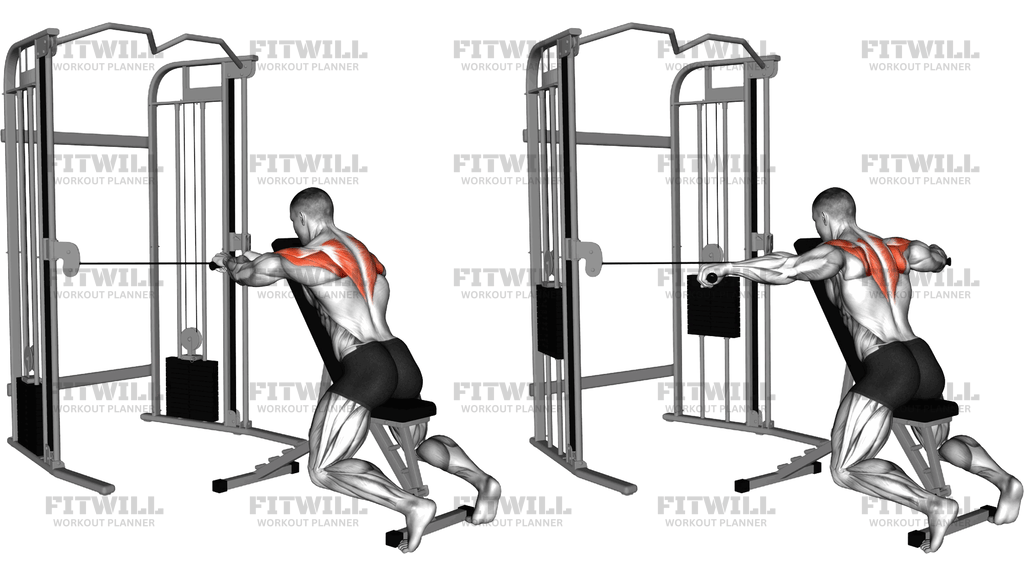
Cable Seated Overhand Grip Rear Delt Fly With Chest Support is a rear shoulder isolation exercise performed on a dual-pulley cable station. You sit astride a bench with a chest pad in front of you, reach forward to grab the handle from the opposite side with an overhand grip so the cables cross in front of your body, then sweep your arms out and back until they line up roughly with your shoulders. The chest pad keeps your torso upright and fixed, which takes your lower back and momentum almost entirely out of the movement.
The main work falls on the rear delts, with the mid traps and rhomboids assisting as the shoulder blades draw together near the end of each rep. Because the cables provide tension pulling forward and slightly down, the rear delts stay loaded even when your arms are extended in front of you — something dumbbell rear delt flys cannot do. That continuous tension is the biggest reason lifters choose this version when they want to actually feel the rear delts working instead of just moving weight.
This setup suits anyone whose front delts get plenty of work from pressing but whose rear delts lag behind, which is one of the most common imbalances in regular gym training. It is also a good option for people who feel bent-over rear delt flys in their lower back, since the chest support removes the need to hold a hinged position. Powerlifters and desk workers alike tend to benefit from the extra horizontal pulling and scapular retraction this movement encourages.
Setup matters more here than in most isolation work. The pulleys should be set at a low to mid height so the cables run roughly parallel to the floor when your arms are extended, and you need to grab the opposite handle rather than the one on your own side — that cross-body path is what lets the arms travel out wide instead of just pulling straight back. Sit far enough forward that your chest is firmly on the pad with a slight forward lean, and keep the bench stable under you.
To execute it well, start with your arms extended forward and a light bend in the elbows. Lead the outward sweep with your elbows, keeping the arms high and the wrists neutral, and stop when your hands are level with or just behind your shoulders. Pause briefly, then let the arms travel back forward under control so the cables pull the shoulder blades apart again. The rep should look like the letter T viewed from above, not like a row.
Keep the weight modest. This is a small muscle moving a light load through a long lever arm, and heavy weights almost always turn the fly into a rowing motion, which defeats the purpose. Two to four sets of twelve to twenty reps at the end of a shoulder or upper back session is a practical placement.
[ Workout Log & Planner ]
Put your next workout in Fitwill
Keep your plan and training log ready when you are.


Instructions
- Set both pulleys of the cable crossover to a low or mid-low position and attach a single handle to each side.
- Sit astride a flat bench facing the machine so your chest rests against the upright chest pad, with a slight forward lean into it.
- Reach forward and grab the handle on the opposite side with each hand, palms facing down in an overhand grip, so the cables cross in front of your torso.
- Extend your arms forward until they are roughly parallel to the floor, elbows slightly bent, and let the cables pull your shoulder blades apart.
- Brace your core and press your chest firmly into the pad so your torso stays still throughout the set.
- Sweep both arms out to the sides in a wide arc, leading with the elbows, until your hands are level with or slightly behind your shoulders.
- Hold the open position for a beat and squeeze your shoulder blades together without shrugging up toward your ears.
- Slowly return your arms forward along the same arc until the cables draw your shoulder blades apart again.
- Exhale as you sweep the arms out, inhale as you bring them back forward.
- Complete your reps, then release one handle at a time and stand up carefully, as the cables will pull the free handles back toward the stacks.
Tips & Tricks
- If you feel this in your biceps or forearms, the weight is too heavy — the elbow bend increases and the fly turns into a row as soon as the load gets ambitious.
- Grab the opposite-side handles, not the ones on your own side; the same-side grip shortens the arc and makes the movement feel cramped and awkward.
- Keep your chest glued to the pad. If your torso rocks backward as the arms open, you are using your body weight instead of your rear delts.
- Stop the outward sweep when your hands reach shoulder line. Pushing far behind you shifts work into the traps and irritates the shoulder capsule.
- Keep your thumbs level with or slightly higher than your pinkies... a neutral-to-slightly-raised wrist position keeps the rear delts in their strongest line.
- Do not shrug. If your shoulders creep toward your ears at the end of each rep, consciously pull them down and back before starting the next rep.
- A one-second pause at the widest point is worth more here than extra weight, because the rear delts respond to the squeeze, not momentum.
- Set the pulleys low enough that the cables run under your arms, not above them; cables pulling downward change the resistance angle and pull the hands toward the floor.
- Let your shoulder blades spread apart fully at the start of each rep — beginning the sweep from a protracted position gives the rear delts a longer working range.
Frequently Asked Questions
Which muscles does Cable Seated Overhand Grip Rear Delt Fly With Chest Support work?
The rear delts do the bulk of the work, with the middle traps and rhomboids assisting as the shoulder blades retract. Smaller stabilizers around the shoulder joint help control the wide arc.
Why grab the opposite-side handles instead of the ones directly in front of me?
Crossing the cables lets your arms travel through a much wider arc to the sides, which is what a rear delt fly requires. A same-side grip turns the movement into a pull toward your torso rather than an outward fly.
Is this exercise good for beginners?
Yes, as long as the weight stays light. The chest pad makes it one of the more forgiving rear delt exercises because it removes the balance and lower back demands of bent-over versions, so beginners can focus purely on the arm movement.
How is this different from a bent-over dumbbell rear delt fly?
The cables keep constant tension on the rear delts even when your arms are extended forward, while dumbbells only load the movement against gravity. The chest pad also removes the need to hold a hinged torso position.
What height should I set the pulleys at?
Low to mid-low, so the cables run close to parallel with the floor when your arms are extended in front of you. If the pulleys are too high, the cables pull your hands downward and fight the fly instead of resisting it.
Why do I feel Cable Seated Overhand Grip Rear Delt Fly With Chest Support in my traps?
You are likely shrugging as your arms open, or swinging the weight up with momentum. Drop the weight, consciously keep your shoulders pulled down, and stop the sweep once your hands reach shoulder height.
Can I do this exercise without a crossover machine?
You can recreate it with a resistance band anchored at low height, seated in front of a bench or the end of an incline bench. A dumbbell chest-supported rear delt fly on an incline bench is another close substitute.
How heavy should I go on this movement?
Treat it as an isolation exercise: a weight you can control for twelve to twenty strict reps. If your elbows bend more and your torso pulls off the pad, the load has exceeded what the rear delts can handle.
Where should I put this exercise in my workout?
It works well near the end of a shoulder or upper back day, after your heavier presses or rows. Pre-fatiguing the rear delts with it first can also improve your feel for the muscle during subsequent rowing work.
Is it safe for my shoulders?
For most people, yes, provided the range stops at shoulder height and the weight is moderate. If you have a current shoulder injury or the movement causes pinching at the front of the shoulder, reduce the range or check with a qualified professional before continuing.