Sitting Lotus Pose Twist
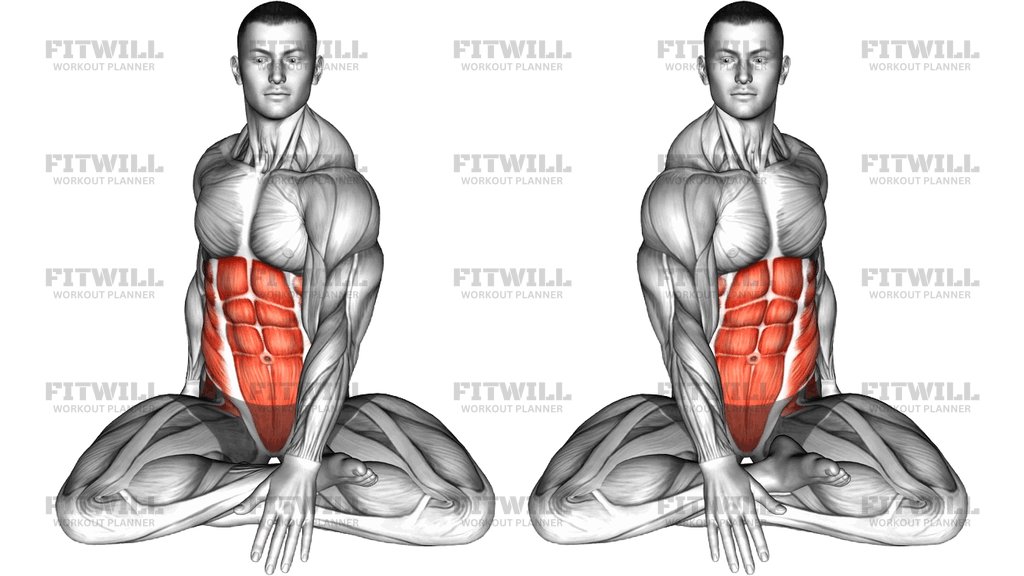
The Sitting Lotus Pose Twist is a seated rotational stretch performed from a cross-legged lotus position. You sit tall on the floor with your legs folded and feet resting on the opposite thighs, then rotate your upper body slowly from side to side, letting your hands guide the turn. The abdominals light up in the illustration because they are the muscles controlling and resisting the rotation, while the hips and outer thighs stay under a steady stretch from the folded leg position.
This movement works two jobs at once. The crossed legs open the hips, stretch the inner thighs and outer hips, and encourage the knees to settle toward the floor. The torso rotation mobilizes the spine and challenges the abs and obliques to control the turn rather than letting momentum swing you around. Because nothing external is moving, every degree of rotation comes from your own trunk, which makes it a clean way to feel where your rotational range actually ends.
It suits people who sit for long hours, anyone warming up for training that involves rotation or bending, and yoga practitioners building toward deeper seated postures. It is also a useful cooldown after lower body work, since the hip opening and gentle spinal rotation help the legs and trunk relax together. If full lotus is beyond your current hip mobility, a half-lotus or simple cross-legged seat is a fine substitute and the twist works the same way.
Setup matters here more than in most stretches. If your sit bones are not grounded and your spine is rounded, the rotation happens through a bent lower back instead of the waist, which reduces the benefit and can feel pinching rather than opening. Sitting on the edge of a folded towel or thin cushion to lift the hips slightly is an easy fix that lets the spine stack before you turn.
To execute it well, hinge nothing and lean nothing. Grow tall through the crown of your head, soften your shoulders, and rotate from the ribs and waist with your hands resting lightly on your knees as reference points, not levers. Move with your breath: turn as you exhale, hold briefly, and come back through center before switching sides. Small, repeated rotations beat one big forced twist.
Keep the movement pain-free at all times. Mild stretch in the hips, waist, and along the spine is the goal; sharp sensation in the knees, ankles, or lower back means you should ease out of the position or widen your leg setup. As with any seated floor stretch, come out slowly rather than bouncing out of the twist.
[ Workout Log & Planner ]
Put your next workout in Fitwill
Keep your plan and training log ready when you are.


Instructions
- Sit on the floor or an exercise mat and fold your legs into lotus, placing each foot on top of the opposite thigh with your knees dropping toward the floor.
- Rest your hands palm-down on your knees and settle your sit bones evenly into the floor so your weight feels balanced left to right.
- Lengthen your spine as if the crown of your head is being lifted, relax your shoulders down, and take a slow breath in through your nose.
- As you exhale, rotate your upper body slowly to the right, keeping your hands resting on your knees rather than pushing against them.
- Continue the turn until you feel a firm but comfortable stretch through your waist and the sides of your ribcage, and hold for two to three breaths.
- Rotate back through center without letting your torso slump, then repeat the same rotation two to three times on the right side.
- Switch to the left side and repeat the same number of slow rotations, keeping the range equal on both sides.
- Breathe steadily the whole time, exhaling as you turn and inhaling as you return through center.
- After the final repetition, return to facing forward, gently release your legs one at a time, and shake them out before standing.
- If your knees sit well above your hips and your back rounds, reseat yourself on a folded towel or low cushion and restart the twist from a taller position.
Tips & Tricks
- If your knees float far off the floor in lotus, do not force them down; the twist still works from a half-lotus or simple cross-legged seat.
- A common mistake is pushing hard on the front knee with the trailing hand to gain rotation. This wrenches the shoulder and steals the work from your waist, so keep the hands as light contact points only.
- Watch for the chest collapsing as you rotate. If your sternum drops, the turn is coming from a rounded upper back; reset tall first, then turn.
- Keep both sit bones glued to the floor. If one hip lifts as you twist, you have gone past your true rotational range and are tilting instead of rotating.
- Move at the pace of your exhale. Rushing the turn turns this into a momentum swing and the abs stop controlling the range.
- Stop short of the sticky point rather than grinding into it. Repeated comfortable rotations improve range more safely than one forced end-range hold.
- If you feel pinching in the front of the ankle or knee during the hold, come out, change which leg is on top, and rebuild the position gradually.
- Warm hips twist better than cold ones, so a few minutes of easy walking or gentle hip circles before this stretch makes the seated position far more comfortable.
- Keep your neck in line with your chest rather than cranking the chin over your shoulder; the eyes can lead the turn while the head stays neutral.
Frequently Asked Questions
What muscles does the Sitting Lotus Pose Twist work?
The abs, especially the rectus abdominis and obliques, control and resist the rotation, while the hips, inner thighs, and outer hips receive the main stretch from the crossed-leg position. The muscles along the spine work lightly to keep you tall as you turn.
Is the Sitting Lotus Pose Twist good for beginners?
Yes, provided you swap full lotus for a simple cross-legged seat if your hips are tight. Beginners should keep the rotation small and prioritize a tall spine over twist depth.
Should my hands push against my knees during the Sitting Lotus Pose Twist?
No. Hands rest on the knees as light contact points, and the rotation should come from your waist and ribs. Pushing hard transfers tension into the shoulders and reduces the work your core is doing.
Why do my knees stay high off the floor in this pose?
Tight hips and inner thighs usually hold the knees up, which is common for people who sit a lot. Sit on a folded towel or low cushion to tilt the pelvis upright, and let the knees lower gradually over weeks of practice rather than forcing them down.
Can I do the Sitting Lotus Pose Twist if full lotus hurts my knees?
Yes. Use half-lotus or a simple cross-legged position with the shins crossed on the floor; the torso rotation and its core benefit stay the same. Never push through knee pain to achieve the full foot placement.
How long should I hold each rotation?
Two to three slow breaths per side is a practical starting point, and you can repeat the rotation two to three times per side. Consistency matters more than long end-range holds.
Is this better as a warm-up or a cooldown?
It works well for both. As a warm-up it mobilizes the spine and hips before training, and as a cooldown it lets the legs and trunk release after lower body work. Keep the intensity lower when using it before heavier exercise.
My lower back rounds when I twist. How do I fix that?
Elevate your hips on a cushion so your knees sit below hip level, and reduce how far you rotate. The turn should come from the waist and ribs while the lower back stays neutral.
Can I hold my breath during the twist to go deeper?
No. Holding your breath increases tension and makes the rotation feel strained. Exhale as you turn, which naturally lets the ribs and waist release a little further.