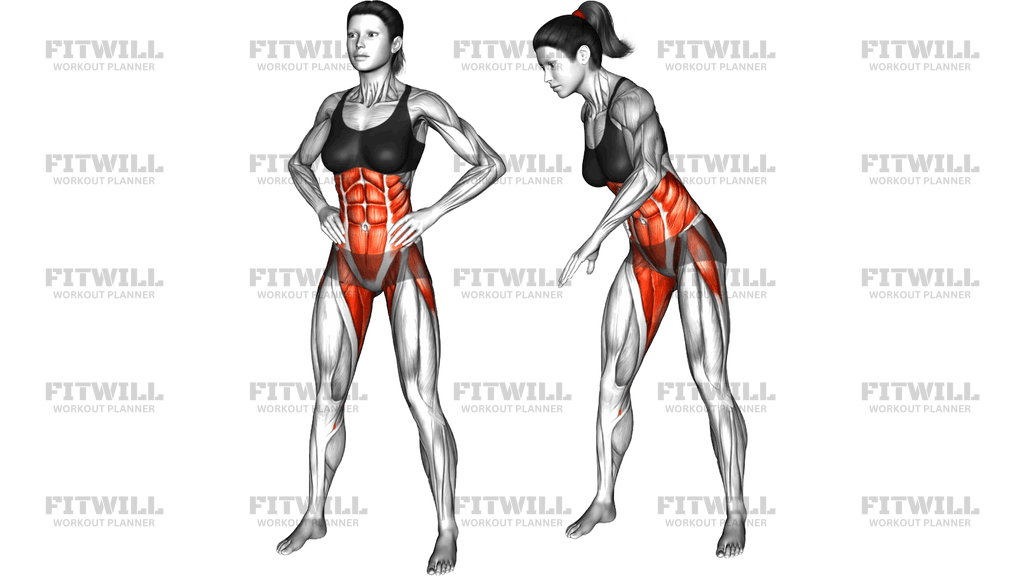
Back Kick Heel Touches
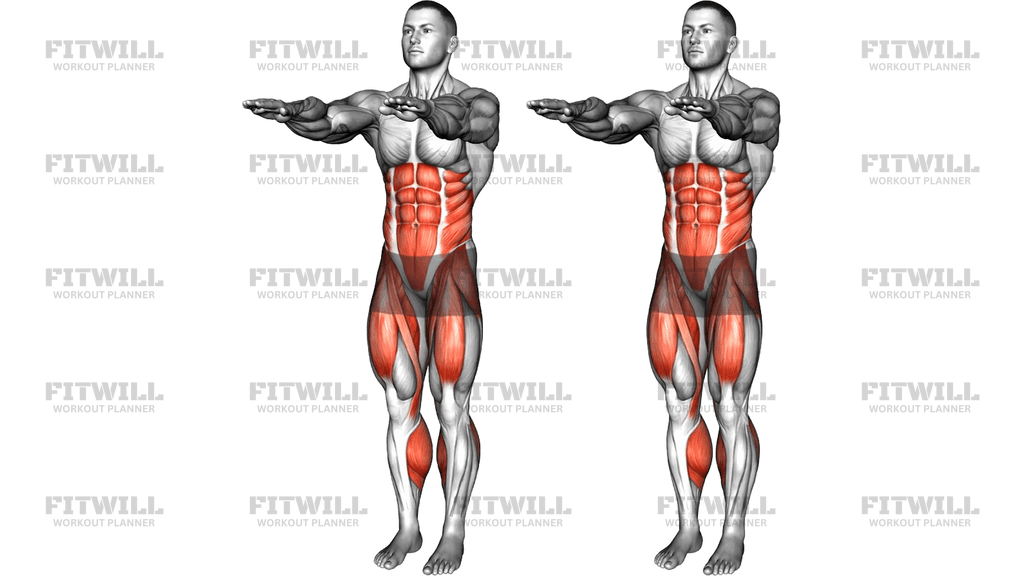
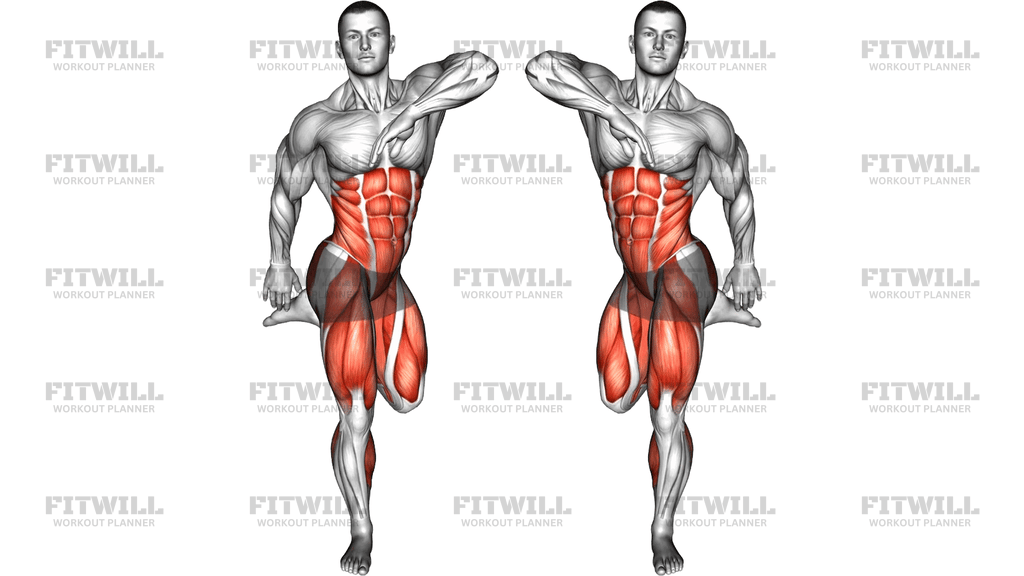
Back Kick Heel Touches are a standing core exercise that combines a single-leg balance hold with a kick-back leg position and a reach-back heel tap. You stand tall on one leg, sweep the other foot back behind you with the knee bent so the heel lifts toward your glute, then reach the same-side or opposite hand down and back to tap that heel while your torso folds slightly forward. The working abdominals light up through the crunch portion of the move, while the standing leg and hips handle the balance demand.
This movement works best as a body-weight core exercise that also trains coordination. The abdominal muscles contract as you compress the torso toward the kicked-back heel, the obliques assist as the ribcage rotates and side-bends toward the reach, and the glute of the lifted leg holds the foot up behind you. Meanwhile the standing leg's quads, hamstrings, and ankle stabilizers work overtime to keep you from wobbling, which is why many people feel this in their legs almost as much as their waist.
Because it requires no equipment and very little floor space, Back Kick Heel Touches fit easily into warm-ups, home workouts, circuit training, or active recovery days. They are especially useful for people who spend most of their core training lying down and want a functional alternative that teaches the abs to work while standing and balancing. Athletes in running, martial arts, and field sports appreciate the carryover, since the position mirrors the single-leg stance and hip extension those sports demand.
Setup matters more here than in most floor ab work. Your stance width, torso angle, and where you place your free hand all determine whether you get a clean abdominal crunch or an awkward lurch. Stand near a wall or sturdy object at first if your balance is a limiting factor, and keep the movement slow enough that you can feel your abs doing the folding rather than momentum swinging you around.
To execute the movement well, shift your weight fully onto one foot before the other leg leaves the floor, kick that foot straight back with the knee pointing down, and let the heel rise behind you. Bend slightly forward from the hips rather than rounding your lower back, reach the hand down and back to tap the heel, squeeze the abdominals at the closest point, then lengthen back to standing under control. Breathe out on the crunch and in as you return.
The most common fault is rushing. When people flick the leg back and slap at the heel, the abs barely work and the balance falls apart. Treat every rep as a deliberate two-part action — kick and reach, then extend and stand tall — and the exercise becomes far more demanding than it looks.
[ Workout Log & Planner ]
Put your next workout in Fitwill
Keep your plan and training log ready when you are.


Instructions
- Stand tall with your feet hip-width apart and your arms relaxed at your sides, core braced and gaze fixed on a point straight ahead.
- Shift your weight completely onto your right foot, pressing the ball of the foot into the floor to create a stable base.
- Sweep your left foot straight back behind you, bending the knee so the heel lifts up toward your glute with the toes pointing down.
- Allow your torso to hinge slightly forward from the hips while keeping your chest open and your lower back in a neutral arch.
- Reach your left hand down and back toward the lifted heel, compressing your abdominals as your hand makes contact with the heel.
- Hold the touched position for a brief moment, feeling the abs and obliques squeeze as you balance on the standing leg.
- Reverse the motion under control: release the reach, extend the left leg back down, and return to a tall two-foot stance.
- Exhale as you kick back and reach for the heel, inhale as you return to standing.
- Complete your reps on the left leg and left hand, then switch to the right leg reaching with the right hand for the same number of reps.
- Reset your stance and brace between reps if your balance drifts, rather than rushing into the next kick off-center.
Tips & Tricks
- If you wobble badly on the standing leg, hover a hand near a wall or chair back for light support and reduce the support over time instead of shortening the kick.
- Point the knee of the kicking leg toward the floor rather than out to the side; an externally rotated leg changes the crunch angle and pulls your torso into a twist you cannot control.
- Keep the heel close to your glute. A long, extended leg behind you turns this into a balance drill and removes the abdominal compression that makes the heel touch effective.
- Hinge from the hips, not the mid-back. If you round your lower back to reach the heel, your abs lose tension and your spine takes the load instead.
- Slow the return phase down. Most people snap back to standing quickly, which lets momentum do the work the obliques should be handling.
- Keep a soft knee on the standing leg. Locking it out makes the ankle rigid and actually makes balancing harder, not easier.
- If your hand cannot reach the heel without collapsing your posture, shorten the range and tap the ankle or calf until your flexibility and balance improve.
- Fix your eyes on a single spot at eye level for the whole set. Vision drift is one of the fastest ways to lose single-leg balance in this position.
- Do this exercise early in a workout, before heavy leg training fatigues the stabilizers of the standing leg.
Frequently Asked Questions
What muscles do Back Kick Heel Touches work?
The abdominals, especially the rectus abdominis, do the main crunching work, with the obliques assisting as you fold toward the heel. The glute of the lifted leg holds the kick-back position, while the standing leg's quads, hamstrings, and ankle stabilizers manage the balance.
Are Back Kick Heel Touches suitable for beginners?
Yes, because they are body-weight only and easily scaled. Beginners can stand beside a wall, reduce the kick height, and tap the ankle instead of the heel until balance and control improve.
Should I reach with the same-side hand or the opposite hand to touch the heel?
The standard version shown uses the same-side hand reaching down and back to the heel, which keeps the torso folding in line with the leg. Reaching with the opposite hand adds rotation and shifts more work to the obliques, so both are valid but they are slightly different exercises.
Why do I feel Back Kick Heel Touches in my standing leg more than my abs?
Single-leg balance challenges the standing leg's stabilizers hard, so fatigue there can mask the abdominal work. Slow the tempo, hold the kicked position longer, and focus on squeezing the abs at the heel contact point to shift the emphasis back to your core.
How many reps and sets of Back Kick Heel Touches should I do?
Start with 8 to 12 controlled touches per side for 2 to 3 sets. Prioritize clean balance and a deliberate abdominal squeeze over speed or rep count.
What is the most common mistake in this exercise?
Rushing the kick and slap at the heel, which turns the movement into an uncontrolled swing. Kicking the leg straight back with the knee down, hinging from the hips, and pausing at the touch keep the abs in charge.
Can I use Back Kick Heel Touches as a warm-up?
Yes, they work well as a movement preparation drill because they wake up the core, hips, and ankle stabilizers together. Use fewer reps at an easier range before a lower-body or running session.
What can I substitute if single-leg balance is too difficult?
Standing cross-body crunches with both feet closer to the floor, or standing knee-to-elbow crunches while holding a wall, train a similar core pattern with less balance demand. You can also perform the same kick-back and heel touch with the toes of the kicking leg lightly resting on the floor.
Is it safe for my lower back?
For most people, yes, as long as you hinge from the hips and keep the lower back neutral instead of rounding aggressively to chase the heel. If standing balance work or forward folding causes discomfort, stop and choose a supported core exercise instead.