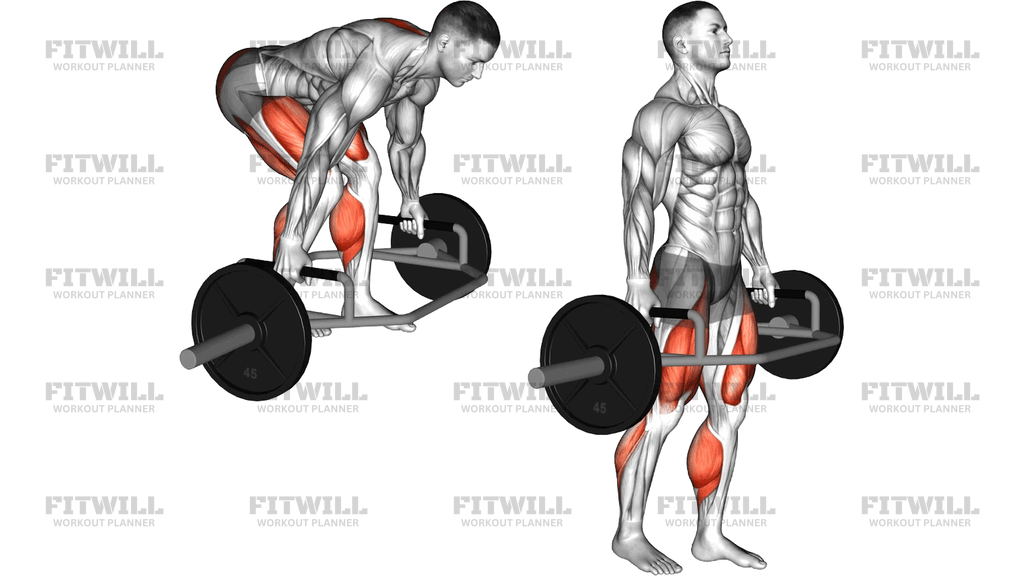
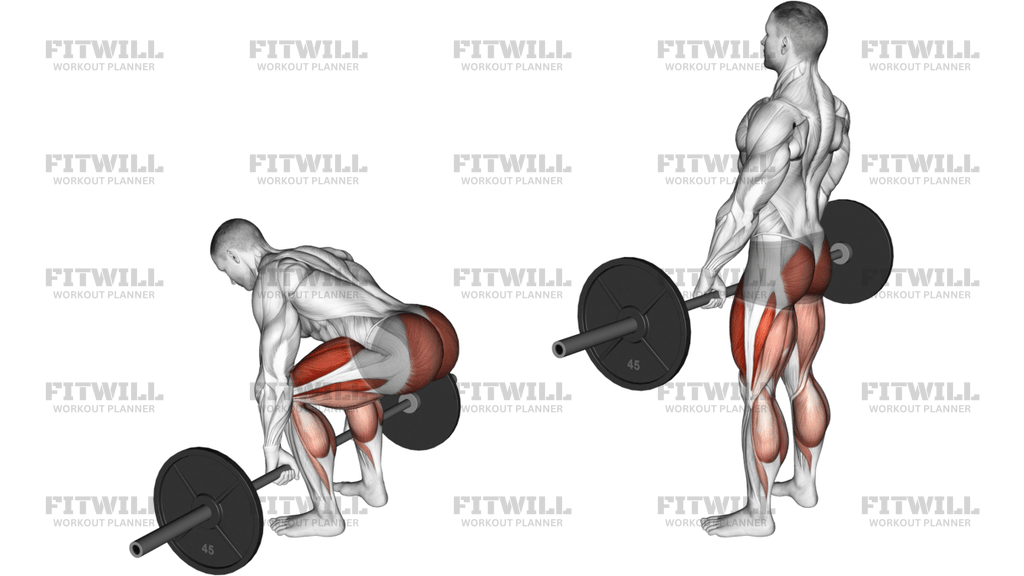
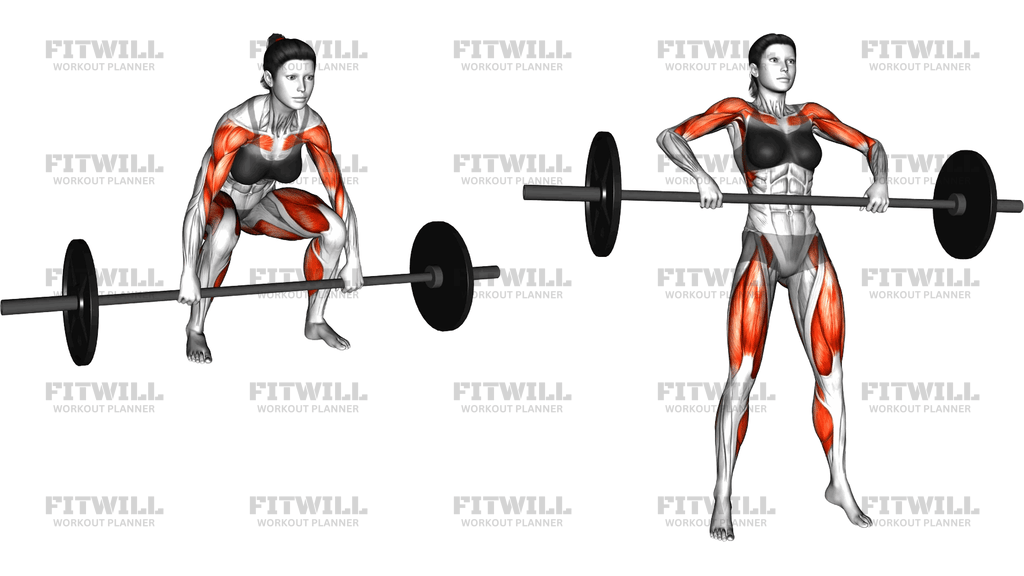
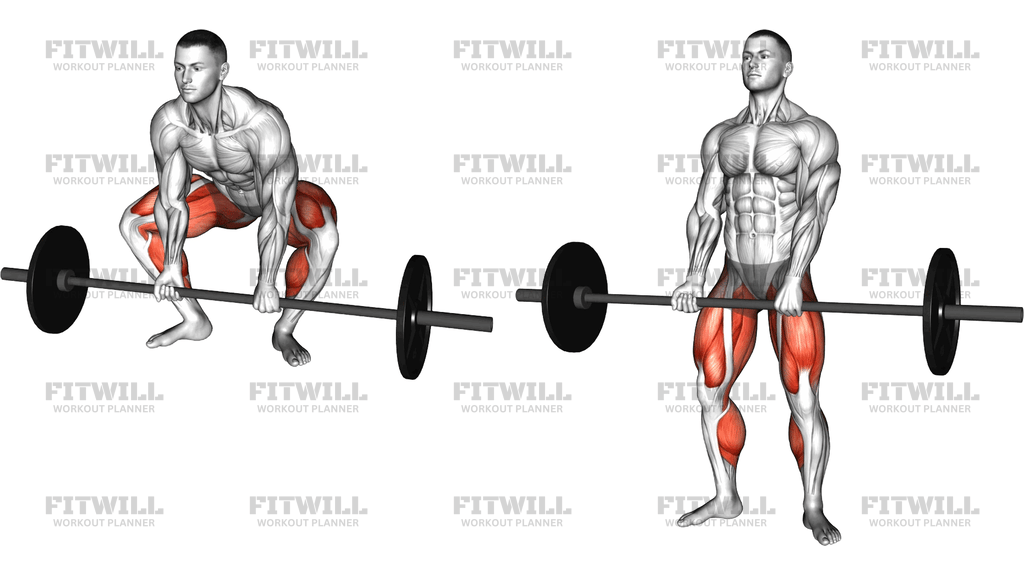
Trap Bar Romanian Deadlift From Deficit
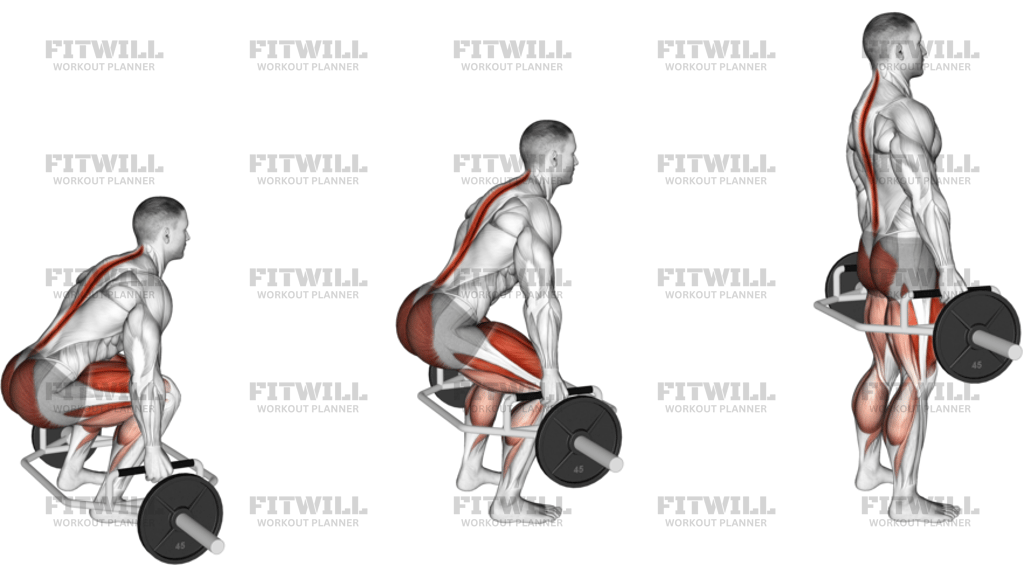
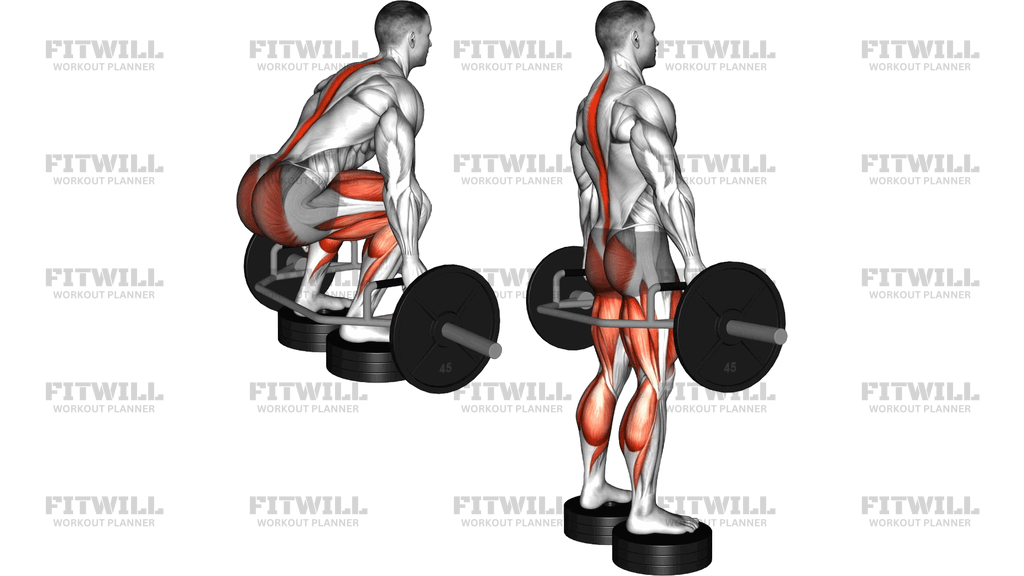
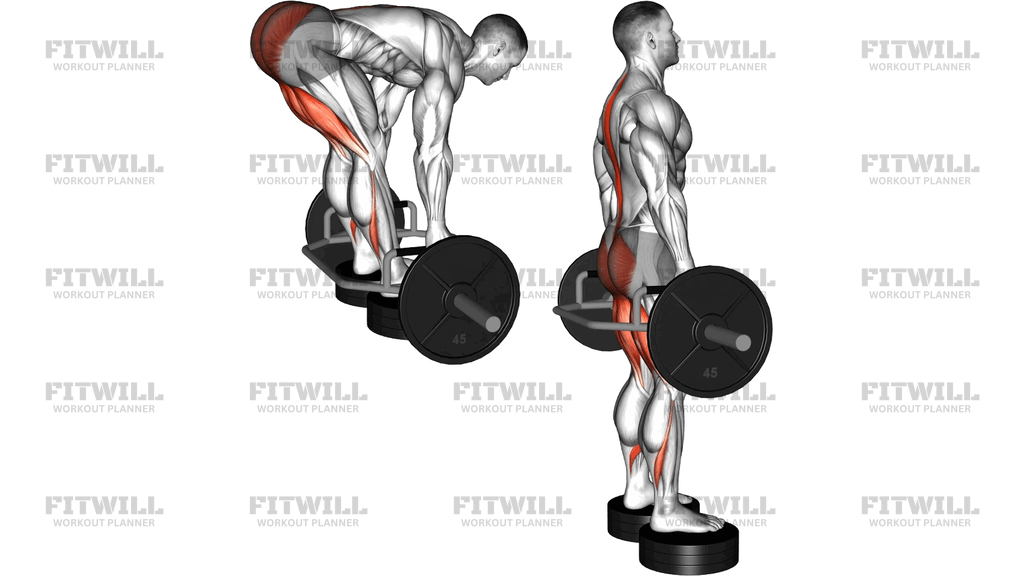
The Trap Bar Romanian Deadlift From Deficit is a hinged hip exercise performed while standing on an elevated surface, usually one or more weight plates, so the trap bar starts and finishes below foot level. That extra drop gives you a longer range of motion than a floor-level Romanian deadlift, which means your hamstrings get loaded through a deeper stretch before you drive the hips forward to stand tall. The trap bar's neutral handles keep your shoulders in a comfortable, arms-at-your-sides position, which is easier on the shoulder joints than a straight bar pulled behind the shins.
This movement is a hamstring builder first and foremost. The deep hinge loads the hamstrings hard at long muscle lengths, the glutes finish the lockout, and the erector spinae of the lower back work isometrically to hold your spine neutral. The adductors assist at the bottom of the hinge, and your forearms and grip handle the weight through the extended range. Compared with a deficit straight-bar RDL, the trap bar version shifts a little more emphasis to the legs and a little less demand on the lower back because the weight sits closer to your midline.
The deficit setup is the defining detail, and it deserves respect. Standing on plates or a low platform means the bar travels further down before the plates touch the floor, so your hamstrings and hips need the mobility to reach that depth without your lower back rounding. Start with a modest deficit, typically a single 45-pound plate or a low step, and only add height once you can reach the bottom with a flat back and control.
To execute it well, stand centered in the trap bar on your plates with feet about hip-width apart, hinge at the hips while letting the knees bend slightly, and lower the bar along the front of your legs until you feel a strong hamstring stretch or the plates lightly touch the floor. Keep your chest proud, lats engaged, and the bar close to your body the whole way. Drive the hips forward to return, squeezing the glutes at the top without leaning back or hyperextending.
This lift suits intermediate to advanced lifters who already own a solid hinge pattern from conventional Romanian deadlifts. It is popular in off-season strength work, hamstring-focused hypertrophy blocks, and programs where heavy straight-bar hinge volume aggravates the lower back or shoulders. Because it is demanding on the posterior chain and grip, place it early in a session when you are fresh, and treat it as a controlled strength movement rather than something to rush through.
Safety comes down to spine position and honest range. Never chase depth by rounding your lower back, and keep the plates you stand on stable and non-slip under your whole foot. Warm up the hinge pattern without the deficit first, build up the range gradually over weeks, and drop the set if your back starts doing the work your hamstrings should be doing.
[ Workout Log & Planner ]
Put your next workout in Fitwill
Keep your plan and training log ready when you are.


Instructions
- Place one or two flat 45-pound plates on the floor as a stable platform, then set the loaded trap bar in front of them so the handles will hang slightly below foot level.
- Step onto the plates with both feet fully supported, feet hip-width apart, and center yourself inside the trap bar with the handles directly over your midfoot.
- Hinge at the hips with a slight knee bend and grip the handles with a neutral grip, arms hanging straight down from your shoulders.
- Take a breath into your belly, brace your core, pull your shoulder blades back, and lift the bar to a tall standing position to start each rep from the top.
- Push your hips back and let the bar slide down the front of your thighs, keeping your chest up, spine neutral, and the bar close to your body.
- Lower until you feel a deep hamstring stretch or the bar's plates lightly touch the floor, whichever comes first, without letting your lower back round.
- Drive your hips forward and squeeze your glutes to stand back up to full height, finishing with your legs straight but knees soft.
- Exhale as you rise, then reset your brace and take a new breath at the top before starting the next rep.
- Keep your weight balanced over your whole foot on the plates, never shifting onto your toes, and control the descent on every rep instead of dropping fast.
- After the final rep, lower the bar under control, set it down, and step off the plates carefully rather than stepping over the bar.
Tips & Tricks
- Start with just one 45-pound plate as your deficit. If your back rounds or your hips tuck under near the bottom, the deficit is too tall for your current hamstring and hip mobility.
- A common mistake is turning this into a squat by bending the knees too much. Keep the knee bend fixed and small, roughly 15 to 20 degrees, and let the hips do the traveling.
- Let the bar drift away from your legs and your lower back takes over. Keep the handles tracking straight down your thighs and lightly brush the bar against your shins at the bottom.
- Because the bar hangs below your feet, the stretch is much deeper than a normal RDL. Cut your usual RDL weight by 20 to 30 percent for your first few sessions while you learn the range.
- Squeeze the bar hard. Grip strength often fails before the hamstrings do on this movement, and a firm grip also keeps your shoulders packed and your torso stable.
- Do not hyperextend your lower back or lean back at the top. Lock out by finishing the hip drive, standing tall with ribs down over your pelvis.
- Go barefoot or wear flat, thin-soled shoes. Standing on plates in cushioned running shoes creates an unstable base exactly when you need balance the most.
- Move slowly through the first third of the descent. Rushing the eccentric is the fastest way to lose your neutral spine once the bar drops below your knees.
- If you feel the work shifting into your lower back, stop the rep one or two inches higher than your deepest point and own that shorter range with strict form.
Frequently Asked Questions
What muscles does the Trap Bar Romanian Deadlift From Deficit work?
The hamstrings are the primary movers, working hardest in the deep stretched position the deficit creates. The glutes drive the lockout, the lower back stabilizes the spine isometrically, and the adductors, forearms, and grip assist throughout.
How much deficit should I use for the Trap Bar Romanian Deadlift From Deficit?
Begin with a single 45-pound plate, roughly 2 inches of elevation. Increase the height only when you can reach the bottom of every rep with a flat back and full control.
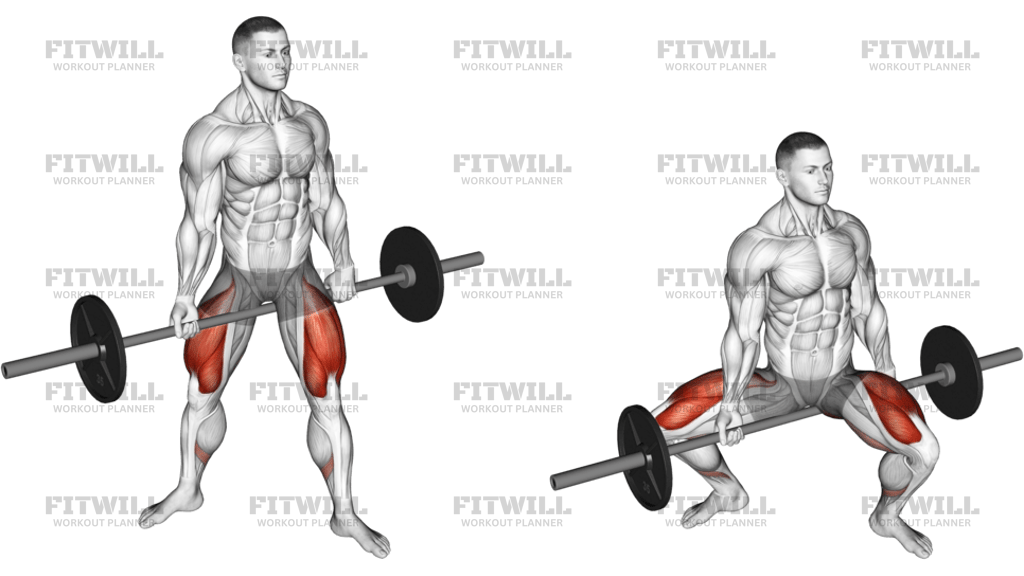
Why use a trap bar instead of a barbell for a deficit Romanian deadlift?
The trap bar's neutral handles let your arms hang at your sides, which reduces shoulder strain and keeps the weight closer to your midline. Most lifters find it easier to keep a neutral spine at the deeper range this deficit demands.
Can beginners do the Trap Bar Romanian Deadlift From Deficit?
It is better suited to lifters who already own a solid hinge from regular Romanian deadlifts. If you are new, master the floor-level version for several months, then add a small deficit once your hamstring flexibility and back control allow it.
How is this different from a regular Trap Bar Romanian Deadlift?
Standing on plates drops the bar below foot level, extending the range of motion by a few inches on each side. That extra distance loads the hamstrings through a deeper stretch, which is why you should use less weight than the standard version.
Should my knees bend during the Trap Bar Romanian Deadlift From Deficit?
Yes, but only slightly, around 15 to 20 degrees, and that angle should stay fixed for the whole rep. The movement is a hip hinge, so the hips travel back and forward while the knees barely change.
How far down should I lower the bar?
Lower until you feel a strong hamstring stretch or the bar's plates lightly touch the floor, whichever happens first with a neutral spine. If your lower back starts to round before that point, stop higher and treat that as your working range for now.
What should I do if my grip gives out before my hamstrings?
Use lifting straps for your heavier sets so the hamstrings, not the forearms, become the limiting factor. You can also keep lighter deficit work strapless to train the grip, since the longer range already taxes it more than a normal RDL.
What can I substitute if I do not have a trap bar or stable plates to stand on?
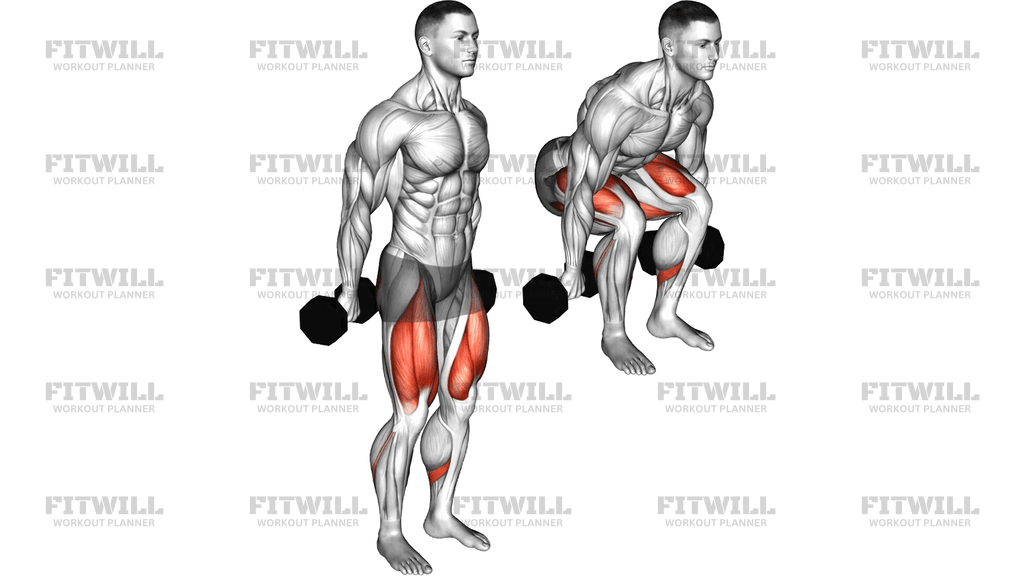
A dumbbell or kettlebell Romanian deadlift from a low step is the closest match, using one or two implements held at your sides. Dumbbells let your arms hang naturally like trap bar handles, which keeps the shoulder position similar.
Is the Trap Bar Romanian Deadlift From Deficit safe for the lower back?
It is safe when your spine stays neutral and the load matches your mobility and control. The main risk is rounding at the bottom of the deep range, so respect the height of your deficit, progress gradually, and stop any set where form breaks down.