Standing Shoulder Flexion
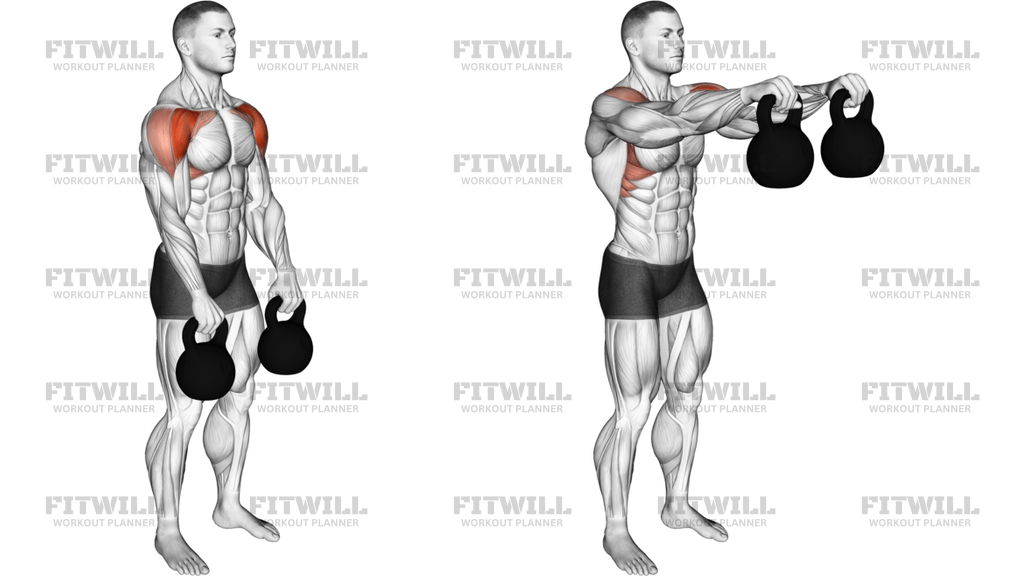
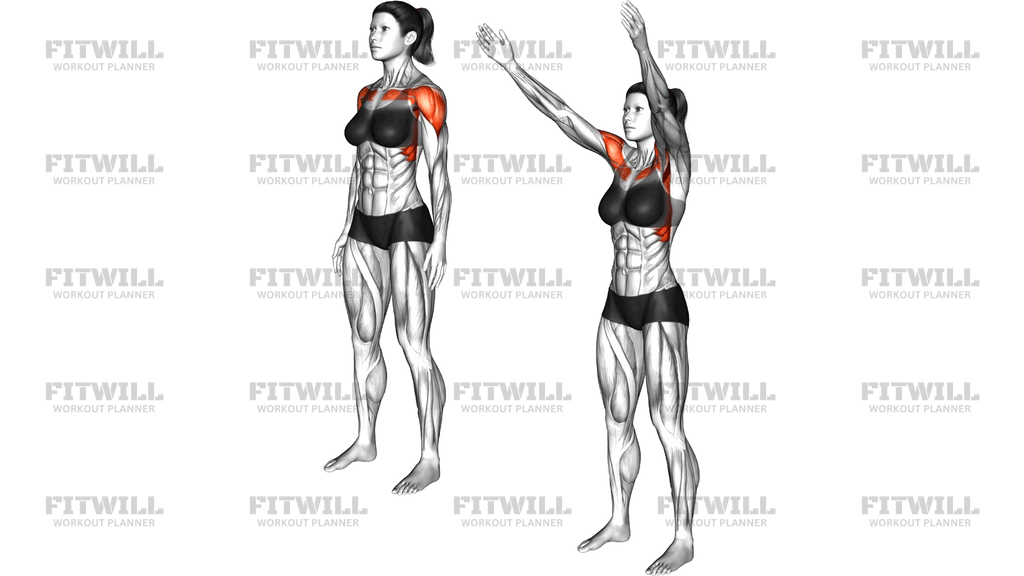
Standing Shoulder Flexion is a simple bodyweight movement where you raise one or both straight arms forward and up through a full arc until they finish overhead, then lower them back down under control. Because there is no external load, the exercise isolates the shoulder's ability to move cleanly through its largest range of motion, making it one of the most underrated drills for shoulder health and movement quality.
The main muscle working is the front of the shoulder, with the side shoulder, upper traps, and rotator cuff assisting as the arm travels overhead. The serratus anterior and the muscles that control the shoulder blade also play a key role, since your scapula must rotate upward for the arm to reach full overhead range without compensation. That makes this as much a coordination drill as a strengthening one.
This movement is especially useful for anyone rebuilding overhead capacity, warming up before pressing or pulling workouts, or spending long hours at a desk where the shoulders tend to drift forward and lose range. Physical therapists frequently use shoulder flexion patterns for exactly this reason: it trains the joint through its full arc with minimal stress, so you can practice it often without excessive fatigue.
Setup matters more than it looks. Stand tall with feet about hip-width apart, ribs stacked over the pelvis, and arms relaxed at your sides. A common error is arching the lower back or shrugging the shoulders to gain extra height, which turns a shoulder drill into a spine and neck exercise. Keeping the torso quiet forces the shoulders to do the actual work.
To execute well, raise your straight arm forward in line with your shoulder, lead with the thumb or palm turning slightly inward, and follow the arc all the way up until the arm is beside your ear. Pause briefly at the top, then lower along the same path rather than letting gravity drop the arm. The lowering half is where much of the control is built, so give it the same attention as the lift.
You can perform Standing Shoulder Flexion as part of a warm-up, between sets of pressing to keep the joints moving, or in higher-repetition sets on recovery days. Since the resistance is just the weight of your arm, the goal is smooth, repeatable reps and full range rather than speed or load. If you cannot reach full overhead range without leaning back, simply work to the height you can control and let the range improve over time.
Fitwill
Log Workouts, Track Progress & Build Strength.
Achieve more with Fitwill: explore over 9600 exercises with images and videos, access built-in and custom workouts, perfect for both gym and home sessions, and see real results.
Start your journey. Download today!




Instructions
- Stand upright with your feet hip-width apart and your weight evenly distributed across both feet.
- Let your arms hang relaxed at your sides with your palms facing your thighs and your shoulders pulled gently down away from your ears.
- Brace your abdominals lightly and stack your ribs over your pelvis so your lower back stays neutral.
- Keep your arm straight with a soft elbow and begin raising it forward directly in line with your shoulder, not out to the side.
- Continue the arc upward, allowing your shoulder blade to rotate naturally, until your arm is fully overhead next to your ear.
- Pause for a moment at the top without shrugging your shoulder toward the ear or arching your lower back.
- Lower your arm slowly back down along the same forward path until it returns to your side.
- Exhale as you raise the arm and inhale as you lower it, keeping your breathing steady throughout.
- Complete the desired repetitions on one arm, then switch sides, or alternate arms rep by rep if both arms are trained individually.
Tips & Tricks
- If your torso leans backward as the arm climbs, the range has exceeded your current overhead mobility, so stop at the height where your ribs stay stacked.
- A lifted or shrugged shoulder at the top means the upper traps are taking over; reset with the shoulder blade pulled down and rebuild the last portion of the arc gradually.
- Keep the moving arm in the plane of the body, forward of the side; if the arm drifts outward it becomes a partial lateral raise rather than true flexion.
- Control the descent for roughly two to three seconds instead of letting the arm drop, since the lowering phase trains the rotator cuff and shoulder blade stabilizers.
- A fully locked elbow can make the arc feel jammed at the top; a small bend keeps the movement smooth and comfortable.
- If you feel pinching at the front of the shoulder near the top, try turning your palm slightly inward so the thumb leads, which often gives the tendons more room.
- Treat this as a quality drill, not a rep race; ten slow, clean reps beat twenty fast swings for warming up the shoulder before pressing work.
- Check your reflection from the side: the arm should finish in line with the ear, not stretched forward of the head with the chest collapsed.
Frequently Asked Questions
Which muscles does Standing Shoulder Flexion work?
The front shoulder is the primary mover, supported by the side shoulder, upper traps, and rotator cuff. The serratus anterior and shoulder blade muscles also work hard to rotate the scapula as the arm travels overhead.
Is Standing Shoulder Flexion good for beginners?
Yes, it is one of the best starting points for shoulder training because there is no external load and the demand comes purely from moving your own arm with control. Beginners should focus on full range and a quiet torso rather than speed or reps.
Should I raise one arm or both arms during Standing Shoulder Flexion?
Both options work. Single-arm versions make it easier to spot side-to-side differences in range and control, while raising both arms together lets you feel the overhead position symmetrically.
Why does my lower back arch when I raise my arms overhead?
That usually means the shoulders or upper back lack the range to get the arm fully overhead, so the body borrows extension from the spine. Brace the abdominals lightly, stop at the height you can reach with a neutral back, and the range should improve with practice.
Can I add a dumbbell or light weight to Standing Shoulder Flexion?
You can once you own the bodyweight version with clean form and full range. Start with a very light weight, because the front shoulder works hardest at the top of the arc and form tends to break down quickly under load.
How is Standing Shoulder Flexion different from a front raise?
They follow the same forward path, but a front raise is typically loaded and often stops around shoulder height, while Standing Shoulder Flexion emphasizes the complete arc all the way overhead with no added resistance. The overhead finish makes shoulder blade rotation a bigger part of the movement.
How many reps should I do?
Eight to fifteen slow, controlled reps per arm works well as a warm-up or mobility drill. Since the resistance is only the weight of the arm, quality and range matter far more than volume.
Is it safe if I have a shoulder injury?
The movement is low-load and often used in rehabilitation settings, but any painful arc or pinching at the top is a signal to shorten the range and consult a qualified professional before continuing. Never push through sharp pain.
When is the best time to use Standing Shoulder Flexion in my workout?
It works well as the first drill in an upper-body warm-up before pressing or pulling, and it can also be used between heavy sets or on recovery days to keep the shoulders moving through their full range.