Burpee Jump Box
The Burpee Jump Box combines two demanding movements into one continuous effort: a full burpee performed on the floor, followed immediately by an explosive jump onto a sturdy box or step platform. Instead of finishing the burpee with a small vertical hop, you drive out of the squat and land on top of the box, then step or drop back down to begin the next repetition. This hybrid turns a already-intense conditioning drill into a true power developer.
The exercise taxes nearly the whole body. The push-up portion loads the chest, shoulders, and triceps, the squat and jump phases hammer the quads, glutes, and hamstrings, and the box jump adds an explosive hip and knee extension demand that plain burpees lack. Your calves, hip flexors, and core work continuously to absorb landings, hold a rigid plank, and snap your feet back under your hips. Because the heart rate climbs quickly and stays high, it doubles as one of the most efficient conditioning tools you can do with minimal space.
This movement suits intermediate to advanced trainees who already own a confident burpee and a controlled bodyweight squat jump. It shows up in CrossFit-style circuits, MMA and field-sport conditioning, and short metabolic finishers where the goal is maximum work in minimal time. If you are new to training, build the base version first before adding the box.
Setup matters more here than in a standard burpee because you are jumping toward a target under fatigue. Position the box so it sits an arm's reach in front of your hands when you are in the plank, and choose a height you can clear repeatedly with a tall posture — usually 12 to 20 inches for most people. A box that is too high forces ugly, desperate jumps late in a set, which is where shins and balance suffer.
Execution hinges on rhythm and landing quality. Drop into the plank with control rather than crashing down, keep the hips level during the push-up, and snap both feet forward together. On the jump, swing the arms, extend the hips fully, and land softly on the box with knees tracking over the toes in a quarter squat. Step down one foot at a time rather than rebounding straight into the next rep, at least until your landing mechanics stay clean.
The main safety point is honesty about fatigue. Box jumps under exhaustion are where most scraped shins and missed landings happen. If your jumps start shortening or your landings get loud and heavy, either lower the box or switch back to regular burpees for the remainder of the set. A stable, non-slip box on a flat surface and enough clearance around you are non-negotiable.
[ Workout Log & Planner ]
Put your next workout in Fitwill
Keep your plan and training log ready when you are.


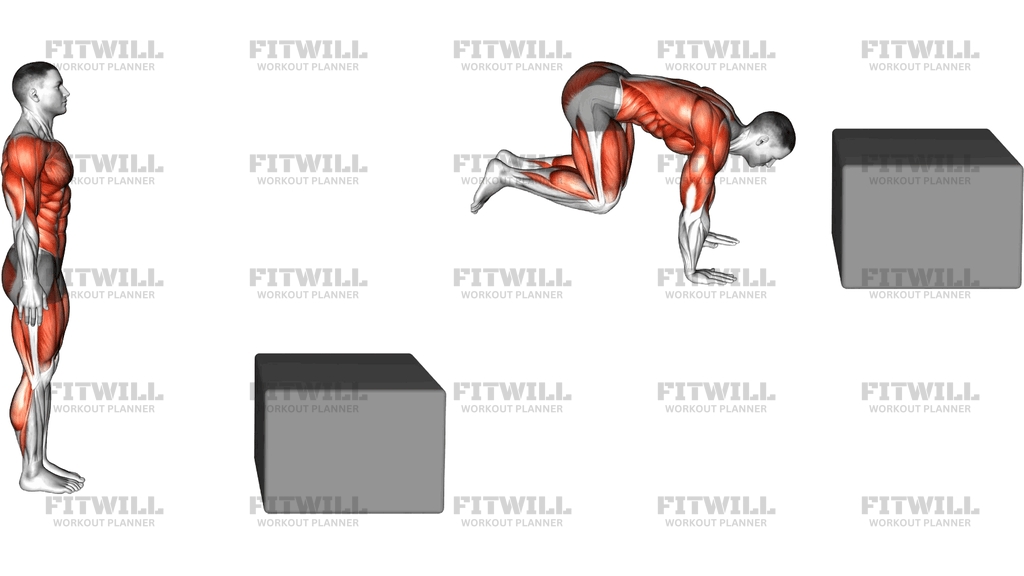
Instructions
- Place a sturdy plyo box or step platform about an arm's length in front of where your hands will sit during the plank, on a flat, non-slip surface with clear space around it.
- Stand facing the box with feet hip-width apart and weight over the midfoot.
- Hinge at the hips, place your palms flat on the floor shoulder-width apart, and kick both feet back so you land in a rigid plank with shoulders stacked over the wrists.
- Perform one push-up, keeping the elbows at roughly 45 degrees to the torso and the hips in line with the shoulders — skip the push-up only if your plank position would sag.
- Jump both feet forward together so they land just outside your hands, returning to a low squat.
- From the squat, swing your arms back then forcefully overhead as you extend your hips, knees, and ankles and jump onto the box.
- Land on top of the box with both feet fully on the surface, knees bent in a quarter squat, chest tall, and eyes forward.
- Stand up fully on the box, then step down one foot at a time back to the starting spot.
- Exhale as you push up and jump, inhale as you lower into the plank, and take one steadying breath before the next repetition if needed.
- Reset your stance and hand position each rep so every burpee starts from the same distance from the box.
Tips & Tricks
- The most common mistake is letting the feet drift toward the box as fatigue builds, which shortens your takeoff room and makes each jump harder — reset your standing spot every rep.
- If your shins are clipping the box edge, the box is too high or you are jumping from too close; lower the height or take a half step back rather than muscling through.
- Land quietly. A loud, heavy landing on the box signals stiff knees and a collapsed arch; aim for a soft, midfoot landing with the knees tracking over the toes.
- Do not rebound straight off the box into the next burpee. Step down until your jump mechanics stay crisp — the rebound version belongs in advanced conditioning only.
- Keep the push-up honest. Piking the hips up or dropping the belly to the floor turns the burpee into two sloppy partial reps and robs the chest and shoulders of work.
- Film yourself from the side for one set. The most common form leak is a sagging or piked plank, and it is hard to feel while your heart rate is near maximum.
- Choose a box you can clear on your worst rep, not your best one. Late-set misses happen when the height is chosen based on a fresh first jump.
- If your wrists ache from the plank-to-floor transition, walk the feet back one at a time instead of kicking both, or briefly elevate your hands on a low step.
- Program this movement early in a session when you are fresh, or cap the set at 6-10 reps per round — quality jumps beat grinding out extra sloppy repetitions.
Frequently Asked Questions
What muscles does the Burpee Jump Box work?
It hits nearly everything: quads, glutes, and hamstrings drive the squat and box jump, the chest, shoulders, and triceps handle the push-up, and the calves, hip flexors, and core stabilize every landing and plank. No single muscle is maximally loaded, but the total-body demand is high.
How high should the box be for the Burpee Jump Box?
Start with 12 to 16 inches if you are new to the movement and only progress to 20 inches or more once you can clear it consistently on tired reps. The right height lets you land softly with both feet fully on the surface even in your last repetition.
Can beginners do the Burpee Jump Box?
Beginners should first master regular burpees and standard bodyweight box jumps separately. Once both feel controlled, combine them with a low box of about 12 inches and short sets of 4-6 reps.
Should I jump back down from the box or step down?
Step down, especially under fatigue. Jumping down and immediately rebounding into the next burpee doubles the landing impact and is where most balance losses and shin scrapes happen in this exercise.
Why do my jumps onto the box get shorter halfway through a set?
Fatigue in the quads and calves plus creeping foot placement are the usual causes. Check that your takeoff spot has not drifted closer to the box, and lower the box height or end the set if your hips no longer fully extend.
Is the push-up required in every rep of the Burpee Jump Box?
A full push-up makes it a complete movement, but dropping it is a legitimate scaling option when your plank position collapses or your upper body gives out before your legs do. Keep the chest close to the floor even if you skip the push.
What can I substitute if I do not have a box?
A sturdy bench, low plyo platform, or even a stable stair step works, as long as it cannot slide or tip. Without any platform, do burpees with a maximum-height vertical jump instead and focus on a soft landing.
How many Burpee Jump Box reps should I do in a workout?
Work in sets of 4-8 reps or timed intervals of 20-30 seconds, resting enough that your jump stays explosive. Long sets past the point of clean landings train sloppiness, not conditioning.
Is the Burpee Jump Box safe for the knees?
It is generally fine when the box height is matched to your ability and your landings are soft with knees tracking over the toes. If you currently have knee pain or a recent lower-body injury, get clearance from a qualified professional before adding explosive jumps under fatigue.