Side To Side Jump Over Stepbox
The Side To Side Jump Over Stepbox is a lateral plyometric drill where you jump sideways back and forth over a low step platform, landing softly on each side and immediately reversing direction. Unlike forward jumps, this movement forces you to generate and absorb force in the frontal plane, which is something most training programs neglect entirely. It is one of the simplest ways to build reactive strength in the legs without any equipment beyond a single low box.
The main work is done by the quads and glutes, which power each takeoff and cushion every landing, while the calves and ankle stabilizers handle the rapid ground contacts. Because you are constantly changing direction, your core works hard to keep your torso upright and squared forward while your lower body travels side to side. Hip flexors and obliques contribute as you reposition your legs mid-air for each crossing.
Setup matters more than it looks with this exercise. The box should be low enough that you can clear it comfortably with a quick, low hop rather than a maximal leap. If you have to think about clearing it, it is too high. Place it on a flat, non-slip surface with a couple of feet of clear space on both sides, and check that it will not slide when you land near it.
Execution comes down to rhythm and landing quality. Push laterally off the outside foot, stay tall through the torso, and aim to spend as little time on the ground as possible between jumps. Land on the whole foot with the knee tracking over the toes, not collapsing inward, then rebound straight into the next jump. Your arms should swing naturally with each takeoff to help drive you sideways.
This drill shows up in athletic preparation for sports with lateral demands like basketball, tennis, soccer, and skiing, and in conditioning circuits where a short burst of high-effort jumping raises the intensity quickly. It is also a practical introduction to lateral plyometrics for intermediate lifters who have already built decent landing mechanics with simpler jumps.
Treat this as a quality-over-quantity movement. Ten to twenty sharp, quiet landings beat fifty sloppy ones. Stop the set as soon as your jump height drops or your landings get loud and heavy, because that is when ankle and knee stress climbs without any additional training benefit.
[ Workout Log & Planner ]
Put your next workout in Fitwill
Keep your plan and training log ready when you are.


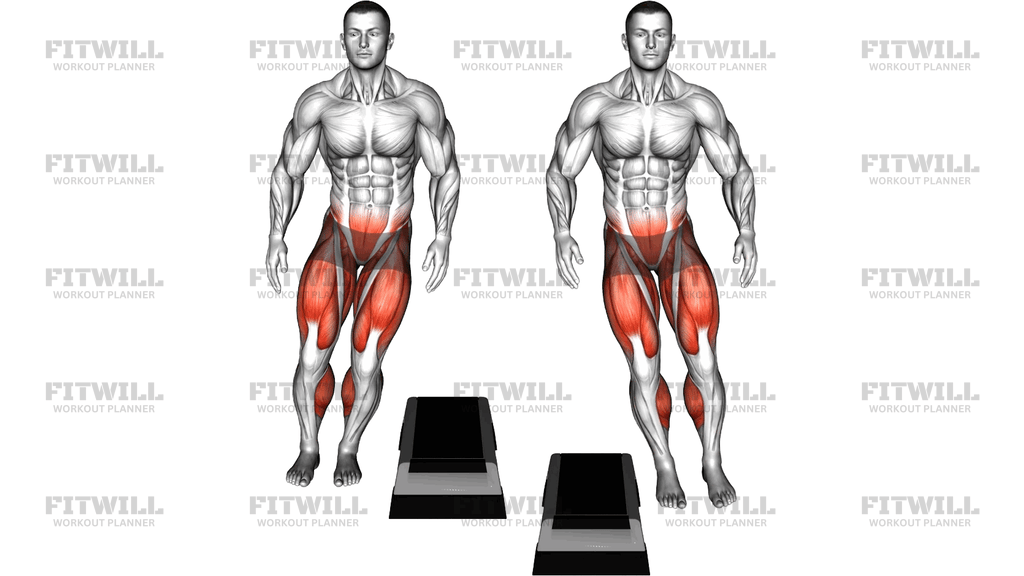
Instructions
- Place a low step platform on a flat, non-slip surface and stand beside it with your feet about hip-width apart, one shoulder roughly lined up with the box.
- Check that you have clear landing space on both sides of the box, and that the platform is stable and will not slide under your weight.
- Stand tall with a soft bend in the knees, braced core, and arms hanging relaxed at your sides.
- Shift slightly onto your outside leg, then push off laterally to hop sideways over the box, keeping the jump low and quick rather than high.
- Lift both feet enough to clear the box, keeping your torso upright and facing forward the whole time.
- Land on the opposite side on the balls of your whole foot with the knee bent and tracking in line with the toes, absorbing the landing through hips, knees, and ankles.
- Rebound immediately into the next sideways jump back over the box, minimizing ground contact time as you get comfortable.
- Breathe steadily throughout, exhaling on each takeoff rather than holding your breath.
- Continue for the planned number of jumps or time, then step away from the box and rest until your landings are quiet and crisp again before the next set.
Tips & Tricks
- If the box is high enough that you hesitate before each jump, switch to a lower platform. Hesitation kills the rebound and doubles the ankle load when you clip the edge.
- Listen to your landings. Loud, slapping contacts mean you are landing flat-footed or stiff-legged; aim for quiet landings with the knee and hip bending together.
- Watch for knees caving inward on landing, which is the most common fault in lateral jumps. Cue yourself to land with the knee stacked over the middle of the foot.
- Keep your chest facing forward instead of rotating your whole body toward the direction of travel. Rotation turns a lateral drill into a messy twisting jump.
- Do not stand up fully between jumps. The drill works because you rebound from a partially bent knee; straightening completely each time turns it into slow, separate hops.
- Keep the jumps low on purpose. Height slows ground contact and fatigues you faster without adding anything the sideways crossing does not already train.
- Use your arms deliberately: a small sideways swing of both arms on each takeoff adds rhythm and lateral drive, especially as you tire.
- Start on a rubber or turf surface rather than concrete if possible. Hard floors magnify every landing error, especially in higher-volume sets.
- Cut the set the moment your jump trajectory gets sloppy or you brush the box. Repeated edge contact on a step platform is how rolled ankles happen.
Frequently Asked Questions
What muscles does the Side To Side Jump Over Stepbox work?
The quads and glutes drive each takeoff and absorb each landing, with strong involvement from the calves and ankle stabilizers. The core, especially the obliques, works to keep your torso facing forward while your legs travel side to side.
How high should the stepbox be for this exercise?
Low enough that you can clear it with a quick, comfortable hop without thinking about it. For most people a step platform of roughly 10 to 30 centimeters works; if you hesitate or clip it, go lower.
Is the Side To Side Jump Over Stepbox suitable for beginners?
Beginners can do it after building basic landing skills with simple squats and low two-foot hops. Start with slow, separated jumps over a very low box before trying to rebound quickly.
How many jumps should I do per set?
Quality matters more than volume. Ten to twenty continuous jumps per set is plenty for most people, and you should stop when your landings get loud or your jump height drops.
Why do my knees hurt or feel stressed during lateral jumps?
The usual causes are landing with knees caving inward, landing stiff-legged, or using a box that is too high. Fix your knee tracking over the toes, soften the landing, and lower the box before continuing.
Can I substitute the Side To Side Jump Over Stepbox if I have no box?
Yes. Any stable low object you can safely hop over works, or you can do lateral line hops over an imaginary line on the floor. The box just adds a clear target and a small height demand.
Should I stay on the ground briefly or rebound as fast as possible?
Start with a short pause between jumps to own each landing, then progress to faster rebounding once your landings are consistently quiet and controlled. Fast ground contacts are the goal, but only on top of good mechanics.
Does this exercise improve cardio or strength?
It sits between the two. Short, sharp sets build reactive leg power and landing mechanics, while longer timed sets push your heart rate up and work as a conditioning burst in a circuit.
What surface is best for the Side To Side Jump Over Stepbox?
A flat, non-slip surface with some give, such as rubber gym flooring or turf, is ideal. Avoid slick tiles, uneven ground, and concrete when you can, and always confirm the box itself cannot slide.