Burpee Over The Dumbbell
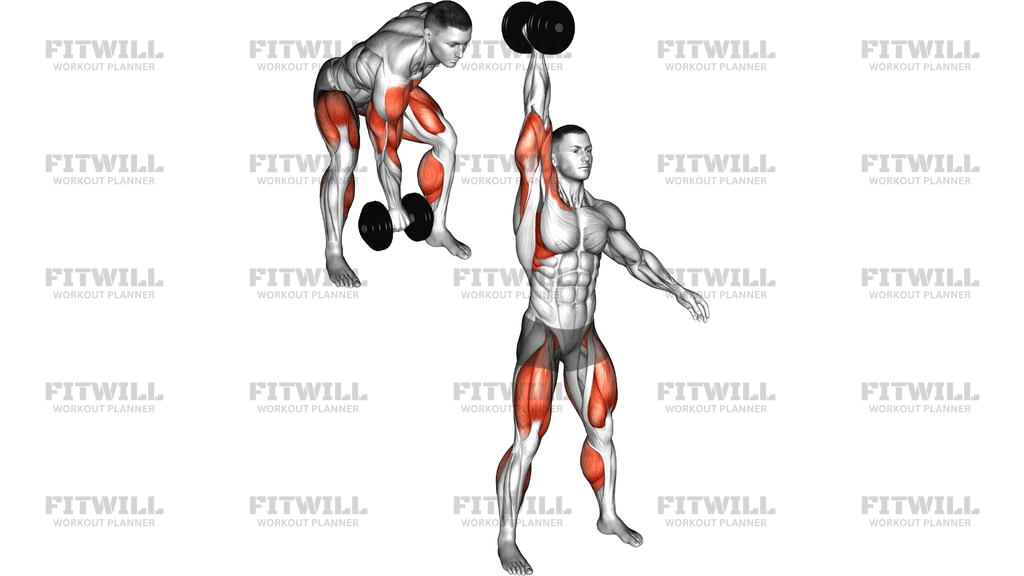
Burpee Over The Dumbbell is a conditioning movement that combines the standard burpee with a lateral jump over a single dumbbell placed on the floor beside you. Instead of jumping straight up at the top of the rep, you drop down, kick your feet back to a plank, perform a push-up, snap your feet back under you, then jump sideways over the dumbbell and repeat the whole sequence on the other side. Each rep forces you to change direction, which adds a lateral power demand that a regular burpee simply doesn't have.
This movement works as a full-body effort: the push-up hits the chest, shoulders, and triceps, the hip hinge and snap of the burpee load the quads, glutes, and hamstrings, and the repeated sprawl and jump keep your heart rate near its ceiling. The lateral hop over the dumbbell recruits the hip abductors, adductors, and calves in a way forward-and-up jumps don't, and your core works overtime to hold your spine together through the transition from plank to standing.
The dumbbell on the floor is more than decoration — it sets a fixed target you must clear on every rep, which keeps your jump honest and adds a timing element under fatigue. Use a weight that sits low and stable on the floor; a moderately heavy dumbbell lying on its side works well because it won't roll or shift if your foot clips it. Place it far enough from your burpee path that you won't land on it, but close enough that the side jump stays short and quick.
Burpee Over The Dumbbell fits naturally into metabolic conditioning circuits, CrossFit-style workouts, and short finishers at the end of a lifting session. It's a go-to choice when you want a lot of work done in little time with a single piece of equipment. Because the movement is genuinely demanding, most people do best with sets of 8-15 reps or timed intervals of 20-40 seconds, rather than long unbroken sets.
Before adding this variation, make sure you own the standard burpee and can land laterally with control. The most common breakdown point is the landing: tired athletes rush the hop over the dumbbell, land with stiff knees or a rounded back, and pay for it on the next rep. Keep your chest tall on the descent to the floor, land softly on flat feet, and treat every jump over the dumbbell as its own deliberate rep rather than a throwaway transition.
[ Workout Log & Planner ]
Put your next workout in Fitwill
Keep your plan and training log ready when you are.


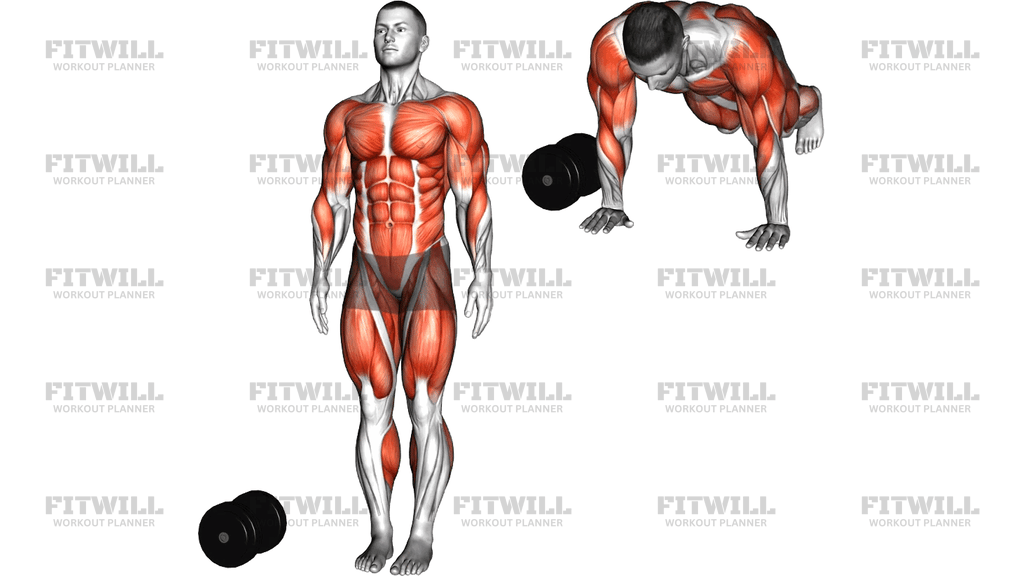
Instructions
- Place one dumbbell on the floor beside you, lying horizontally so it sits stable and will not roll.
- Stand tall facing the dumbbell's long side with your feet roughly hip-width apart, about a forearm's length away from it.
- Set your stance, brace your abs, and keep your ribs stacked over your pelvis before you start moving.
- Squat down and place both palms flat on the floor just inside shoulder width, then kick your feet back into a straight plank with your shoulders stacked over your wrists.
- Lower your chest to the floor in a controlled push-up, keeping your elbows at about 45 degrees to your torso and your body in one line.
- Press back up, jump your feet forward under your hips, and rise into a quarter squat with your weight on the balls of your feet.
- Explode into a lateral jump, driving your knees up just enough to clear the dumbbell, and land softly on the opposite side on flat feet with bent knees.
- Breathe steadily throughout — exhale as you press up and jump, inhale briefly on the way down to the floor.
- Turn or reposition as needed, then repeat the full sequence, jumping back over the dumbbell to complete one rep.
- Between sets, step away from the dumbbell, shake out your wrists, and reset your stance before starting the next set.
Tips & Tricks
- Choose a dumbbell that lies flat and doesn't roll — a round plate-style dumbbell on its side can shift if you clip it mid-jump.
- If your chest sags toward the floor during the push-up, drop to knees briefly or cut the push-up until you can hold a rigid plank.
- Most people fail on the landing, not the jump — aim to land toe-ball-heel with your knees tracking over your feet, not collapsing inward.
- Keep the dumbbell close enough that the lateral hop stays short; a long bounding jump burns energy you'll need for the burpee itself.
- Don't let your lower back round as you place your hands on the floor — hinge at the hips and bend your knees more instead.
- If you catch your foot on the dumbbell, stop, reposition it, and restart rather than improvising a higher, sloppier jump.
- Pacing matters more than speed: a smooth two-second descent and an crisp jump will hold up longer than an all-out sprint that falls apart in round two.
- On a hard floor, place the dumbbell on a mat so it stays put and gives you a slightly more forgiving landing zone on both sides.
- If your wrists ache from the plank position, spread your fingers and grip the floor slightly, or use push-up handles set just outside the dumbbell.
Frequently Asked Questions
What muscles does Burpee Over The Dumbbell work?
It's a full-body movement: the push-up targets the chest, shoulders, and triceps, the squat and jump load the quads, glutes, and hamstrings, and the core stabilizes your spine through every transition. Calves and hip stabilizers work hard on the lateral landing.
How heavy should the dumbbell be for Burpee Over The Dumbbell?
The weight isn't lifted during the movement, so prioritize stability over load. Pick a dumbbell heavy enough that it won't slide or roll when your foot brushes it, typically somewhere in the 10-25 kg range depending on what you have available.
Can beginners do Burpee Over The Dumbbell?
Yes, with modifications. Step back instead of jumping into the plank, skip or shorten the push-up, and step over the dumbbell laterally rather than jumping until you can land softly and consistently.
Do I have to jump sideways over the dumbbell, or can I jump forward?
The defining feature of this variation is the lateral jump over the dumbbell, which trains side-to-side power. Jumping forward turns it into a regular burpee with an object nearby and loses that benefit.
Why do I keep clipping the dumbbell with my feet?
You're likely jumping too late or standing too close before the hop. Give yourself a clear setup position, drive the knees up rather than swinging the feet back, and slow down — a slightly higher, more deliberate knee lift clears the dumbbell more reliably than a long flat jump.
Is the push-up mandatory in Burpee Over The Dumbbell?
Traditionally yes, it's part of the full rep. If you're fatigued or training for volume, chest-to-floor with a hop-back is a valid scaled version, but note the change so your session stays measurable.
How many reps should I do?
For conditioning, 8-15 reps per set or 20-40 second work intervals work well. Stop the set when your push-up form or your landings deteriorate, since sloppy landings are where injuries happen.
What can I use instead of a dumbbell for Burpee Over The Dumbbell?
Any low, stable object works — a kettlebell lying on its side, a small hurdle, or a weight plate. Avoid anything tall or tippy, since a stumble mid-jump is the main safety risk of this movement.
Is Burpee Over The Dumbbell safe for the knees?
It's generally fine if you land with soft knees, feet flat, and knees tracking over your toes. If you have knee discomfort on lateral jumps, reduce the height and speed of the hop or step over the dumbbell instead.