Dumbbell Overhead Lunge
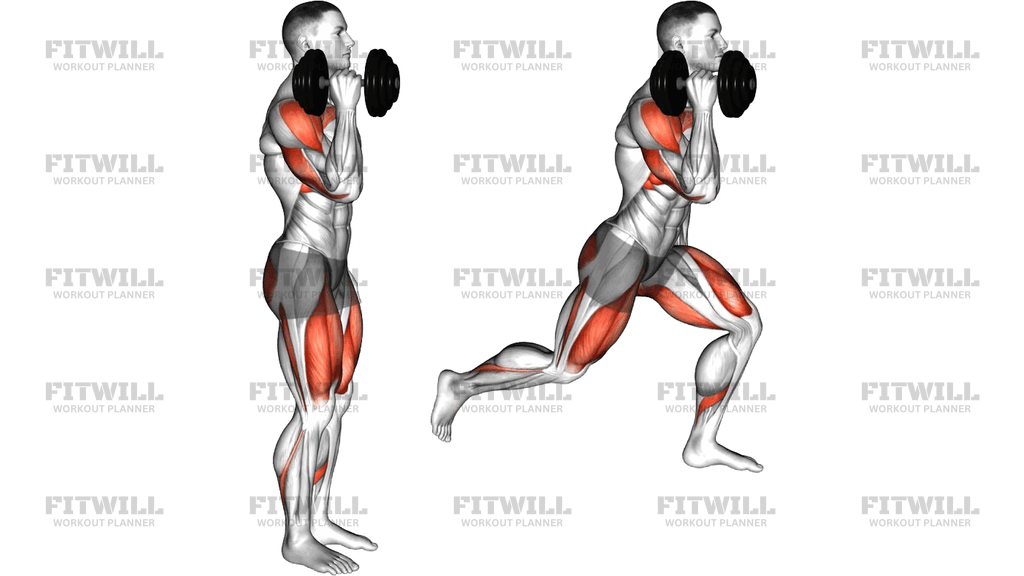
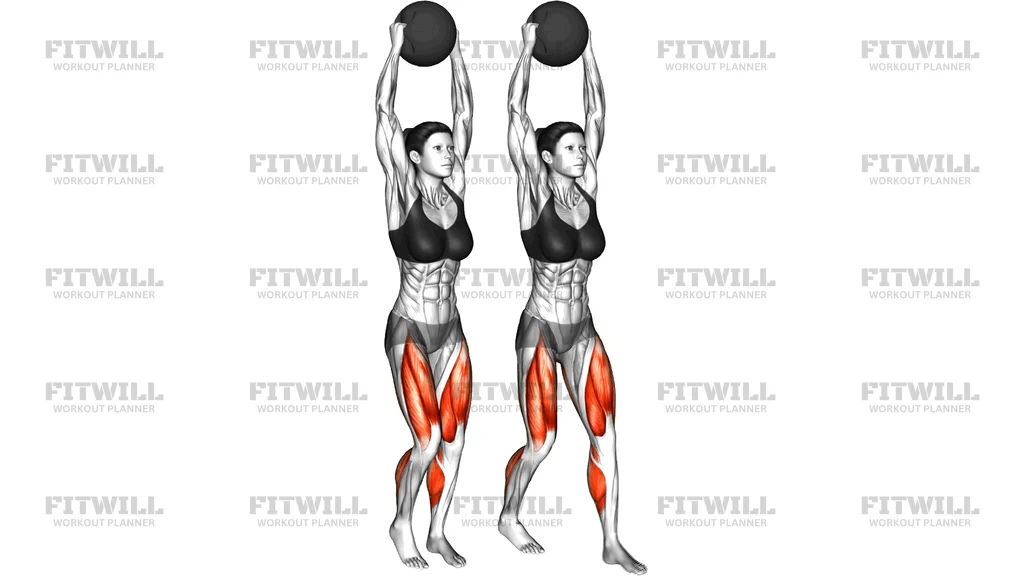
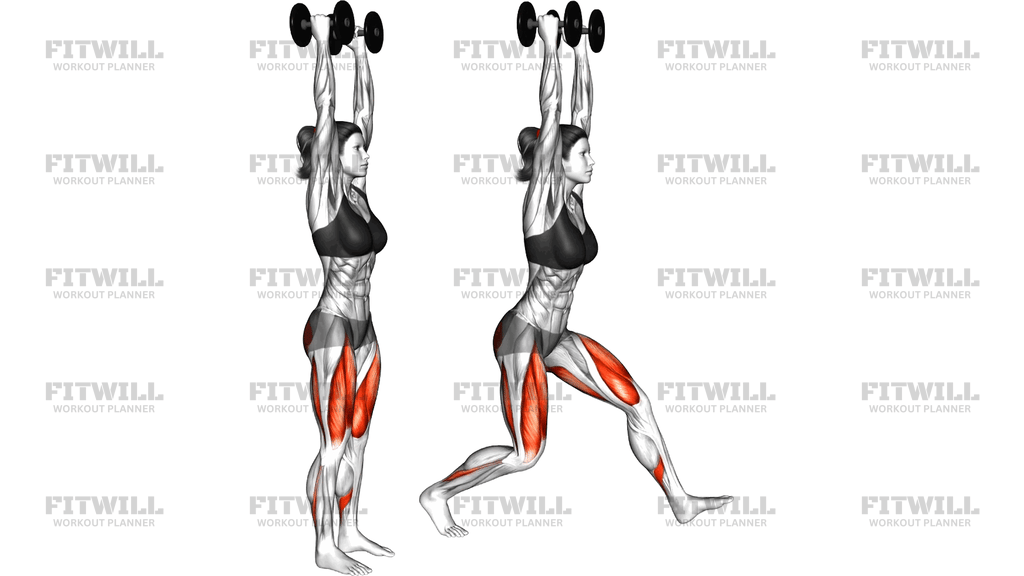
The Dumbbell Overhead Lunge is a full-body strength movement where you hold one or two dumbbells locked out overhead while stepping back into a reverse lunge and driving back up to standing. It takes the familiar lunge pattern and adds an overhead component, which forces your shoulders, upper back, and trunk to work overtime just to keep the weight stacked over your hips while your legs do the driving.
The main work comes from the quads and glutes of the front leg as you lower and rise from the split stance. The hamstrings and calves assist with control and stabilization, while the deltoids, traps, and lats hold the dumbbells overhead. Your entire trunk acts as the link between the two: if your core lets the weight drift forward or sideways, the whole rep falls apart. That is exactly what makes this movement so effective — it trains the legs and the trunk as a coordinated unit rather than in isolation.
This exercise suits intermediate lifters who already own a solid bodyweight lunge and a reasonably stable overhead press position. It is popular in general strength training, athletic conditioning, and functional fitness programming because it combines lower-body strength with overhead stability in one economical movement. It is also a practical way to add training density when you are short on time.
Setup matters more here than in most lunge variations. Stand tall with a dumbbell in each hand, arms fully extended so the weights sit directly over your shoulders, not out in front of them. If the weights drift forward, your lower back compensates and the rep becomes a strain rather than a lift. Grip the handles firmly, pull your shoulder blades slightly toward each other, and keep the elbows straight but not hyperextended.
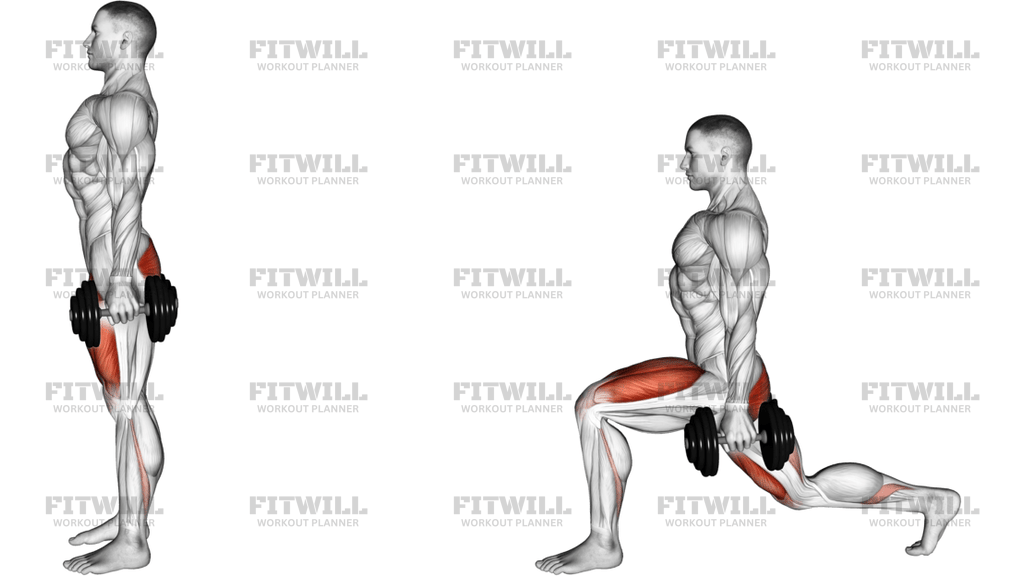
To execute the movement, brace your midsection, then step one foot back into a long split stance, lowering until both knees form roughly 90-degree angles and the back knee hovers just above the floor. Keep your torso upright and the dumbbells stacked over your hips the entire time. Drive through the front heel to return to standing, completing all reps on one side or alternating legs as your program calls for.
Keep the load modest at first. Most people can lunge far more than they can press overhead, so the dumbbells you choose for this exercise will usually be lighter than your standard lunge weight. Start with a weight you can hold locked out for all your reps without the arms trembling or the ribs flaring, and progress from there. Stop the set the moment your overhead position degrades — that is the point where the exercise stops training what it is meant to train.
[ Workout Log & Planner ]
Put your next workout in Fitwill
Keep your plan and training log ready when you are.


Instructions
- Stand tall with a dumbbell in each hand, then press both straight overhead until your arms are fully extended and the weights sit directly above your shoulders.
- Set your feet hip-width apart with toes pointing forward, and squeeze the handles firmly so the dumbbells feel secure in your palms.
- Draw your shoulder blades slightly together, straighten your elbows, and brace your core as if bracing for a light push to the stomach.
- Inhale, then step one foot backward into a long split stance, keeping the dumbbells stacked over your hips as your back foot plants.
- Lower your back knee toward the floor until both knees form roughly 90-degree angles, with the front shin vertical and the front heel flat.
- Keep your torso upright and your ribs down — do not let the weights drift forward or your lower back arch as you descend.
- Pause briefly at the bottom, then exhale and drive through the front heel to push back up to the standing position.
- Finish each rep with your legs together and arms still locked out overhead before stepping into the next lunge.
- Complete all reps on one leg, then switch sides, or alternate legs rep by rep depending on your program.
- Lower the dumbbells to your shoulders with control before setting them on the floor, and rest before the next set.
Tips & Tricks
- Choose a weight based on your overhead hold, not your lunge strength — a dumbbell you can lunge with but cannot keep locked out will turn this into a lower-back exercise.
- If the dumbbells drift in front of your ears as you tire, your lats and upper back have stopped supporting the weight; actively pull the weights slightly back over your shoulders.
- Keep the step back long enough that your front knee stays over your ankle. Short steps push the knee past the toes and shift stress away from the quads and glutes.
- If your balance wobbles at the bottom, widen your split stance slightly sideways — a narrow tightrope stance makes overhead stabilization much harder than it needs to be.
- Squeeze the glute of the back leg as you descend; this stabilizes the rear hip and keeps your pelvis level under the weight.
- Do not let the elbows bend mid-rep to rest the weight. If you need to soften the arms, the set is over — rack the dumbbells and rest.
- Push the floor away with your whole front foot, keeping the heel down. Rising onto the ball of the foot usually means the step was too short or the load too heavy.
- If your lower back feels the work instead of your legs and shoulders, check your rib position: exhale, tuck the ribs down, and re-brace before the next rep.
- On days when overhead work feels stiff or restricted, do the first warm-up set with no dumbbells, arms raised and hands clasped, to groove the position.
Frequently Asked Questions
Which muscles does the Dumbbell Overhead Lunge work?
The quads and glutes of the front leg do the primary work during the lunge, while the shoulders, traps, and lats hold the dumbbells overhead. Your core works throughout to keep the weight stacked over your hips.
Is the Dumbbell Overhead Lunge suitable for beginners?
It is best treated as a step up from regular lunges. Beginners should first master the bodyweight reverse lunge and a stable overhead dumbbell hold, then combine them with very light weights.
Should I hold one dumbbell or two overhead during this lunge?
Two dumbbells, one in each hand with both arms locked out, is the standard setup and keeps the load balanced. Holding a single dumbbell is a valid variation but shifts the demand toward anti-rotation in the core.
Why do the dumbbells want to drift forward when I lunge?
This usually happens when the lats and upper back stop actively supporting the weight, or when the core fatigues and the ribs flare. Squeeze the handles, pull the shoulder blades together, and think of pushing the weights slightly back over your shoulders.
Should I step backward or forward with the Dumbbell Overhead Lunge?
Stepping backward, as in a reverse lunge, is generally easier on the knees and keeps your torso position more stable under the weight. Forward steps are possible but demand more control as the front foot absorbs the landing.
How heavy should the dumbbells be?
Pick a weight you can hold fully locked out overhead for every rep without the elbows bending or the lower back arching. For most people that is noticeably lighter than their regular lunge load.
Can I substitute the Dumbbell Overhead Lunge if I lack shoulder mobility?
Yes. A standard dumbbell reverse lunge with the weights held at your sides trains the legs similarly, while a front-rack lunge keeps the core demand without requiring full overhead position.
How many reps and sets should I do?
Because overhead stability tends to fail before leg strength, moderate sets of 6 to 10 lunges per leg work well. Prioritize keeping the weights stacked over your shoulders over chasing higher rep counts.
Is it safe for my knees and lower back?
With a controlled reverse lunge pattern, a vertical front shin, and a braced trunk, the movement is generally well tolerated. Discomfort usually points to a step that is too short, a load that is too heavy overhead, or ribs flaring under fatigue.