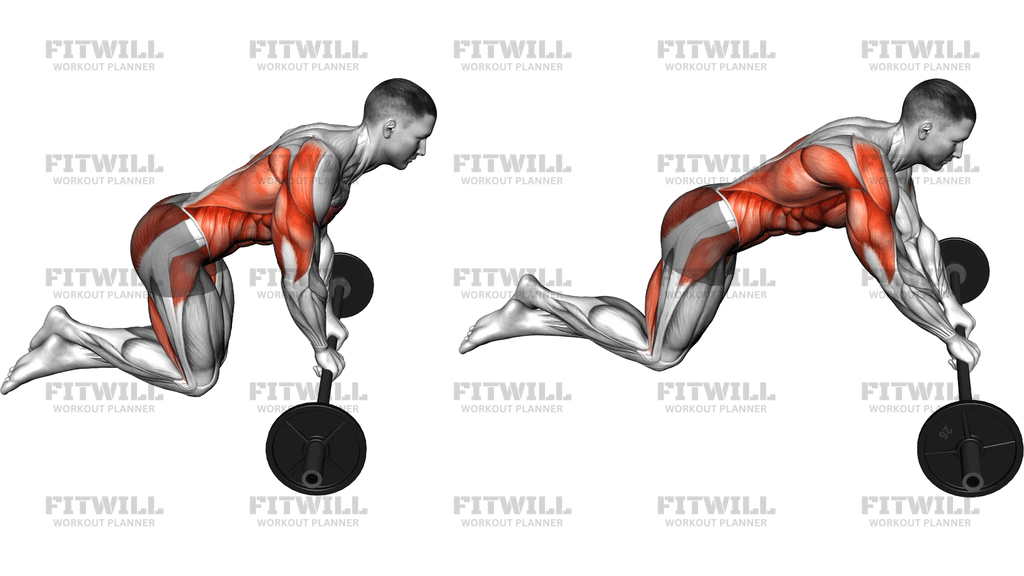
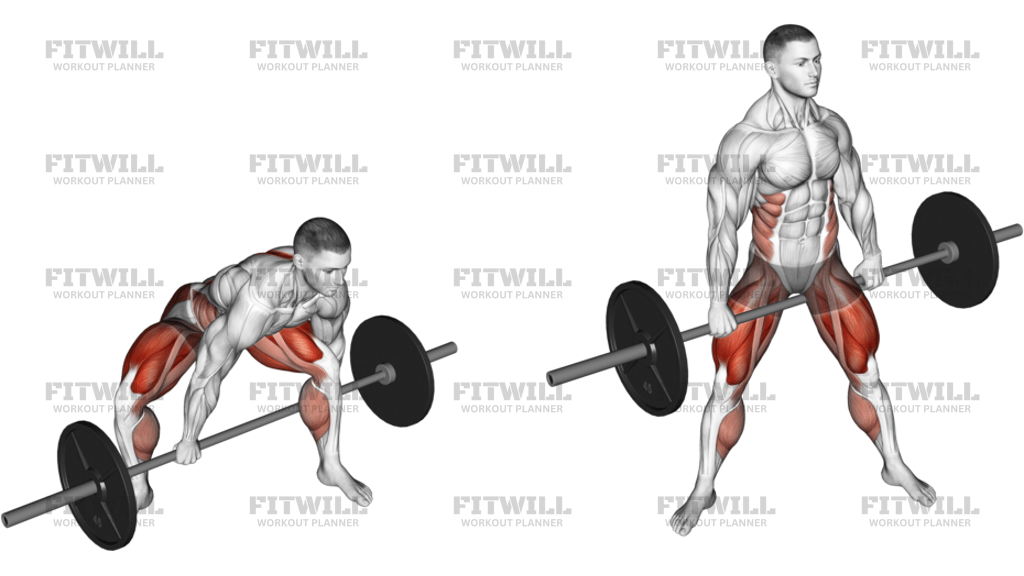
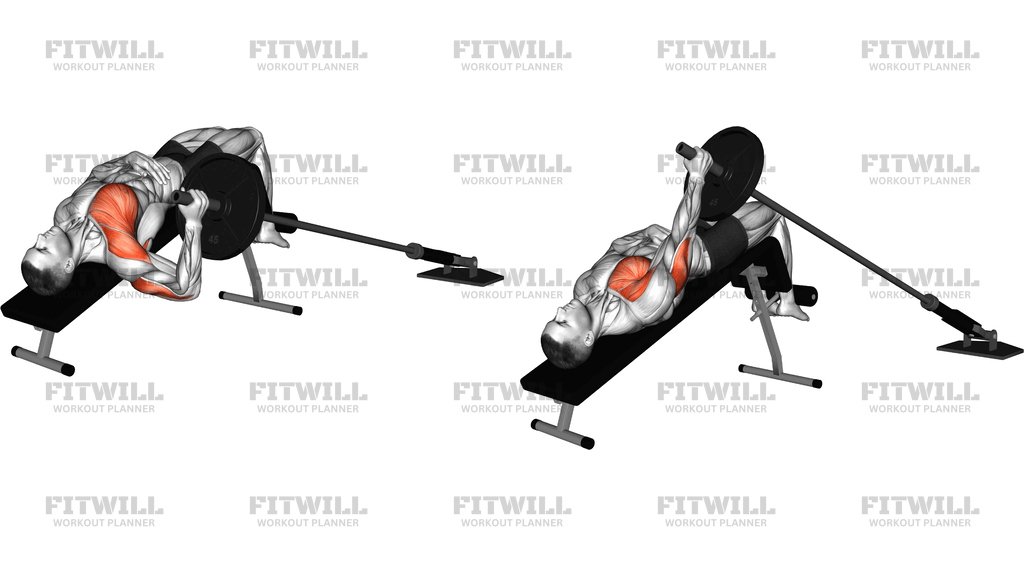
Barbell Half Kneeling Thor Lift
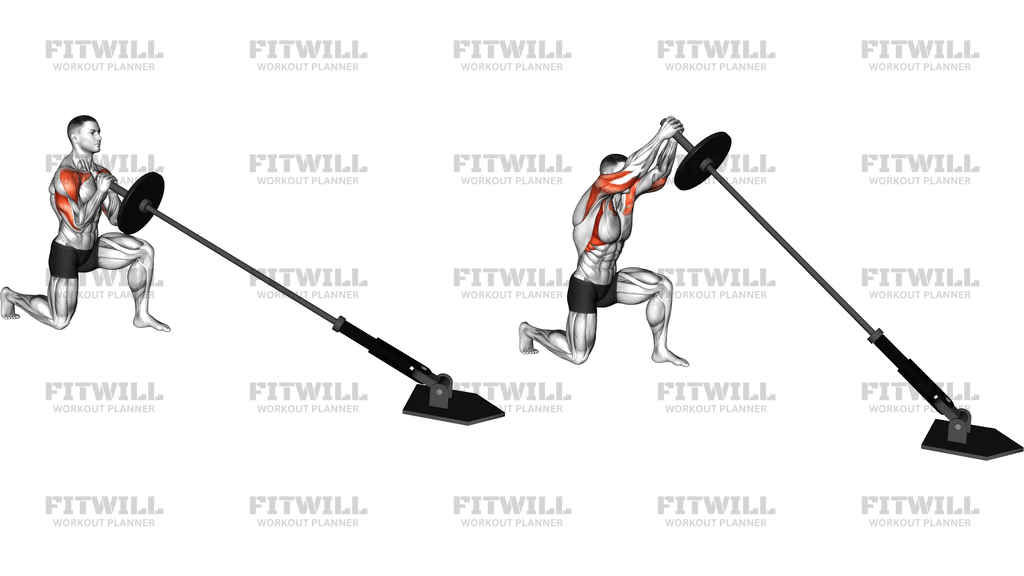
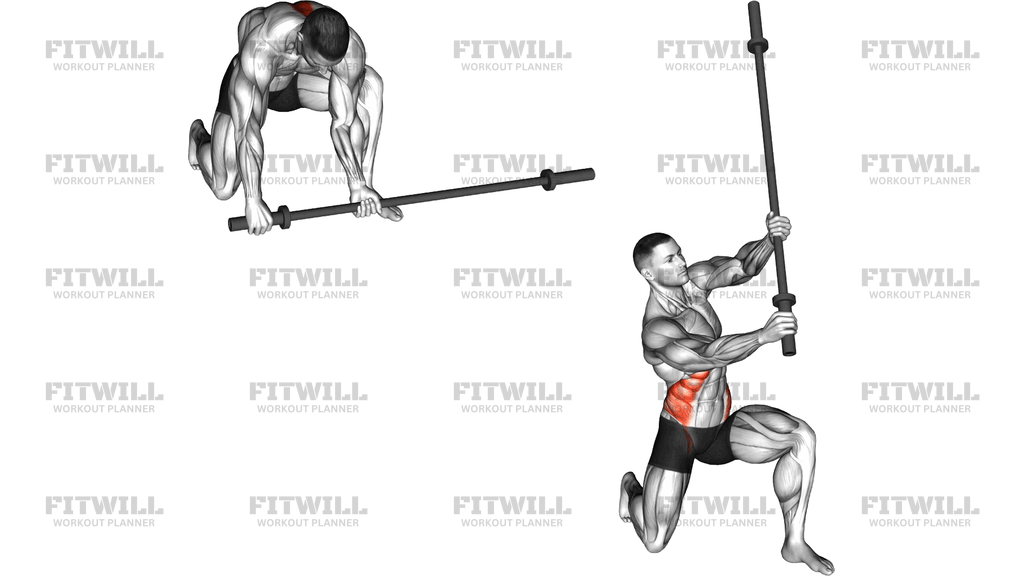
The Barbell Half Kneeling Thor Lift is a diagonal, rotational lift performed with one end of a barbell. You set up in a half-kneeling stance, grip the free end of the bar with both hands, and drive it from low beside one hip up and across your body until your arms finish overhead on the opposite side. Because the weight travels along an angled path while your lower body stays planted, the movement blends rotation, upward drive, and anti-rotation control in one rep.
The main work comes from the obliques, which rotate the trunk and control the bar as it sweeps across the midline. Your deep core and lower back stabilize the spine throughout, while the front leg's glutes and the down knee's hip stabilizers anchor the base. The shoulders and upper back handle the pressing and guiding portion of the lift, and the thoracic spine — the mid-back segment the exercise is named for — is the area doing much of the rotating.
The half-kneeling position is what makes this lift so useful. With one knee down, you lose the ability to cheat with leg drive and hip thrust, so the trunk has to produce and control the rotation on its own. The split stance also lengthens the hip flexor of the down-knee side and forces the front hip to hold stable under a twisting load, which is exactly what most people need after long hours of sitting.
To execute it well, keep the ribs stacked over the pelvis and avoid leaning back as the bar rises. Think of the barbell tracing a rainbow: low at the outside of one hip, up across the chest, finishing overhead toward the opposite side. Your eyes follow the bar, the rotation comes from the mid back rather than cranking at the low back, and the arms mostly steer the weight instead of lifting it.
This lift fits well as a core finisher on strength days, as rotational power prep for throwing and swinging sports, and as a controlled way to restore thoracic rotation. It pairs naturally with a same-stance chop in the reverse direction, giving you both halves of the diagonal pattern.
Because the free end of a barbell moves fast and the overhead finish sits close to your head and shoulder, treat this as a technique-first exercise. Start with an empty bar or a light plate, master the path on one side, and only then add load or speed.
[ Workout Log & Planner ]
Put your next workout in Fitwill
Keep your plan and training log ready when you are.


Instructions
- Anchor one end of the barbell in a landmine attachment or set it securely in a corner, and slide a light plate onto the free end you will hold.
- Set up in a half-kneeling stance facing the free end at an angle: front foot flat on the floor with the knee bent about 90 degrees, opposite knee resting on a pad directly under the hip.
- Grip the sleeve end of the bar with both hands, one stacked above the other, and start with the bar low at the outside of your front hip, arms extended and torso rotated toward the bar.
- Brace your core, pull your ribs down, and squeeze the glute of the down-knee leg so your pelvis stays level and square.
- Pull the bar up and across your body in a smooth diagonal arc, rotating through the mid back and letting the torso turn away from the starting side.
- Finish with the bar directly overhead on the opposite side, arms extended, shoulders packed down rather than shrugged toward the ears.
- Pause briefly at the top, then reverse the same path under control until the bar returns to the low position beside the starting hip.
- Exhale as you drive the bar up, inhale as you lower it back down.
- Complete all repetitions on one side, reset your stance, then switch sides so the bar lifts from the opposite hip.
- Keep the front heel planted and the front knee tracking over the toes for the entire set — the base never moves, only the trunk and arms.
Tips & Tricks
- The most common error is turning this into a low-back crunch: if you feel the lift in your lumbar spine, reduce the range and focus the rotation higher, in the area between the shoulder blades.
- Do not let the down-knee side's pelvis drift or the front knee cave inward as the bar crosses the midline — that lost base is where most of the tension leaks out.
- Grip close to the sleeve with the top hand nearly over the bottom hand; a wide split grip makes the bar wobble and pulls your shoulders out of position.
- If you arch and lean back at the top, the weight is too heavy or you are chasing extra range. Stack ribs over pelvis and stop the bar where you can stay tall.
- Start with an empty bar or a 2.5–5 kg plate. The long lever of the bar end amplifies whatever load you put on it far more than a dumbbell would.
- Move the bar at the speed of a controlled lift, not a throw. Fast rotation belongs in later progressions once the half-kneeling pattern is solid.
- Place a folded mat or pad under the down knee, especially on hard floors — an uncomfortable knee will quietly shorten every rep.
- Match sides for volume but not necessarily load feel: your tighter or weaker side often moves worse. Always start your set on that side.
- Pair this with a half-kneeling chop in the reverse diagonal during the same session to train both halves of the rotation pattern evenly.
Frequently Asked Questions
What muscles does the Barbell Half Kneeling Thor Lift work?
The obliques are the primary movers, rotating the trunk as the bar sweeps diagonally overhead. Your deep core, lower back, glutes, and shoulders all work to stabilize the half-kneeling base and guide the bar along the arc.
Do I need a landmine attachment, or can I wedge the bar in a corner?
Either works as long as the anchored end cannot slide or rise. A landmine attachment is cleaner and safer; if you use a corner, wedge the bar into a wall corner away from foot traffic and check that it stays seated between reps.
Why is this lift done half-kneeling instead of standing?
The half-kneeling position removes leg drive and hip rotation from the equation, so the trunk has to produce and control the movement itself. It also trains stability in the front hip and lengthens the hip flexor of the down-knee side.
Should the bar start on the same side as the down knee or the front foot?
Start the bar low at the outside of the front hip so it lifts up and across toward the opposite side, finishing overhead away from the down knee. Perform all reps on that side before switching your stance and repeating on the other.
Is the Barbell Half Kneeling Thor Lift a beginner-friendly exercise?
Yes, provided you start with an empty bar and a slow, controlled arc. Beginners benefit most from mastering the set position and rotation path before adding any plate, because the long bar end makes light loads feel heavier than expected.
What is the most common mistake with this movement?
Rotating from the low back instead of the mid back, often paired with leaning backward at the top. Keep the ribs stacked over the pelvis, drive the rotation between the shoulder blades, and shorten the range before you shorten your form.
How heavy should I go on the Barbell Half Kneeling Thor Lift?
Stay light enough that you can pause at the top without arching, shrugging, or losing the half-kneeling base. For most lifters this is an empty bar to a small plate — this is a control and rotation exercise, not a maximum-load lift.
What can I substitute if I have no barbell available?
A single dumbbell or kettlebell held with both hands works well for the same half-kneeling diagonal pattern, or you can use a cable machine set low and perform a half-kneeling lift with a single handle.
Is this exercise safe for my lower back and shoulders?
When performed with light load, a braced trunk, and rotation coming from the mid back, it is a controlled and joint-friendly pattern. Keep the bar's overhead finish well aligned over the shoulder rather than behind the head, and stop any set where form starts to break down.