Landmine Half Kneeling Shoulders Press
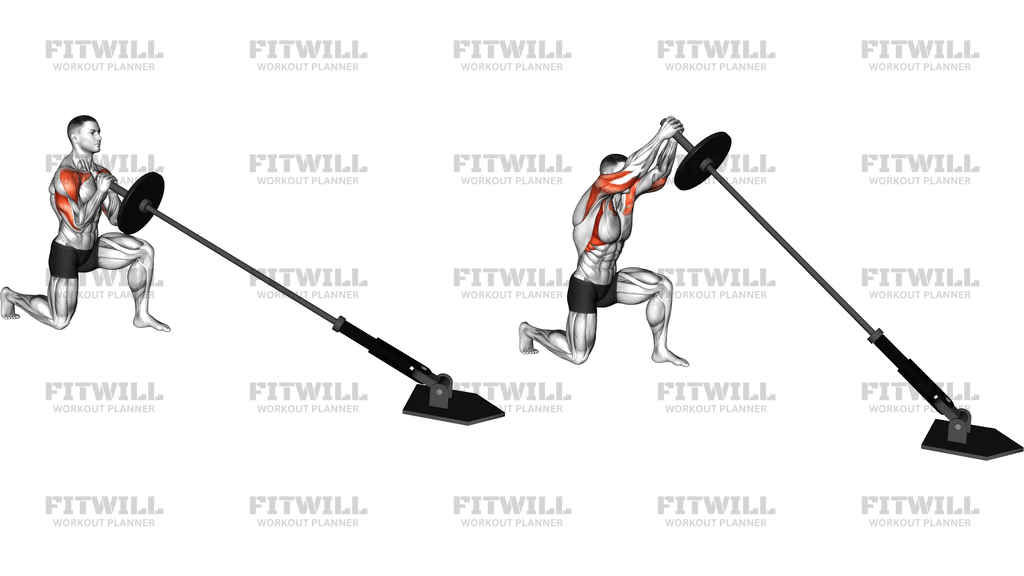
The Landmine Half Kneeling Shoulders Press is a landmine press performed from a half-kneeling position, with one knee down on the floor and the other foot planted in front. One end of the barbell sits in a landmine attachment or wedged into a corner, while you hold the loaded sleeve at shoulder height with both hands. Because the bar travels along a fixed diagonal path up and away from your body, this is one of the most shoulder-friendly pressing variations you can load.
The angled bar path is what sets this movement apart. A straight barbell overhead press forces the shoulder through a vertical arc that many people find uncomfortable, especially with limited overhead mobility. The landmine setup lets you press in front of and slightly above your head instead, which suits lifters with cranky shoulders and still challenges the front shoulders and triceps hard. The triceps and upper chest assist the press, and the serratus anterior works to control the shoulder blade as the arm extends.
The half-kneeling stance turns this into a genuinely full-body stability exercise. With one knee down, you cannot rely on a wide stance to keep your torso steady, so the glutes, obliques, and deep core have to work to stop your hips from rotating or your lower back from arching as you press. That anti-rotation and anti-extension demand makes this a favorite in rehab settings, athletic training, and general strength programs alike.
Setup matters more here than in most presses. Your front shin should stay roughly vertical, your back knee planted directly under or slightly behind your hip, and your torso tall. If your stance is too narrow or your hips are loose, the press turns into a leaning, twisting grind that strains the lower back instead of training the shoulders. Take a moment to square your hips toward the landmine before every set.
To execute the press, start with the bar held at your upper chest, elbows tucked slightly in front of your shoulders. Press the bar up and forward along the natural angle of the landmine until your arms are fully extended and the weight sits over the midpoint between your knees and your head. Your head stays neutral and your ribs stay down. Lower the bar under control back to the chest, letting the elbow travel slightly forward rather than flaring wide.
This exercise fits well as a primary press for anyone managing shoulder discomfort, as an accessory after heavier bench or overhead work, or as a core-and-shoulder combo on days when you want strength without maximal spinal loading. Because you can adjust weight in small plate increments, it scales cleanly from early rehab loads to challenging strength work.
[ Workout Log & Planner ]
Put your next workout in Fitwill
Keep your plan and training log ready when you are.


Instructions
- Set one end of a barbell into a landmine attachment or firmly wedge it into a corner, and load the free end with a small plate.
- Kneel down facing the landmine: drop to your back knee and plant your front foot flat on the floor so the front shin is roughly vertical, both hips squared toward the bar.
- Grip the sleeve with both hands at chest height, one stacked over the other or side by side, elbows tucked slightly in front of your shoulders.
- Sit tall, squeeze the glute on your kneeling side, and brace your midsection as if preparing for a light push.
- Press the bar up and forward along the bar's natural diagonal angle, extending the elbows fully as the weight moves in front of and slightly above your head.
- At the top, hold for a beat with arms straight, shoulders shrugged slightly forward, and your torso still vertical with no lean back.
- Lower the bar in a slow, controlled arc back to your upper chest, keeping the elbow tracking close to the body rather than flaring wide.
- Exhale as you press and inhale as you lower, maintaining steady breathing without holding your breath through the set.
- Complete all repetitions on one side, then switch your stance so the opposite knee is down and repeat for the same number of reps.
Tips & Tricks
- Keep the front shin vertical; if your knee drifts past your toes, widen your stance or shorten it until the shin stacks over the ankle.
- The most common fault is leaning the torso back as the weight gets heavy. Film yourself from the side once in a while; a straight line from head to back knee should stay intact throughout the press.
- Watch for hip rotation toward the pressing side. Actively squeezing the glute of the kneeling leg locks the pelvis in place and keeps the obliques doing their job.
- Do not chase range by letting the bar drift behind your head. The landmine path should finish in front of you; if you feel it pulling backward, you are pressing too vertically.
- Start lighter than you think you need. The diagonal lever makes the weight feel manageable at the chest but noticeably heavier at full extension.
- If the sleeve digs into your chest at the bottom, adjust your grip slightly further out on the bar or add a pad, but keep your elbows from dropping below chest height.
- Keep your head neutral rather than craning forward to watch the plate. Looking up as you press tends to open the rib cage and arch the lower back.
- For a harder core challenge, pause two seconds at the top of each rep instead of adding weight immediately.
- If your back knee is uncomfortable on a hard floor, kneel on a mat or pad rather than shifting your weight to one side of the knee.
Frequently Asked Questions
Which muscles does the Landmine Half Kneeling Shoulders Press work?
The front shoulders drive the press, supported by the triceps and upper chest. The half-kneeling stance also makes the glutes, obliques, and deep core work hard to keep your torso from rotating or arching.
Why press with the landmine angle instead of a barbell overhead?
The fixed diagonal path lets the shoulder blade rotate freely and keeps the press in front of the body, which many shoulders tolerate better than a straight vertical bar path. You still load the pressing muscles effectively.
Is the Landmine Half Kneeling Shoulders Press suitable for beginners?
Yes. Start with just the bar or a small plate, focus on keeping the hips square and the torso tall, and the movement pattern is easy to learn. The kneeling position actually helps beginners because it removes leg drive and forces honest pressing.
Should I kneel on my same-side knee as the pressing direction or the opposite?
In the standard setup you face the landmine with either knee down and press with both hands together on the sleeve, so the press is bilateral from the chest. Whichever knee is down, square both hips toward the bar before pressing.
My lower back arches when the bar goes up. How do I fix that?
Squeeze the glute of your kneeling leg harder, brace your abs before each rep, and think about pressing the weight up and slightly forward rather than straight up. If the arch persists, reduce the load until you can keep a tall torso.
What can I use if I do not have a landmine attachment?
You can wedge the empty end of the barbell securely into a corner with a towel protecting the wall. Make sure it cannot slip, and keep the bar path away from your face.
How heavy should I go on this exercise?
Because the top of the press puts the weight at the end of a long lever, the load feels heavier at lockout than at your chest. Choose a weight you can press smoothly for your target reps without your torso leaning or twisting.
Can I do this exercise one arm at a time?
Yes, a single-arm landmine press from the same half-kneeling stance increases the anti-rotation demand on the obliques. Master the two-hand version first so the pressing path stays consistent.
Is it safe for my knees to kneel while pressing overhead weight?
The kneeling knee only supports your body weight, not the bar, so the load on the joint is modest. Use a pad under the knee, keep the front shin vertical, and stand up between sets if kneeling becomes uncomfortable.