Plank Arm Reach
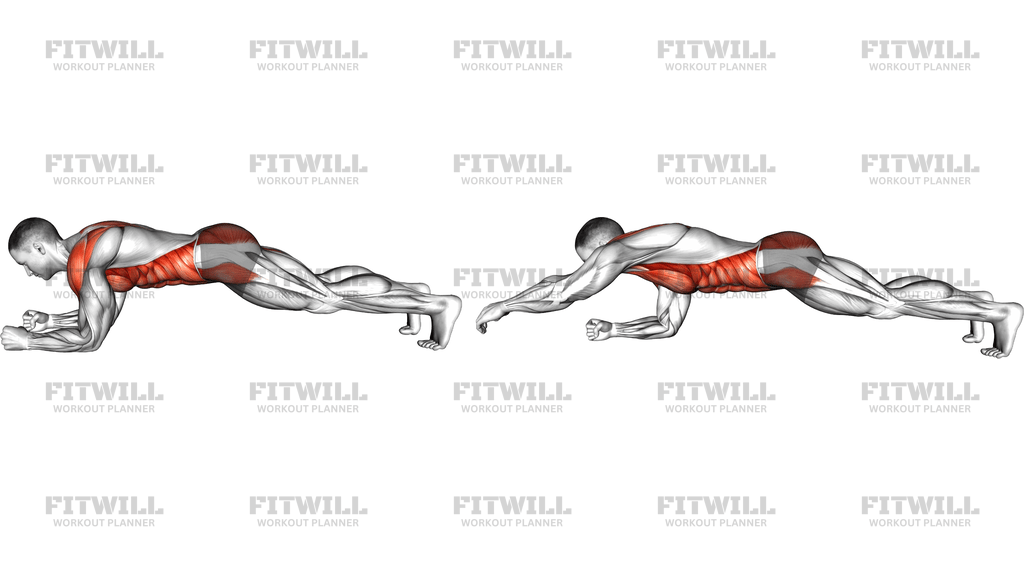
Plank Arm Reach is an anti-rotation core exercise performed from a forearm plank position. Instead of simply holding a static plank, you extend one arm forward until it is level with your shoulder, hold briefly, and bring it back before switching sides. Lifting one point of support away from the floor forces the trunk to resist twisting and sagging, which is a far more demanding task than a standard two-arm forearm plank.
The main challenge falls on the deep core, particularly the transverse abdominis, along with the rectus abdominis and obliques working to keep your hips square to the floor. The supporting shoulder and the muscles around the shoulder blade take on extra stabilization work, while the glutes help lock the pelvis in place. Because the demand is about resisting movement rather than producing it, this exercise builds the kind of trunk control that transfers directly to running, lifting, and carrying.
This variation suits anyone who can already hold a solid forearm plank for 30 seconds or more and wants to progress the difficulty without adding external load. It is commonly used in general strength training, athletic conditioning, and rehabilitation-style programs where controlled anti-extension and anti-rotation work is preferred over heavy loading.
Setup matters because small positional errors get amplified the moment an arm leaves the floor. Place your elbows directly under your shoulders, set your feet roughly hip-width apart, and create a straight line from head to heels before you reach. If your starting plank position is sloppy, every repetition will reinforce that pattern rather than correct it. Wider feet give you more stability; narrowing the stance is a simple way to make the exercise harder later.
To execute well, brace your abdominal wall as if bracing for a light punch, squeeze your glutes, and slide one arm forward along the floor until it is fully extended at shoulder height. Keep your hips level and your shoulders square to the ground the entire time. The moment you feel the torso start to rotate or the hips tilt, that is your end range for now. Move slowly in both directions and breathe steadily throughout.
Common mistakes include rushing the reach, letting the hips sway side to side, and dropping the lifted arm below shoulder level without control. Slowing down and reducing the reach distance usually fixes all three. If the full version is too challenging, perform the reach from a high plank with hands under shoulders, or keep your feet wider apart. Stop the set as soon as your hips drop or your lower back starts to arch, since a fatigued plank does more harm than good.
[ Workout Log & Planner ]
Put your next workout in Fitwill
Keep your plan and training log ready when you are.


Instructions
- Set up on an exercise mat on your forearms with your elbows directly under your shoulders and your forearms parallel to each other on the floor.
- Extend your legs behind you with your feet about hip-width apart, resting on the balls of your feet, so your body forms one straight line from head to heels.
- Squeeze your glutes, brace your abdominal wall, and tuck your chin slightly so your neck stays in line with your spine.
- Keeping your hips square to the floor, slowly slide one arm forward along the mat until it is fully extended at roughly shoulder height.
- Pause at the end of the reach for one to two seconds while keeping both hips level and your shoulders facing the ground.
- Pull the arm back along the same path with control until your forearm is back under your shoulder.
- Steady your plank position, then repeat the reach with the opposite arm.
- Exhale gently as you extend the arm and inhale as you return it, keeping your breathing continuous rather than holding your breath.
- Continue alternating sides for your target number of repetitions, or reset on your knees between sides if your hips begin to sag or rotate.
Tips & Tricks
- Imagine a glass of water balanced on your lower back; if the reach makes you tip to one side, shorten the reach distance instead of widening your stance to compensate.
- A common mistake is lifting the reaching arm toward the ceiling, which opens the chest and rotates the torso; keep the hand at shoulder height and reaching straight ahead.
- Do not let the supporting elbow drift backward as you reach; keeping it stacked under the shoulder preserves the plank structure.
- If your hips sway with each reach, think about pressing the ball of each foot firmly into the floor, which gives the glutes something to stabilize against.
- Slowing the return phase to a two-count makes the exercise noticeably harder and reduces the tendency to yank the arm back.
- Avoid letting the reaching hand slap down at the end of the extension; the arm should arrive light and controlled.
- If your lower back arches as fatigue sets in, end the set; a sagging plank shifts the load to the lumbar spine rather than the abs.
- Progress by narrowing your feet from hip-width toward a narrower stance once you can keep the hips perfectly level for all repetitions.
- Warm up the shoulders with a few arm circles or slow reaches before starting, since the supporting shoulder works harder than in a standard plank.
Frequently Asked Questions
Which muscles does Plank Arm Reach work?
The primary work comes from the abs, especially the deep transverse abdominis, with the obliques resisting rotation. The glutes, lower back, and the shoulder stabilizers of the supporting arm assist throughout.
How is Plank Arm Reach different from a regular forearm plank?
Removing one arm from the floor cuts your support points and creates a rotational force your core must resist. This makes the same position significantly harder and adds an anti-rotation demand a static plank lacks.
Is Plank Arm Reach suitable for beginners?
Yes, if you can first hold a basic forearm plank for about 30 seconds with good form. Beginners can keep the feet wider apart or shorten the reach to reduce the difficulty while learning to keep the hips level.
Why do my hips rotate when I reach my arm forward?
This usually means the load exceeds your current anti-rotation strength or the reach is too fast. Slow the movement down, shorten the reach slightly, and consciously press the opposite forearm and both feet into the floor.
How long should I hold the extended position?
One to two seconds is enough to challenge stability without losing plank position. Longer holds tend to cause the hips to sag or rotate, which defeats the purpose of the exercise.
Can I do Plank Arm Reach instead of weighted core exercises?
It serves a different purpose: it trains control and endurance rather than maximal strength under load. It works well alongside weighted core work or as the primary trunk exercise if you prefer low-load training.
How many repetitions should I perform?
Eight to twelve controlled reaches per side is a practical starting range. Stop the set as soon as your hips drop, your back arches, or you can no longer keep the hips square.
My shoulders fatigue before my abs. Is that normal?
Yes, the supporting shoulder and shoulder blade stabilizers carry extra load in this position. If it limits you too early, shift more weight toward the feet, or build up with standard planks and shoulder taps first.
Is it safe for my lower back?
When performed with a braced trunk and a straight body line, it is a low-load, back-friendly core exercise. Discomfort usually signals a sagging hip position or an overly long hold, so reset and shorten your sets if that occurs.
What can I use if I cannot yet do Plank Arm Reach?
Shoulder taps from a plank or a forearm plank with just one foot lifted both train similar stability with less demand. You can also perform the reach from a high plank, which some people find easier to stabilize.