Superman Back Raise Hold
The Superman Back Raise Hold is an isometric bodyweight exercise performed lying face down on the floor with the arms extended overhead, like the classic Superman flying pose. Instead of repeating repeated lifts, you raise the chest, arms, and legs off the ground at the same time and hold that lifted position for a set period. The static hold is what separates this version from the standard Superman rep-based variation, demanding sustained tension from the spinal erectors rather than short bursts of effort.
This exercise is a solid choice for anyone building foundational posterior chain strength. Office workers who sit for long hours, beginners preparing for more demanding back training, and lifters who want a low-load way to condition their lower back between heavier sessions all benefit from it. Because it requires no equipment beyond a floor and ideally a mat, it fits easily into home workouts, warm-ups, and hotel-room routines.
The main muscles at work are the erector spinae running along the lower and mid back, supported by the glutes, which extend the hips to lift the legs, and the muscles of the upper back and rear shoulders, which hold the arms up and control the shoulder blades. Holding the arms overhead lengthens the lever and increases the demand on the upper back compared to keeping the hands beside the hips.
Setup matters more than most people expect. Lying with the body fully lengthened, arms stretched forward, and the neck in a neutral line lets you lift evenly from both ends instead of cheating with only the chest or only the legs. A mat under the hips and ribs makes the hold far more comfortable and helps you focus on the position rather than the hard floor.
To execute it well, squeeze the glutes and brace the abs slightly before lifting, then raise the arms, chest, and legs just off the ground so the tension comes from muscle contraction rather than momentum or hyperextension. Hold there with steady breathing for the prescribed time, then lower down under control and reset before the next hold. The lift itself should be modest — a few inches of clearance is enough.
Common use cases include back-friendly conditioning circuits, rehabilitation-style programming where spinal loading needs to stay minimal, and endurance work for the posterior chain. Keep holds in the 15 to 40 second range at first, and stop the set when the lift height starts to sag. If you feel pinching or sharp pain in the lower back rather than muscular effort, come down and reduce the hold time or lift height.
[ Workout Log & Planner ]
Put your next workout in Fitwill
Keep your plan and training log ready when you are.


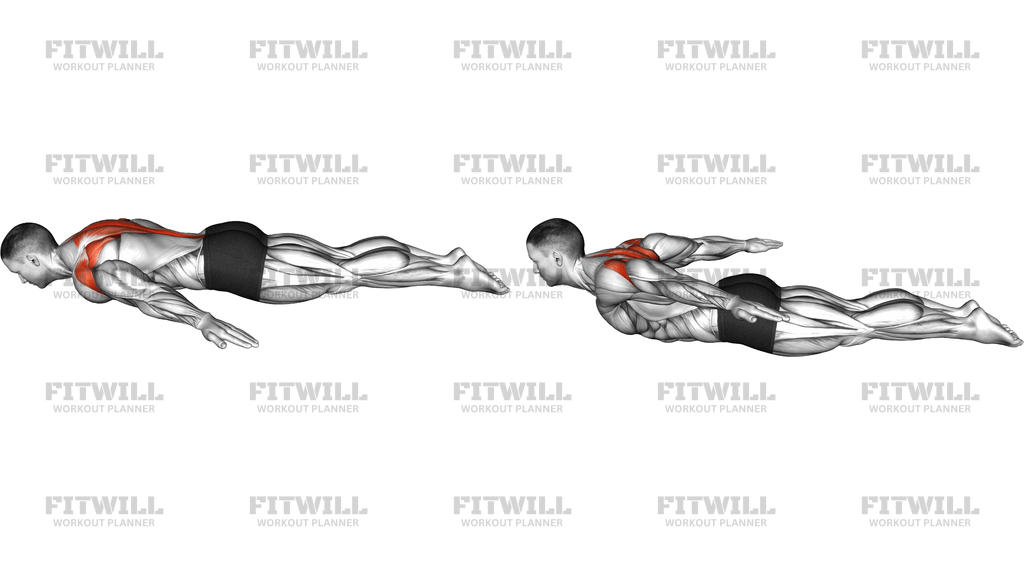
Instructions
- Lie face down on an exercise mat with your legs straight behind you and your feet about hip-width apart.
- Extend both arms straight overhead in line with your shoulders, palms facing the floor, so your body forms one long line from fingertips to toes.
- Point your toes away and rest your forehead gently toward the mat so your neck stays in a neutral line rather than craning upward.
- Take a breath in, brace your abdominal muscles lightly, and squeeze your glutes before anything moves.
- Exhale as you lift your arms, chest, and legs off the floor at the same time, keeping the lift small and even from both ends.
- Hold the raised position with the arms reaching forward and the legs squeezed straight, keeping the shoulder blades pulled gently down toward the hips.
- Breathe steadily throughout the hold, avoiding the temptation to hold your breath as the position gets harder.
- After the hold time is up, lower your arms, chest, and legs back to the floor slowly rather than dropping.
- Rest for a few seconds with your arms relaxed at your sides, then re-lengthen your body before starting the next hold.
Tips & Tricks
- Lift only a few inches off the floor — height is not the goal here, and reaching for maximum clearance usually just arches the lower back aggressively.
- If your neck aches during the hold, you are most likely looking up. Keep your gaze down at the mat so the back of your neck stays long.
- Reach your fingertips actively toward the wall ahead of you during the hold; this keeps the upper back and rear shoulders working instead of letting the arms hang limp.
- When the legs refuse to stay lifted, the usual culprit is inactive glutes. Squeeze them hard before lifting instead of trying to raise the legs with the lower back alone.
- If your lower back tires before anything else, shorten the hold to 10 to 15 seconds rather than arching harder to finish the set.
- Do not bounce or pulse up and down to buy time — this variation gets its value from a steady, unmoving hold.
- Placing a thin towel under the hip bones and rib cage can make longer holds much more comfortable on a firm floor.
- Keep the legs together and pointed; letting the feet drift wide or turn inward usually means the hips have lost their extension.
- Use it as a finisher after deadlifts or rows, or as a standalone set of two to four holds on days you are not lifting heavy.
Frequently Asked Questions
Which muscles does the Superman Back Raise Hold work the most?
The erector spinae along the lower back do the bulk of the work holding your chest up. The glutes lift and hold the legs, while the upper back and rear shoulders keep the extended arms raised.
Is the Superman Back Raise Hold good for beginners?
Yes, it is one of the simplest ways to train the posterior chain with zero equipment. Beginners should start with 10 to 15 second holds and stop the set once the lift height starts dropping.
How high should I lift during the Superman Back Raise Hold?
Only a few inches — enough that your arms, chest, and legs are clearly off the floor. Chasing height leads to excessive arching in the lower back rather than better muscle work.
Why does my neck hurt when I do the Superman Back Raise Hold?
Almost always because the head is tilted up to look forward. Rest your gaze toward the mat and keep the back of your neck long so the neck muscles stay relaxed.
How long should I hold the Superman Back Raise position?
Fifteen to forty seconds per hold works well for most people. Once you cannot maintain an even lift with steady breathing, the set is over even if the timer says otherwise.
Can I do the Superman Back Raise Hold every day?
Because the load is light and it is a static hold, many people tolerate it several days a week. Still, treat it like any training stress — if your lower back feels consistently fatigued or sore, scale back the volume.
What can I use instead of the Superman Back Raise Hold?
A reverse back extension on a bench or Roman chair trains the same hip and back extension pattern with a larger range of motion. Bird dogs are a good lower-load alternative if the prone position is uncomfortable.
Why do my legs drop before my arms during the hold?
The legs are being held up mainly by the glutes and hamstrings, so they usually fail first. Squeeze the glutes deliberately before lifting and keep the legs straight to share the work.
Should I hold my breath during the Superman Back Raise Hold?
No. Keep breathing in a slow, steady rhythm throughout the hold — breath-holding makes the position harder and builds unnecessary internal pressure.