Cobra To Child Pose
Cobra To Child Pose is a flowing body weight stretch that moves between two opposite ends of the spinal range. You start lying face down on the floor, press your chest up into a cobra position with an extended spine and open chest, then travel back into child's pose by drawing your hips toward your heels and reaching your arms forward. Moving between these two shapes loops your spine through extension into flexion while your shoulders and hips follow, making it a complete reset for the whole back line of the body.
This transition is especially useful first thing in the morning, between heavy lifting sets, or as a warm-up before training that demands spinal mobility, such as squats, deadlifts, overhead pressing, or any barbell work off the floor. Desk workers and anyone who spends long hours sitting tend to feel it quickly, since the cobra phase opens the front of the hips and abdomen while the child's pose phase rounds and decompresses the lower back. Because you control both ends with body weight alone, the intensity is easy to scale for stiff beginners and flexible practitioners alike.
The muscles being stretched differ at each end of the movement. In cobra, the abdominal wall, hip flexors, and chest lengthen while the spinal erectors, glutes, and triceps work to hold you up. In child's pose, the erectors, lats, and shoulder extensors get their stretch, and the hips are folded into flexion. Alternating between them trains your spine through its full pain-free arc rather than locking you into one shape, which is exactly what a good warm-up should do.
Setup matters more than most people expect. Place your hands under your shoulders with fingers spread, keep your thighs and the tops of your feet in contact with the floor during the cobra, and let the hips stay heavy rather than riding up. If the hands drift too far forward or the shoulders shrug toward the ears, the lower back takes the entire load of the extension and the shoulders lose their anchor. A modest, even arch beats a cranked-back neck and jammed facet joints every time.
To execute the flow well, press the floor away to lift the chest, breathe into the front of the torso for a moment, then walk the hands back toward the knees as you push the hips rearward to settle into child's pose. Let the forehead rest down or hover close to the mat, arms extended overhead. Move with the breath: inhale into cobra, exhale into child's pose. There is no rush; two to three seconds of transition in each direction keeps the spine articulate instead of dumping into either end range.
A few practical points keep this safe. Never force the cobra by yanking with the arms; the lift should come from the back and the press of the hands, not a pull. If you feel pinching in the lower back, reduce the height of the extension. If child's pose compresses the knees, place a folded towel behind them or widen the knees. Anyone with acute back pain or a recent spinal issue should work within a short, pain-free range and stop short of any sharp or radiating sensation.
[ Workout Log & Planner ]
Put your next workout in Fitwill
Keep your plan and training log ready when you are.


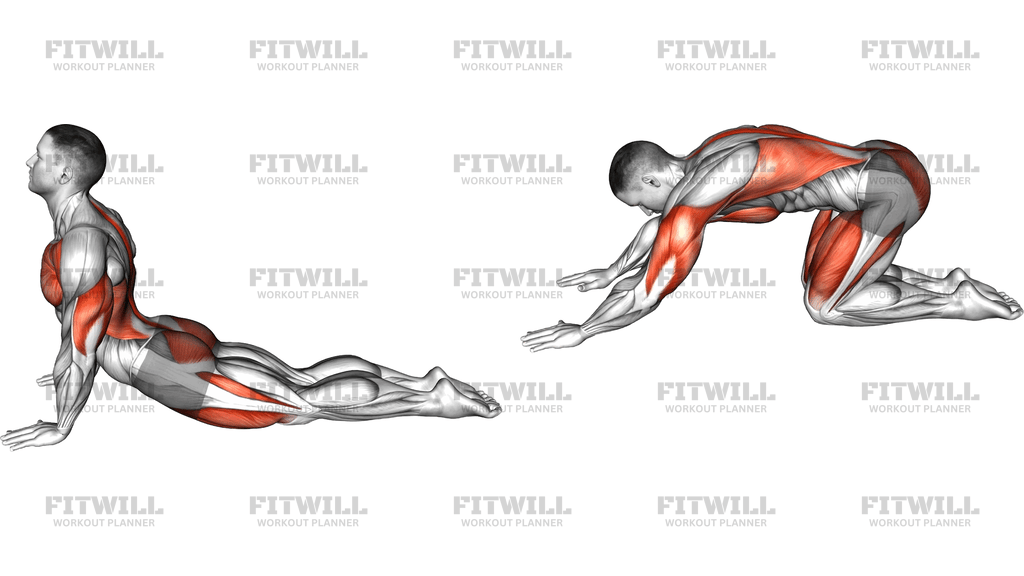
Instructions
- Lie face down on an exercise mat with your legs extended behind you, the tops of your feet on the floor, and your hands planted under your shoulders with fingers spread.
- Draw your shoulder blades down and back so the shoulders sit away from your ears before you lift anything.
- Press your palms into the floor and slowly raise your chest and head into the cobra position, keeping your hips, thighs, and the tops of your feet heavy on the mat.
- Hold cobra for two to three breaths, letting your abdominal wall and hip flexors lengthen while your back muscles support the arch; keep your elbows slightly soft rather than locked.
- On an exhale, push your hips back toward your heels and drag your hands along the floor toward your knees as your torso lowers into child's pose.
- Settle with your hips on or near your heels, arms extended forward on the mat, and let your forehead rest down while your spine rounds gently.
- Hold child's pose for two to three breaths, feeling the stretch across your lower back and along the sides of your back near the armpits.
- Travel forward again by shifting your weight into your hands and gliding your chest along the floor back toward the cobra position.
- Keep the rhythm tied to your breath: inhale as you rise into cobra, exhale as you fold back into child's pose.
- Repeat for 8 to 10 controlled repetitions, then rest; if anything pinches in the lower back, shorten the range of the cobra on the next rep.
Tips & Tricks
- The most common mistake is cranking the neck back in cobra; lead the lift with the sternum and keep the gaze slightly forward and down so the neck stays long.
- If your hips lift off the floor during cobra, you are pushing too hard with the arms—lower the chest a few inches and let the extension come from the back, not the elbows.
- In the transition, keep the hands glued to the mat; lifting them to reposition breaks the flow and loses the shoulder stretch on the way to child's pose.
- Wide knees in child's pose make room for larger hips or tighter lower backs; try this before giving up on the position entirely.
- If your knees complain when sitting back on your heels, slide a folded towel into the knee crease to reduce the fold.
- Do not rush the middle of the movement—the segment where your torso travels between the two poses is where most of the spinal mobility benefit lives.
- Tighten your glutes slightly in cobra; this protects the lower back from over-arching and makes the stretch feel even along the spine instead of hinging at one segment.
- Sore wrists are common here: grip your fingertips into the mat and shift weight slightly toward the base of the palm, or drop to forearms for the cobra portion.
- Use this as a positional reset between sets of deadlifts or rows rather than a long static hold; two or three slow reps restore movement without fatiguing the back.
Frequently Asked Questions
Which muscles does Cobra To Child Pose stretch?
The cobra phase lengthens the abs, hip flexors, and chest, while the child's pose phase stretches the lower back erectors, lats, and shoulder extensors. The back muscles also work isometrically to hold the arch in cobra.
Is Cobra To Child Pose suitable for beginners?
Yes, because the range is fully controlled by your own body weight. Beginners should simply keep the cobra lower to the floor and let the hips settle back only as far as the knees and lower back allow.
How is Cobra To Child Pose different from holding Cobra Pose statically?
Static cobra holds you in spinal extension the entire time, while the paired movement carries the spine through extension and flexion in one continuous flow. That oscillation makes it better suited to warm-ups and relieving stiffness.
Why does my lower back feel pinched when I press up into the cobra position?
The extension is usually being dumped into one segment because the hips have lifted or the arms are doing all the pulling. Lower the chest height, squeeze the glutes lightly, and keep the hips heavy on the mat.
Can I do Cobra To Child Pose if I have knee problems?
The child's pose portion folds the knees fully, so place a rolled towel behind the knees to reduce the angle, or substitute a seated forward fold for that half of the flow. Skip it entirely if kneeling on a mat is painful.
What can I use instead of Cobra To Child Pose?
A standing version of the same arc—gentle backbend with hands on the hips, followed by a forward fold with a rounded back—reproduces the pattern when getting on the floor is not practical.
How many repetitions should I do?
Eight to ten slow transitions tied to your breath works well as a warm-up or between-set reset. Hold each end position for two to three breaths rather than snapping back and forth.
Should my elbows be locked out in the cobra position?
No, keep a slight bend in the elbows so the lift comes from your back muscles and the press of your hands. Locked elbows tend to shove the shoulders up by the ears and overload the lower back.
Is it normal for my hips to sit above my heels in child's pose?
Yes, especially if you have tight hip flexors, quads, or ankles. Let gravity lower the hips gradually over weeks of practice rather than forcing them down, and widen your knees if that helps.
When is the best time to use Cobra To Child Pose in a workout?
It works best as a warm-up before barbell lifts or as a recovery flow after sitting for long periods. Avoid grinding into deep holds immediately after heavy deadlifts when the back is already fatigued.