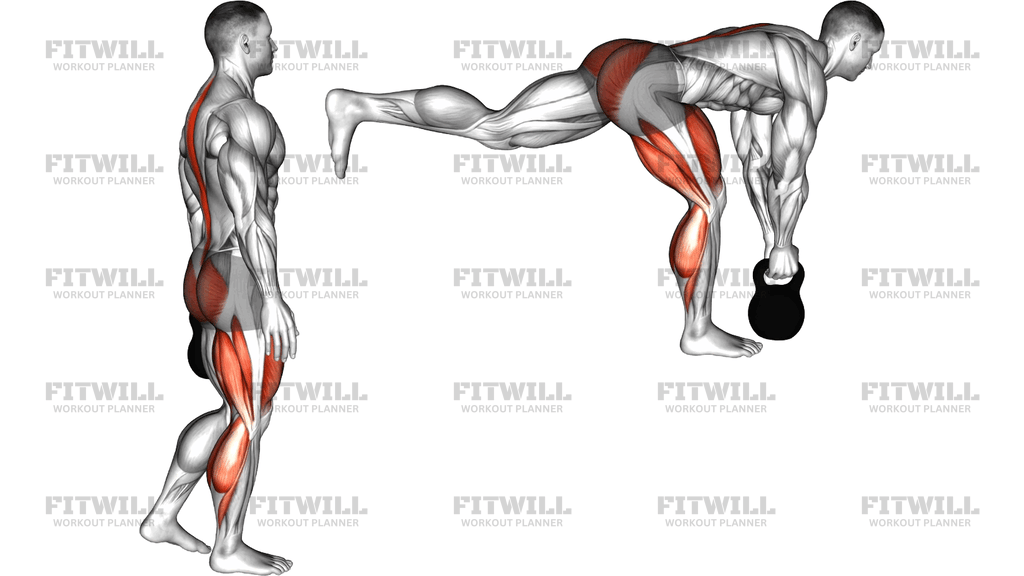
Standing Leaning Forward Walk
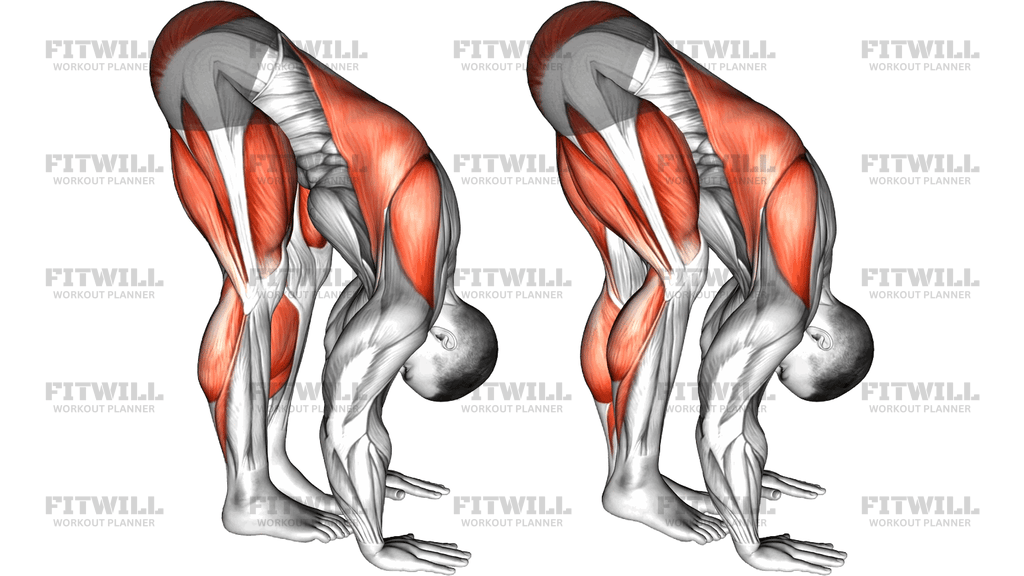
The Standing Leaning Forward Walk is a body weight locomotion drill performed from a deep forward fold, with your palms on the floor and your hips stacked high over your legs. Instead of holding that fold as a static stretch, you travel forward across the floor, alternating hand placements and foot steps while keeping your torso hinged toward your thighs. It is essentially a walking pattern squeezed into a bent-over position, which forces the back of your body to lengthen and load at the same time.
This drill earns its place in a warm-up or movement prep block because it combines three jobs at once: it lengthens the hamstrings and calves through active motion, builds isometric strength in the glutes and lower back as they hold the hinge, and loads the shoulders, wrists, and core as they support your upper body on the ground. Because your legs stay relatively straight, every foot step becomes a pulsing stretch through the posterior chain rather than a simple transfer of weight.
The setup matters more than most people expect. The height of your hips determines everything: hinge too low with a rounded back and you lose the hamstring tension and shift the work into your lumbar spine; keep the hips too high with soft knees and the drill turns into an ordinary walk with no real stretch. Aim for a long, flat line from your hips to your head, letting the knees bend only as much as needed to keep your palms flat on the floor.
To execute it well, walk your hands forward first, one at a time, then take small steps with your feet to follow, keeping your weight balanced between hands and feet throughout. Move slowly enough that you can feel each hamstring lengthen on every step. Short distances with clean positions beat long distances with a collapsing back.
The Standing Leaning Forward Walk suits lifters before deadlifts or squats, runners who need active hamstring work, and anyone building toward more demanding ground-based movements like the inchworm or bear crawl. It needs no equipment and only a few meters of floor space, which makes it an easy drill to program consistently. If your hamstrings feel the stretch but never pain, and your hands tolerate the pressure comfortably, you are in a safe range to keep working.
Fitwill
Log Workouts, Track Progress & Build Strength.
Achieve more with Fitwill: explore over 9600 exercises with images and videos, access built-in and custom workouts, perfect for both gym and home sessions, and see real results.
Start your journey. Download today!




Instructions
- Stand with your feet hip-width apart at one end of a clear floor space, arms relaxed at your sides.
- Hinge forward at the hips and place both palms flat on the floor in front of your feet, fingers spread and pointing forward.
- Straighten your legs as much as you comfortably can, keeping your hips high and your back long rather than rounded.
- Shift your weight slightly into your hands and brace your core to support your upper body.
- Walk your right hand forward a comfortable step, then your left hand, keeping both palms flat and your hips stationary and high.
- After the hands move, take small steps with your feet to follow, feeling each hamstring lengthen as the leg straightens behind you.
- Continue alternating hand-and-foot steps for a set distance, typically five to ten meters, keeping the torso folded toward the thighs the whole way.
- Breathe steadily throughout, exhaling as the hands reach and the legs step through.
- At the end of the distance, walk your feet up to your hands, then roll up to standing one vertebra at a time before resetting for the next pass.
- Reset the hinge each round so the fold stays deep and symmetrical rather than drifting to one side.
Tips & Tricks
- Bend the knees slightly if your hands cannot stay flat on the floor; a slight knee bend with a flat back beats straight knees with a rounded spine.
- Do not rush the steps. The hamstring stretch on each foot step is the point of the drill, and fast shuffling removes almost all of it.
- Keep your weight spread between hands and feet. Dumping all your weight into your shoulders fatigues them early and makes the walk wobbly.
- Watch that your hips do not drop as you travel forward. Hips sinking toward a squat position turn the drill into a bear crawl and off the hamstrings.
- If your wrists complain, spread your fingers wider and grip the floor slightly, or walk on your fists to keep the wrist in a neutral line.
- Avoid letting the head hang loosely and the upper back round into the fold; reach the crown of your head toward the floor to keep the spine long.
- Keep steps short. Long, greedy steps pull you toward your toes and can tip your balance forward onto your hands.
- Turn your toes slightly out and step in the same line as your hands if your hips feel cramped or twisted during the walk.
Frequently Asked Questions
Which muscles does the Standing Leaning Forward Walk work the most?
The hamstrings take the main load as they stretch and re-tension on every step, with the glutes and lower back holding the folded position. The shoulders, wrists, and core support your upper body while your hands are on the floor.
Can beginners do the Standing Leaning Forward Walk?
Yes. Beginners should allow a generous knee bend so the palms rest flat on the floor without forcing the fold, and cover a shorter distance per set. Flexibility will improve with consistent practice, and the knees can gradually straighten over time.
How far should I walk during one set of the Standing Leaning Forward Walk?
A five to ten meter pass is enough for most people, taking ten to twenty controlled steps. Stop the set when your form drifts, not when your muscles fail.
Should my knees be locked straight in the Standing Leaning Forward Walk?
No, never lock or force the knees straight. Keep them as straight as comfortable while maintaining a long back; slight knee bends protect the joint and let you keep your palms flat on the floor.
Is the Standing Leaning Forward Walk a stretch or a strength exercise?
It is both. It works as an active stretch for the hamstrings and calves while the glutes, lower back, shoulders, and core hold your body up and control the movement, which is why it fits well in a warm-up.
My wrists hurt when my hands are on the floor during the walk. What should I do?
Spread your fingers wide and press through the base of the fingers instead of the heel of the palm, or make fists and walk on your knuckles. Both options keep the wrist straighter and reduce the pressure.
What is the most common mistake in the Standing Leaning Forward Walk?
Rounding the lower back and letting the hips sink into a squat as the hands walk forward. Both errors shift the work away from the hamstrings and onto the spine; fix them by keeping the hips high and the back long throughout the set.
What can I use instead of the Standing Leaning Forward Walk if I have limited space?
Walk your hands out to a forward fold hold and step your feet in place, or perform the inchworm in a fixed lane. Both keep the same folded, hands-on-floor position in a much smaller area.
Is the Standing Leaning Forward Walk safe for people with lower back issues?
The folded position loads the hamstrings and the spine, so anyone with an irritated lower back should keep the knees bent, shorten the distance, and stop if symptoms worsen. When in doubt, check with a qualified professional before adding it to your routine.