Band Lying Leg Curl
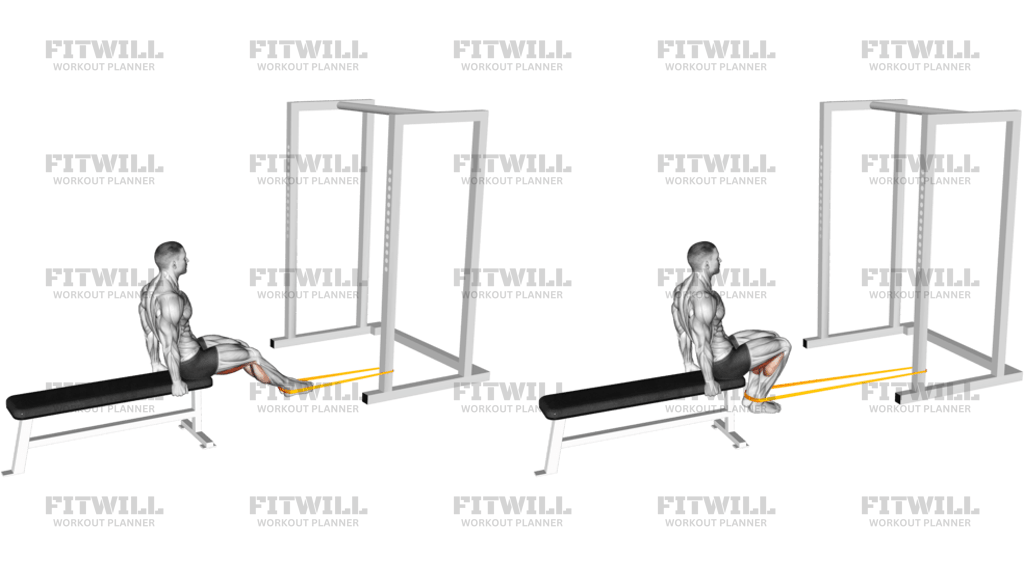
The Band Lying Leg Curl is a single-leg hamstring isolation exercise performed face down on the floor. A resistance band is anchored low behind you—typically looped around the base of a bench or similar sturdy object—and attached to one ankle with an ankle strap. From a flat prone position with arms folded under your forehead, you curl the working leg by pulling your heel toward your glutes against the band's tension, then lower it back down with control.
This movement is a great option when you don't have access to a lying leg curl machine. The band provides resistance that's lightest at the bottom, where the hamstrings are stretched, and heaviest near the top of the curl, which is the opposite strength curve of a machine but still an effective stimulus. Training one leg at a time also exposes and helps correct left-to-right imbalances that often go unnoticed on bilateral machines.
The hamstrings are the primary movers, working to flex the knee, while the calves assist, especially the gastrocnemius, which crosses the knee joint. The glutes and lower back work isometrically to keep your hips pressed down and your torso stable as the band pulls from behind.
Setup details matter more than they might seem. Because you're lying on the floor with the band anchored behind you, the distance from the anchor point determines how much tension you start with—if you're too close, the band goes slack at the bottom and the rep loses its stretch; too far and you can't reach full knee flexion. Position yourself so there's steady tension at the start of every rep.
Execution is simple but easy to rush. Keep your hips in contact with the floor throughout, curl the heel up until the knee is fully bent, pause briefly at the top, then resist the band on the way down rather than letting it snap the leg back. The lowering phase is where most of the muscle-building value lives, so give it at least two to three seconds.
This exercise suits home trainees, people rehabilitating knee flexion strength with light load, and lifters who want a supplementary hamstring movement after heavier work like Romanian deadlifts or Nordic curls. Since it requires no loading on the spine and minimal equipment, it's also a low-friction way to add hamstring volume on days you can't get to the gym.
[ Workout Log & Planner ]
Put your next workout in Fitwill
Keep your plan and training log ready when you are.


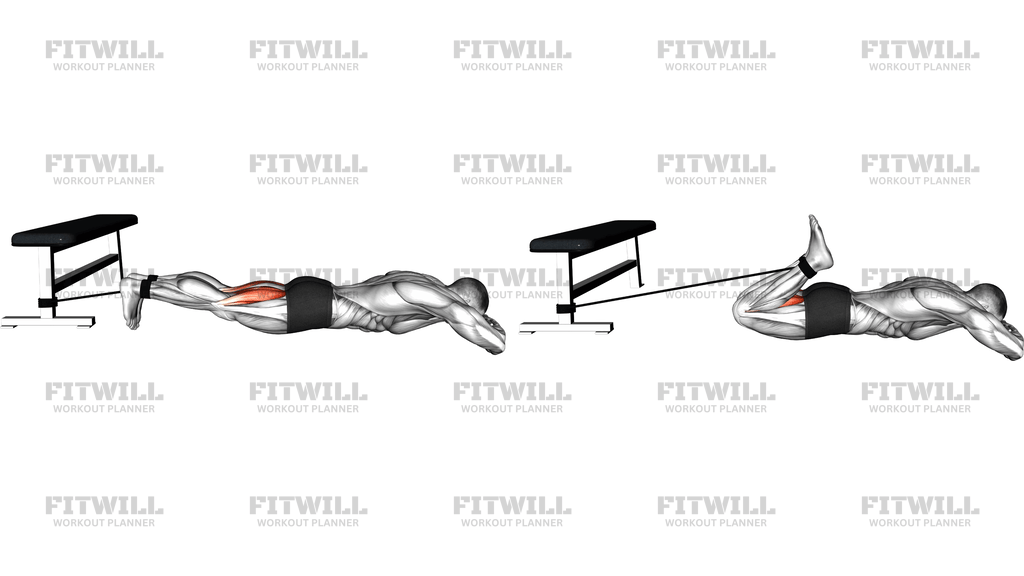
Instructions
- Loop a resistance band around the base of a bench or another low, stable anchor, and attach the free end to the ankle strap on one ankle.
- Lie face down on the floor with your head away from the anchor point, far enough that the band pulls with light, steady tension even when your leg is straight.
- Fold your arms and rest your forehead on them, and extend the working leg straight back so your thigh, hip, and torso form one line.
- Brace your core lightly and press both hips into the floor so your lower back stays flat and your pelvis doesn't tilt.
- Curl the working heel up toward your glutes by bending the knee, keeping the band pulling directly behind you.
- Continue until the knee is fully bent and the heel is close to your glutes, then squeeze the hamstring for a brief pause.
- Lower the leg slowly over two to three seconds, resisting the band's pull until the knee is straight again.
- Exhale as you curl up, inhale as you lower, and keep the breathing steady throughout the set.
- Complete all reps on one leg, then reposition the strap on the other ankle and match the rep count on the second side.
Tips & Tricks
- If the band goes slack when your leg is straight, slide your body further from the anchor—losing tension at the bottom removes the stretched-position work that makes this variation worthwhile.
- Don't let your hip lift off the floor as you curl; a rising hip means the band tension is beating your pelvic control, so reduce band tension or slow the rep down.
- Point your toes downward slightly (plantar flexion) to reduce calf contribution and put more of the work on the hamstrings.
- Keep the working knee from drifting out to the side as you curl—the band pulls straight back, and any sideways movement changes the line of pull on the hamstring.
- Avoid kicking the leg up using momentum; if you can't pause for one second at the top of the curl, the tension is too heavy.
- The non-working leg can stay straight or bend slightly at the knee—use whichever position lets you keep your torso from twisting.
- Place a small pad or towel under your hips if the floor position is uncomfortable on your thigh bones or pelvis.
- The band's resistance is hardest near full knee bend, so expect the last few degrees of the curl to feel different from a machine—fight for the complete range rather than stopping short.
- Check that the ankle strap is snug but not cutting into your skin; a loose strap can slide during the set and shift the band's pull.
Frequently Asked Questions
What muscles does the Band Lying Leg Curl work?
The hamstrings are the primary movers, bending the knee against the band's resistance. The calves assist, and the glutes and lower back stabilize your hips and torso while you lie face down.
Why is the band anchored behind me instead of in front?
With the band pulling backward from behind, it resists the heel moving toward the glutes, which is exactly the knee-flexion direction the hamstrings produce. Anchoring in front would resist the wrong part of the movement.
Is the Band Lying Leg Curl good for beginners?
Yes. It's floor-based, spine-friendly, and the load is easy to adjust by changing band thickness or your distance from the anchor. Beginners should start with a light band and focus on a slow lowering phase.
How far should I lie from the bench or anchor point?
Far enough that the band keeps light tension even with your leg fully straight. If the band goes slack at the bottom of each rep, move further away or switch to a shorter band.
Why do my hips keep lifting off the floor?
The band pulls your leg backward and slightly upward, and a strong curl can tip the pelvis. Reduce the band tension, slow the tempo, and consciously press your hips down before each rep.
Can I do this without an ankle strap?
You can loop the band directly around your ankle, but a strap is more comfortable and less likely to slip mid-set. If looping the raw band, make sure it sits flat and doesn't roll up on your skin.
How does the Band Lying Leg Curl compare to a lying leg curl machine?
Both train knee flexion in a prone position, but the band is easiest at the bottom and hardest at the top, the reverse of most machines. It's a lighter-load option, so treat it as a supplement or home substitute rather than an exact match.
How many reps and sets should I do?
Two to three sets of 10 to 15 reps per leg works well, since band resistance tends to be moderate. If you can easily exceed 20 reps, move further from the anchor or use a thicker band.
Is it safe for my knees?
It's generally a low-stress movement because the band offers little load in the stretched position. Keep the movement smooth, avoid snapping the leg back on the way down, and stop if you feel pinching or sharp pain in the knee.