45 Degrees Arms Plank
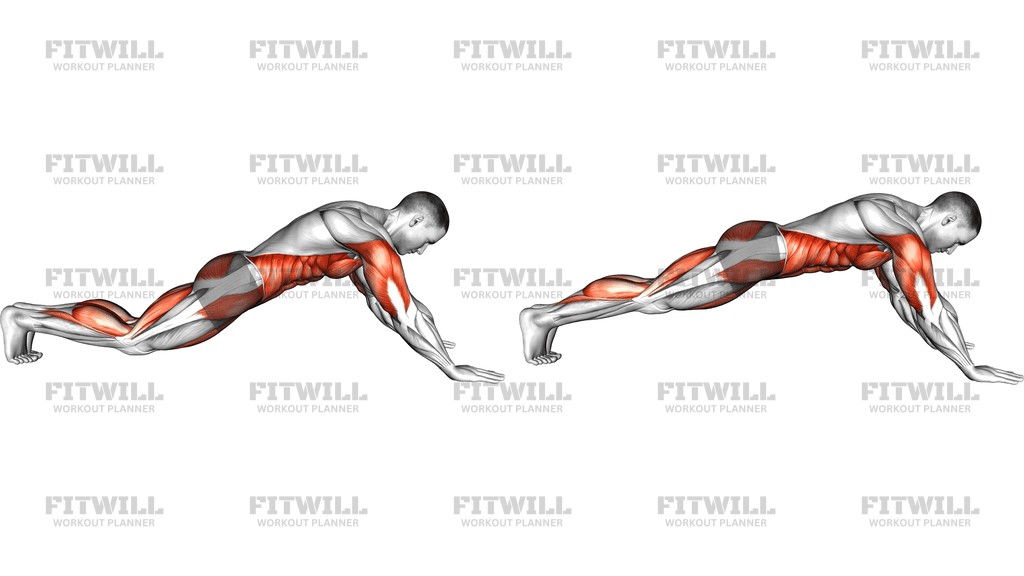
The 45 Degrees Arms Plank is a bodyweight hold that places your body on a diagonal and your arms extended well in front of your shoulders, creating a long lever that your core has to hold together. Instead of stacking your wrists directly under your shoulders as in a standard plank, you reach your hands forward on the floor so your body slopes down at roughly 45 degrees toward your hands. That longer distance between your shoulders and your anchor point is what makes this variation significantly harder than it looks.
Because the arms are extended, this movement shifts the demand away from the shoulders and triceps doing the supporting and onto the abs, obliques, and deep core stabilizers, which must keep the ribs, hips, and legs locked into one straight line. The glutes and thighs stay active to hold the hips level, while the shoulders and triceps work isometrically to keep the extended arms from collapsing toward the floor.
This variation is a strong choice for anyone who has mastered a regular plank and needs more of a challenge without adding external load. It is also a useful stepping stone toward more demanding core tools like the ab wheel or rollout progressions, since it teaches the same skill: resisting extension as the lever lengthens.
Setup matters here more than in most planks. If your hands drift too wide or your hips sag, the angle changes and the abs stop doing the work. Start with your knees on the floor, place your palms down with fingers spread, and walk your hands forward only as far as you can keep a rigid line from head to heels. The further forward the hands travel, the more the body flattens toward the floor and the harder the hold becomes.
Execute the hold by bracing your abs, squeezing your glutes, and pressing your palms firmly into the floor. Keep your neck neutral by looking down at the floor between your hands, and breathe shallow but continuous breaths rather than holding your air. Aim for quality over duration: twenty to forty seconds of a genuinely straight line beats a minute of sagging hips.
Use the 45 Degrees Arms Plank as a finisher after heavier lifts, as a standalone core block two or three times a week, or as a progression test. When you can hold a clean position for forty-five seconds, walk your hands another inch or two forward to increase the difficulty, or move on to kneeling rollouts.
[ Workout Log & Planner ]
Put your next workout in Fitwill
Keep your plan and training log ready when you are.


Instructions
- Kneel on an exercise mat and place your palms flat on the floor, fingers spread, with your hands positioned well in front of your shoulders rather than underneath them.
- Walk your hands forward until your body forms a straight diagonal line at roughly 45 degrees to the floor, with your weight supported on your palms and the balls of your feet.
- Set your feet about hip-width apart with toes tucked under and heels pressing back.
- Brace your abs as if bracing for a light punch, and squeeze your glutes to lock your pelvis into a neutral position.
- Press your palms hard into the floor and push the floor away slightly to keep your upper back from sinking between your shoulder blades.
- Hold this extended position with your body in one straight line from head through hips to heels, eyes looking down at the mat between your hands.
- Breathe in a steady, shallow rhythm through your nose and mouth; do not hold your breath during the hold.
- When your hips start to sag or your lower back arches, end the set rather than pushing into a broken position.
- To reset, walk your hands back toward your knees and sit back on your heels briefly before starting the next hold.
Tips & Tricks
- The most common mistake is letting the hips drop toward the floor as fatigue sets in, which turns the drill into a lower back stretch instead of a core exercise. Film yourself from the side once to see exactly where your line breaks.
- If your shoulders burn before your abs do, your hands may be too far forward for your current strength. Walk them back a few inches until the abdomen becomes the limiting factor.
- Keep your elbows straight but not locked hard; soft elbows let the triceps and shoulders share the load without straining the joint.
- Avoid letting your chest sink between your shoulder blades. Think of pushing the floor away to keep a broad upper back throughout the hold.
- Do not flare your ribs upward. If your lower back arches, exhale fully and tuck your pelvis slightly before settling into the hold.
- Stopping the set at the first sign of hip sag builds better habits than grinding through a rep time you cannot hold cleanly.
- On a slick floor, wear shoes or place your hands on a mat with grip, since sliding hands forward mid-hold changes the angle and can cause a sudden collapse.
- Progress by distance, not just time: once forty-five seconds feels solid, walk your hands an inch or two further forward instead of simply holding longer.
Frequently Asked Questions
What muscles does the 45 Degrees Arms Plank work?
The abs and deep core are the primary workers, with the obliques, glutes, and thighs keeping the pelvis and legs aligned. The shoulders and triceps hold the extended arms in place isometrically.
Why are the arms extended forward instead of under the shoulders?
Extending the arms lengthens the lever between your shoulders and your base of support, which forces the core to resist much greater extension force. This is the same principle that makes ab wheel rollouts difficult.
Is the 45 Degrees Arms Plank suitable for beginners?
Yes, if the hands are kept closer to the shoulders at first. Beginners should start with a shorter reach and build up to the full 45-degree angle as their plank strength improves.
How long should I hold the 45 Degrees Arms Plank?
Aim for twenty to forty seconds with a perfectly straight body line. If you cannot hold the position cleanly past that window, reduce the reach of your arms or end the set early.
What should I do if my lower back hurts during the hold?
Lower back discomfort usually means the hips have sagged and the spine has arched. Stop, reset with a strong glute squeeze and a braced abdomen, and try a shorter arm reach before returning to the full position.
How is this different from a standard forearm or straight-arm plank?
In a standard plank the wrists sit under the shoulders, so the shoulders carry much of the load. With the arms extended forward at an angle, the leverage shifts the challenge onto the abdominal wall, making the hold feel far harder at the same bodyweight.
Can I use the 45 Degrees Arms Plank to prepare for ab wheel rollouts?
Yes, it is one of the best preparatory drills because it trains the same anti-extension skill with a fixed lever. Once you can hold a clean position with the hands far forward, kneeling rollouts are a natural next step.
Should my feet be together or apart?
Hip-width apart gives you a more stable base and makes it easier to keep the hips level. Bringing the feet together is a later progression that narrows the base and increases the demand on the obliques.
What floor surface works best for this exercise?
A mat or any non-slip surface is ideal, since your palms are loaded with your hands far from your body and any sliding changes the angle mid-hold. Avoid very slick floors, especially in socks or smooth-soled shoes.