Kneeling Plank Shoulder Tap
The Kneeling Plank Shoulder Tap is an anti-rotation core exercise performed from a shortened plank position with both knees on the floor and your forearms supporting your upper body. From there, you lift one hand, tap the opposite forearm or shoulder, and place it back down without letting your hips sway. The kneeling setup shortens the lever and removes much of the load that a full plank places on the lower back, which makes the movement approachable while still demanding real control through the trunk.
The main job here is resisting rotation. Every time one hand leaves the floor, your torso wants to twist and your hips want to shift sideways, and your deep core, obliques, and shoulder stabilizers have to work together to keep everything square. That makes it a useful drill for anyone building plank strength, recovering from long hours of sitting, or working on the trunk control that carries over to push-ups, carries, and overhead work.
Setup matters more than speed. Knees stacked under or slightly behind the hips, elbows directly beneath the shoulders, and a braced midsection give you a stable base before the hand ever lifts. If you rush into the tap from a sloppy position, you end up training the wobble instead of the control, and the movement loses its point.
Execution should look almost boring from the outside: a slow lift, a deliberate tap, a quiet return, then the same thing on the other side. Moving slowly is what exposes the weak link, whether that is a hip that drops, a shoulder that dumps into the supporting arm, or a breath you forgot to take. Beginners can start with a few reps per side and short sets; more experienced lifters can slow the tempo, add pauses, or extend the set duration.
You will see this exercise in warm-ups, core finishers, and rehab-style programs because it loads the trunk without heavy equipment and scales easily. All you need is floor space and, ideally, an exercise mat to cushion the knees and forearms. If your wrists or shoulders complain during full planks, the kneeling version often lets you train the same anti-rotation quality with far less strain.
[ Workout Log & Planner ]
Put your next workout in Fitwill
Keep your plan and training log ready when you are.


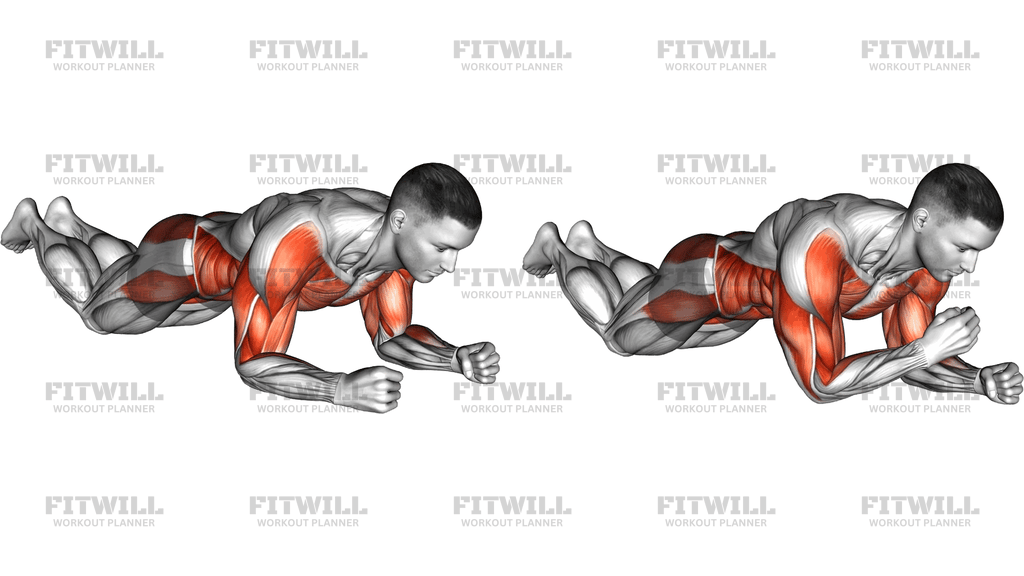
Instructions
- Kneel on an exercise mat with both knees on the floor and your shins resting down, feet lifted behind you.
- Lower onto both forearms and set your elbows directly under your shoulders, forearms parallel or slightly turned in with relaxed fists.
- Pull your shoulders down away from your ears so you are not sinking into the supporting arm.
- Brace your abs and squeeze your glutes to lock your pelvis in a neutral position before moving.
- Keeping your torso square to the floor, lift one hand and tap the opposite forearm or shoulder.
- Pause briefly at the tap, then place the hand back down on the mat under control.
- Alternate sides, completing one tap at a time rather than a fast back-and-forth rhythm.
- Breathe steadily throughout, exhaling as you lift the hand and inhaling as you return it.
- Reset your brace every few reps; if your hips start rocking or your lower back sags, stop the set rather than pushing through.
Tips & Tricks
- Widen your knees slightly if the tap is hard to control; a wider base makes the anti-rotation demand easier before you narrow it.
- Watch your hips in a mirror or film a set from behind — any sideways drift means the rotation is winning, so slow the tap down.
- Keep your weight centered between both forearms before each lift; leaning onto the supporting arm before the tap throws your balance off early.
- Do not let the lifted shoulder collapse toward the floor; think about pushing the supporting forearm into the mat throughout the rep.
- Squeeze the knee of the working side into the mat as you tap — it helps anchor the pelvis and reduces hip sway.
- A common mistake is rushing the alternation like a mountain climber; the value is in the pause, not the rep count.
- If your elbows creep forward as you fatigue, walk them back under your shoulders before continuing instead of compensating.
- Keep your neck long and your gaze down at the mat; craning up adds tension to the upper traps and pulls your spine out of line.
Frequently Asked Questions
What muscles does the Kneeling Plank Shoulder Tap work?
The primary work comes from the deep core and abs holding the plank position against rotation, with the obliques handling most of the anti-twist demand. The front of the supporting shoulder and the glutes also stay active to keep the torso and pelvis steady.
Why is this done from the knees instead of a full plank?
Kneeling shortens the lever and reduces the load on the lower back and shoulders, letting you focus purely on controlling rotation. Once you can keep your hips perfectly still for a full set, progressing to a full high plank shoulder tap is a natural next step.
Should I tap my shoulder or my opposite forearm?
Tapping the opposite forearm or wrist keeps the range shorter and is easier to control; reaching to the opposite shoulder adds a slightly longer lever. Choose whichever lets you keep your hips square, and start with the forearm tap if you are unsure.
How do I stop my hips from rocking side to side?
Slow the movement down, re-brace your abs before each lift, and spread your knees a little wider for a more stable base. If the sway persists, your core is fatigued or the tempo is too fast, so shorten the set and reset.
Is the Kneeling Plank Shoulder Tap good for beginners?
Yes, it is one of the more accessible anti-rotation drills because the kneeling position removes much of the load while still training the trunk control that planks and push-ups require. Beginners can start with five or six controlled taps per side.
What is the most common mistake in this exercise?
Rushing the taps and turning the movement into a fast alternation, which lets momentum do the stabilizing. Another frequent error is letting the supporting shoulder sink toward the floor instead of actively pressing the forearm down.
Can I substitute another exercise if my elbows hurt on the mat?
Try a high kneeling plank with hands under shoulders and tap the opposite shoulder from there, or place a folded towel under your forearms for padding. Both versions keep the same anti-rotation demand while removing pressure from the elbow area.
How many reps and sets should I do?
Two or three sets of eight to twelve taps per side works well as a core finisher or warm-up drill. Focus on quality reps where your torso stays square; if form breaks down at any point, end the set.
How does this exercise carry over to other training?
The anti-rotation control you build here supports push-ups, overhead presses, loaded carries, and any movement where one side works while the trunk has to stay level. It is a low-fatigue way to reinforce that pattern several times a week.