Elbow Plank Thigh Tap
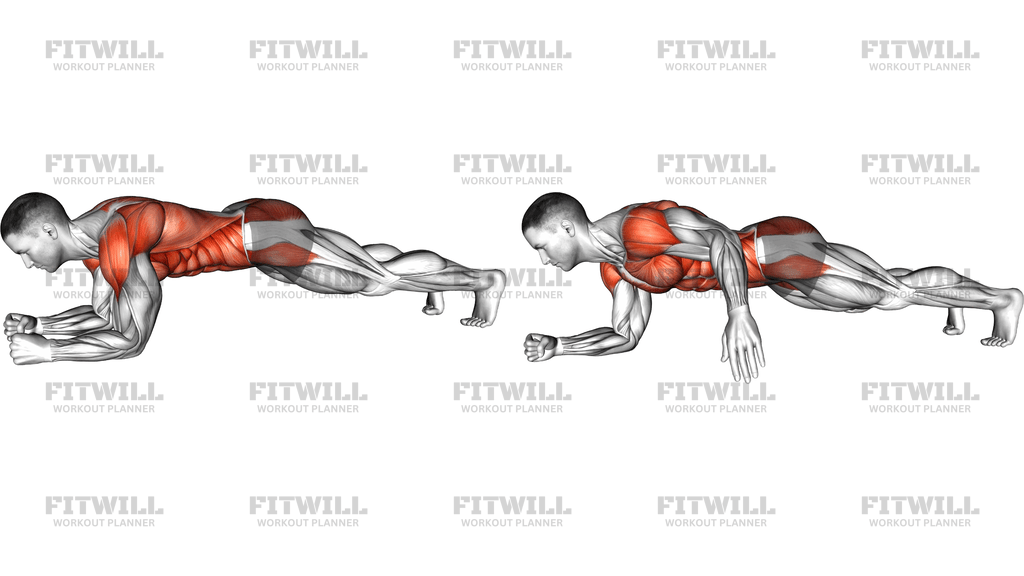
The Elbow Plank Thigh Tap is an anti-rotation core exercise performed from a forearm plank. Instead of simply holding still, you lift one hand off the floor, reach it across your body to tap the opposite thigh, and then return the hand to the floor without letting your hips or shoulders twist. That single point of contact changing turns a static plank into a balance and control challenge that immediately exposes how stable your trunk really is.
This movement is useful for almost anyone who planks. If you can hold a solid forearm plank for 30 seconds or more, this gives you a harder progression without adding external weight. It is especially valuable for lifters and athletes who need trunk stability under asymmetric loading, such as when carrying something on one side or pressing with one arm, because the tap creates exactly that kind of uneven demand.
The primary work comes from the deep core, including the transverse abdominis, along with the obliques, which have to resist the rotation that the reaching arm naturally creates. The supporting shoulder endures most of your body weight on its own during the tap, so the deltoids, rotator cuff, and the muscles around the shoulder blade get significant stabilizing work. The glutes and legs stay active to keep the hips level and the body in a straight line from head to heels.
Setup matters more here than in a standard plank because a poor starting position falls apart the moment one hand lifts. Place your elbows directly under your shoulders, keep your feet about hip-width apart for a slightly wider and more forgiving base, and set your hips in line with your shoulders rather than pitched up or sagging down. Brace your midsection as if bracing for contact before you even think about moving a hand.
To execute it well, shift your weight subtly toward the supporting side, lift one hand smoothly, and tap the top of the opposite thigh near your hip. The tap should be light and deliberate, not a slap, and the hand should return to its original spot directly under the shoulder. Move slowly enough that your hips never visibly rock side to side; if they do, you are moving faster than you can control.
Aim for sets of 6 to 10 taps per side with clean, level hips rather than chasing a long list of fast reps. This exercise pairs well with side planks, bird dogs, and Pallof presses in a core circuit, or it can serve as the finishing anti-rotation block after your main lifting work.
[ Workout Log & Planner ]
Put your next workout in Fitwill
Keep your plan and training log ready when you are.


Instructions
- Set up on an exercise mat in a forearm plank with your elbows directly under your shoulders, forearms parallel or angled slightly inward, and your hands relaxed rather than clasped tight.
- Set your feet about hip-width apart so your base is slightly wider than a narrow plank, and straighten your legs with your heels pushing back.
- Squeeze your glutes, tuck your pelvis slightly, and brace your abs so your body forms one straight line from your head through your heels.
- Take a breath in, then shift a small amount of your weight into your left forearm as you prepare to lift the right hand.
- Lift your right hand off the floor and reach it across the front of your body to tap the top of your left thigh near the hip, keeping your shoulders square to the floor.
- Hold the tap for a brief moment while keeping both hips level and your supporting elbow stacked under your shoulder.
- Return your right hand to its exact starting spot under your shoulder with control, then re-brace and settle back into a still plank.
- Exhale as you reach and tap, inhale as the hand returns, and keep your breathing steady rather than holding your breath.
- Complete all reps on one side or alternate hands rep by rep, resetting your plank position between reps if your hips drift.
- Stop the set when your hips start rotating or sagging, since continuing past that point trains the compensation instead of the core.
Tips & Tricks
- Widen your feet slightly if you notice your hips tipping toward the side of the lifting hand; a wider stance reduces the balance demand and lets you focus on keeping the torso square.
- The most common mistake is rotating the shoulders as the hand crosses the body. Imagine a glass of water resting on your upper back that you cannot spill during the tap.
- Do not clasp your hands together in the plank. Keeping the hands free makes the hand path to the thigh cleaner and prevents you from rolling onto the edge of the supporting forearm.
- Tap the thigh near the hip rather than reaching toward the knee. Reaching further down pulls your shoulder forward and loads the supporting joint in a less stable position.
- If you feel it in your lower back, your ribs are probably flaring as the hand lifts. Re-tuck the pelvis and think about pulling your belly button slightly toward your spine before the next rep.
- Slow the tap down before making it harder. A three-second reach with level hips builds more control than a fast tap that slips into rotation.
- Keep a soft bend at the neck and look at the floor just ahead of your hands. Craning up or dropping the head usually happens at the same time as a sagging chest.
- Warm up your shoulders with a few standard forearm planks or shoulder taps before starting, since one arm carries nearly all your weight during each rep.
- If your hips rock with every rep, regress to lifting the hand just an inch off the floor without tapping, and progress to the full thigh tap once that feels steady.
Frequently Asked Questions
What muscles does the Elbow Plank Thigh Tap work?
The deep core and obliques do most of the work as they resist rotation while one hand reaches across to the opposite thigh. The supporting shoulder and the glutes also work hard to hold the plank position steady.
How is the Elbow Plank Thigh Tap different from a regular forearm plank?
A regular plank holds a static position on two arms, while the thigh tap removes one point of support and adds a reaching motion. This makes it an anti-rotation and anti-lateral flexion challenge rather than a pure hold.
Is the Elbow Plank Thigh Tap suitable for beginners?
Yes, if you can already hold a forearm plank with decent form for around 30 seconds. Beginners can shorten the reach, tap closer to the supporting side, or simply lift the hand slightly off the floor before attempting the full tap.
Why do my hips twist when I tap my thigh?
The hips rotate because the obliques and glutes are not yet controlling the shift in weight. Widen your feet, slow the movement down, and think about pressing the supporting forearm firmly into the floor to anchor your torso.
Should I tap the thigh near the hip or the knee?
Tap near the hip. Reaching toward the knee lengthens the arm path, pulls the supporting shoulder forward, and makes it much harder to keep your torso square to the floor.
What can I use instead of the Elbow Plank Thigh Tap?
Shoulder taps from a high plank are the closest substitute, or you can use a Pallof press or bird dog to train the same anti-rotation quality. A standard forearm plank is a simpler regression if balance is the limiting factor.
How many reps and sets should I do?
Two to three sets of 6 to 10 controlled taps per side works well for most people. Prioritize hips that stay level over total reps, and stop a set as soon as form starts to slip.
Is it safe for my shoulders and lower back?
For most people with healthy shoulders and a pain-free back, yes, as long as the elbow stays stacked under the supporting shoulder and the ribs do not flare. If either area hurts during the tap, regress the range or consult a qualified professional before continuing.