Plank 4 Point Hops
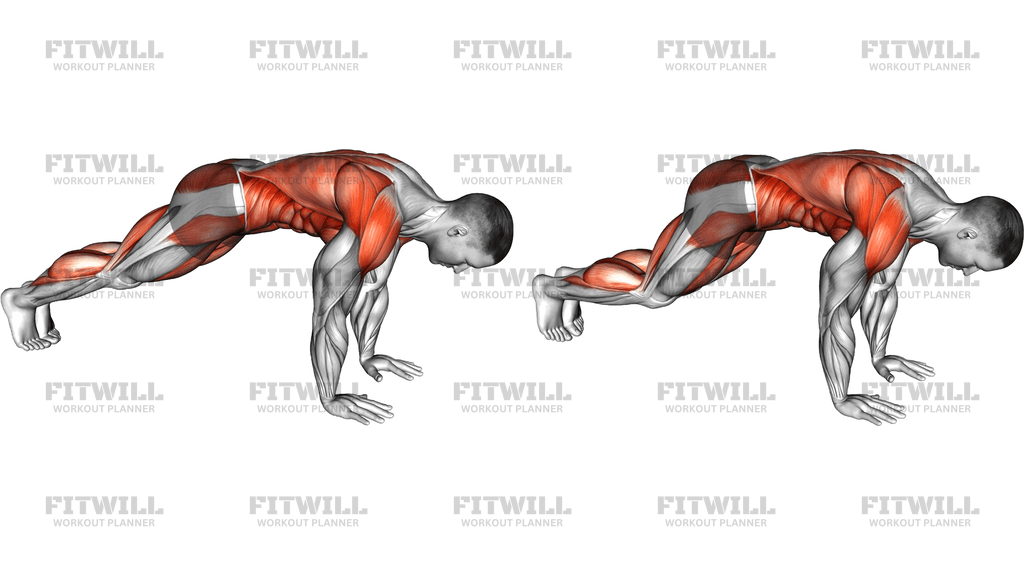
Plank 4 Point Hops are an explosive body weight drill performed from a high plank with your hands staggered — one positioned forward under your shoulder and one set back near your ribs. From there, you hop all four contact points off the floor at once and switch their positions mid-air, landing with the opposite hand forward and the opposite foot forward. The illustration shows the two phases side by side: identical plank posture, with the hand and foot placements reversed between reps.
This is a plyometric core exercise first and a shoulder exercise second. Every hop forces your trunk to stay rigid while all four limbs briefly leave the ground, which is one of the hardest anti-rotation and anti-extension challenges you can ask of your midsection. Your shoulders and arms absorb and produce the landing force on the upper half, while your hip flexors and quads drive the lower half of the switch.
Because there is no equipment involved and the movement happens in a fixed footprint on the floor, it fits well into circuit training, HIIP-style conditioning blocks, or athletic warm-ups that emphasize lateral power and trunk control. Fighters, grapplers, and field sport athletes get particular carryover, since the pattern of absorbing force with one arm loaded while the torso rotates resembles scrambling and change-of-direction demands.
Setup matters more here than in most plank variations. If your staggered hands are too far apart vertically, the hop becomes a clumsy lurch and your hips sag or pike. Keep the forward hand roughly under the shoulder and the back hand near your lower ribs, feet wider than hip width for a stable base, and your body in one straight line from head to heel before you attempt the first hop.
Execution should be crisp rather than frantic. Press the floor away, brace your abs like you are about to take a light punch, then push through both palms and the balls of both feet at the same time. The goal is a low, quick hop — just enough air time to swap positions — followed by a soft, quiet landing back into a solid plank. If your lower back arches or your hips twist on landing, slow down or shorten the hop height.
Treat this as an intermediate-to-advanced progression. Build a confident high plank, then a staggered-hand plank hold, before adding the hop. Even a handful of quality reps per set delivers plenty of stimulus; sloppy, high-volume hopping mostly teaches your spine to compensate.
[ Workout Log & Planner ]
Put your next workout in Fitwill
Keep your plan and training log ready when you are.


Instructions
- Place an exercise mat down and set up in a high plank on your palms and toes, wrists directly under your shoulders.
- Stagger your hands: move one hand forward about a hand-span in front of its shoulder and pull the other hand back so it sits beside your lower ribs.
- Set your feet wider than hip width with one foot slightly ahead of the other, matching the opposite-side hand, so your weight is spread across all four points.
- Brace your abs, squeeze your glutes, and press the floor away so your body forms one straight line from head to heels.
- Bend your elbows slightly and push through both palms while snapping both feet off the floor at the same moment, hopping a few inches into the air.
- Mid-air, swap the positions: the forward hand moves back, the back hand moves forward, and the opposite foot moves to the front on landing.
- Land softly on both palms and both toes, toes quiet, elbows soft, and immediately re-establish the rigid plank line before the next rep.
- Exhale sharply on each hop and inhale during the brief hold between reps.
- Continue alternating for the desired number of reps or time, then step back to your knees to reset rather than collapsing out of the plank.
Tips & Tricks
- Keep the hop low. Height comes from the legs and ego, not from the exercise — a two-to-three inch hop with a clean switch beats a big hop that crashes down.
- If your hips twist when you land, widen your feet. A wider stance gives the lower half a bigger base while the hands swap.
- Spread your fingers and grip the floor with the whole palm; stiff, locked elbows on landing are the most common reason wrists get irritated in this drill.
- Your head should stay in line with your spine — look at a spot on the floor slightly ahead of your hands, not up at the wall or down at your feet.
- Do not let the back hand drift inward as it returns; keep it beside the ribs so the shoulder stays stacked and the trunk resists rotation.
- Breathe out on the hop, not during the landing. Holding your breath through several reps is a fast track to a sagging lower back.
- If you cannot switch cleanly, practice the half version: hop only the feet forward and back while the staggered hands stay planted, then add the hand swap.
- Stop the set the moment your form changes — a piking or sagging hip on rep eight means the last three reps were teaching the wrong pattern.
Frequently Asked Questions
What muscles do Plank 4 Point Hops work?
The core — especially the deep trunk muscles and obliques — does most of the work to keep your torso rigid and level during each hop. The shoulders, triceps, and chest handle the upper-body landing, while the hip flexors and quads drive the foot switch.
Why are the hands staggered instead of side by side in this exercise?
The stagger is the point of the drill: hopping with one hand forward and one back creates rotational force that your core must resist, and swapping the hands each rep trains both sides evenly. A symmetrical hand position would turn it into a plain jump and remove that anti-rotation demand.
Are Plank 4 Point Hops suitable for beginners?
Not usually as a first plank variation. Build up through a standard high plank, then a staggered-hand plank hold of 20-30 seconds per side, and only then add the hop. Beginners who try the full switch tend to lose the plank line and load the lower back.
How many reps should I do?
Start with 4-6 switches per set and stop when your hips start to sag, pike, or twist. Because it is explosive, quality matters far more than volume — 3-4 crisp sets beat 20 sloppy hops.
My wrists hurt when I land — what should I change?
Land with soft elbows and your weight spread across the whole palm and fingers instead of jamming into stiff, straight arms. Warming up the wrists with gentle rocks on all fours beforehand also helps; if pain persists, regress to the non-hopping version.
What is the most common mistake with Plank 4 Point Hops?
Rushing the switch and letting the hips swing side to side, which turns a core exercise into a sloppy shoulder shuffle. Slow the tempo down, prioritize a quiet landing, and re-set your plank line between the first few reps if needed.
Can I substitute this with an easier movement?
Yes. A staggered-hand plank hold, slow hand-step switches without leaving the floor, or plank jacks (hopping only the feet in and out) all train similar qualities with far less demand on the shoulders and wrists.
Should I do Plank 4 Point Hops at the start or end of a workout?
Early in a session when you are fresh, or as a power finisher in a conditioning circuit. Avoid placing them right before pressing work, since the shoulders and triceps take a real beating from the repeated landings.
Is it safe for my lower back?
It is safe when your trunk stays braced and level, but repeated landings with a sagging, arched lower back put unnecessary stress on the spine. If you cannot hold a neutral plank through the hop, reduce the hop height or regress to the stepping version.