Plank Forearms Walk
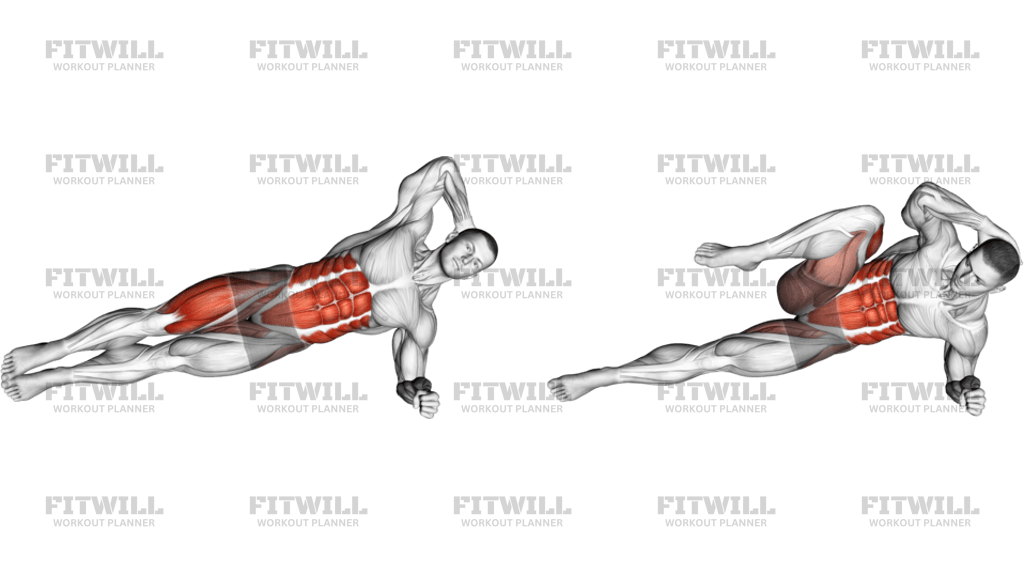
Plank Forearms Walk is a dynamic variation of the classic forearm plank where you travel forward across the floor by stepping or shuffling on your forearms while holding a straight, braced plank position. Instead of simply holding still, you move your body over your forearms one at a time, keeping your hips level and your torso rigid from shoulders to heels. The result is a core exercise that adds shoulder loading, coordination, and anti-rotation demand on top of the usual plank stability work.
Because you are supporting your weight on your forearms and actively pulling and pushing yourself forward, this movement hits the deep core and the front of the shoulders harder than a static plank. The transverse abdominis and rectus abdominis work to keep your spine neutral, the obliques resist unwanted twisting every time one forearm leaves the floor, and the glutes and quads hold the lower body in line. Meanwhile the deltoids, triceps, and the muscles around the shoulder blades handle the load as your weight shifts over each arm.
The setup matters more than in a static plank because any sag or hitch in your position gets amplified by movement. Settle into a proper forearm plank first, then earn the walk with small, controlled steps. If your hips start to rock or your lower back starts to arch, the movement is no longer training your core the way it should, so reduce the range of each step rather than pushing through sloppy reps.
This drill suits people who already hold a solid 30-45 second plank and want something more challenging without adding external weight. It is popular in core circuits, warm-ups for pressing days, and conditioning blocks, since moving slowly for distance keeps the heart rate up while remaining low impact on the wrists compared with hand-walking variations.
Keep the surface in mind: a smooth floor or an exercise mat works best because your forearms and elbows need to slide and step without catching. Focus on moving your whole body as one piece, and treat each step as a small controlled shift rather than a lunge forward. A short set of 10-20 steps with clean alignment will do far more for your midsection than a long, wandering set with a sagging lower back.
[ Workout Log & Planner ]
Put your next workout in Fitwill
Keep your plan and training log ready when you are.


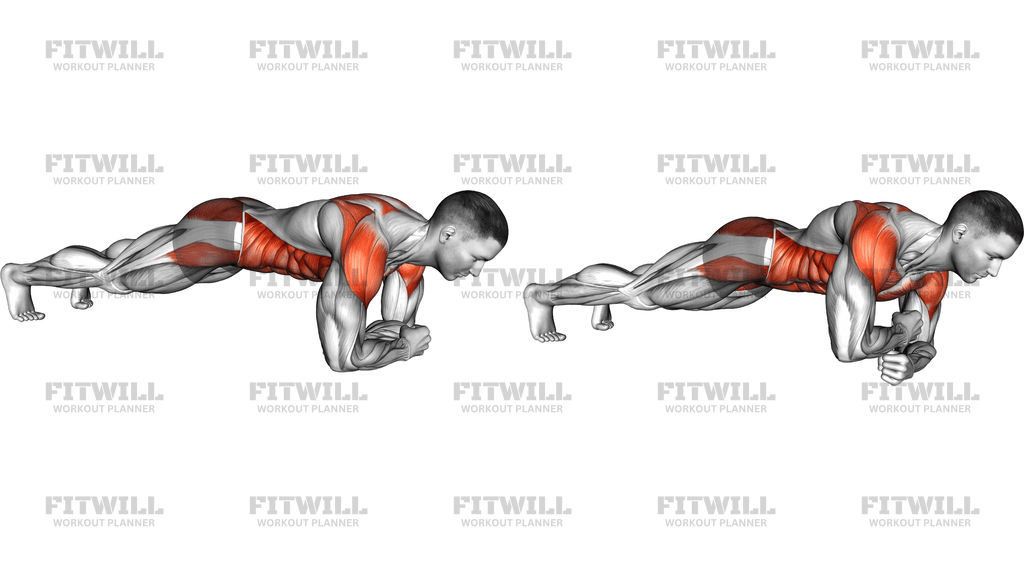
Instructions
- Place an exercise mat on a smooth floor and set up on your forearms with your elbows directly under your shoulders and your fists or flat palms facing forward.
- Extend your legs behind you, tuck your toes under, and lift your hips so your body forms one straight line from your head through your heels.
- Squeeze your glutes, brace your abdominals as if bracing for a light push, and press your forearms firmly into the floor to push your upper back slightly away from the ground.
- Look at the floor just ahead of your hands so your neck stays in line with your spine.
- Step one forearm forward a few inches, driving your elbow into the floor to pull your body over it, then bring the other forearm forward to match it.
- Alternate stepping forearms to travel forward, keeping each step short enough that your hips stay level and square to the floor the entire time.
- Check your hip line every few steps; if your pelvis tilts or rotates, slow down and shorten the steps until the movement is smooth again.
- Breathe steadily throughout, inhaling through your nose and exhaling through your mouth rather than holding your breath as the effort builds.
- To finish, stop walking, hold a still plank for a breath or two, then lower your knees to the mat and shake out your shoulders before the next set.
Tips & Tricks
- The most common fault is hip sway. Each time one forearm steps forward, that side tends to lift or drop. Imagine a glass of water balanced on your lower back and keep it level as you travel.
- If your shoulders burn before your abs do, you are probably creeping your elbows behind your shoulders. Reset so your elbows stay stacked under your shoulders with every step.
- Keep your steps short. Long lunging steps force your lower back to arch and turn the drill into an uncontrolled shuffle rather than a plank walk.
- Push the floor away with your forearms instead of letting your chest sink. A collapsed upper back shifts load into your shoulder joints instead of your muscles.
- On a slippery floor, skip the mat slide and step deliberately; on a grippy floor, a mat under your forearms prevents skin irritation from the stepping motion.
- Your feet can widen slightly to give you a more stable base, but avoid walking your feet forward as you fatigue, which quietly turns this into a short-lever plank.
- If your form breaks down, stop the set rather than resetting mid-move. Quality distance beats total distance for this exercise.
- Start with 5-10 steps and build up. Because the shoulders do a lot of stabilizing work, they fatigue faster than in a static plank.
Frequently Asked Questions
What muscles does the Plank Forearms Walk work?
The core, especially the deep abdominal wall and rectus abdominis, is the primary target, with the obliques working to prevent rotation as each forearm steps. The front shoulders, triceps, glutes, and lower back all stabilize heavily throughout the walk.
Is the Plank Forearms Walk harder than a regular plank?
Yes. Walking adds shifting load on each arm, anti-rotation demand from the stepping forearms, and extra work for the shoulder stabilizers, so it feels significantly harder than holding still for the same time.
Can beginners do the Plank Forearms Walk?
Beginners should first be able to hold a solid forearm plank for 30-45 seconds without sagging hips. If that baseline is met, start with very short walks of 5 steps, or practice from the knees to learn the stepping pattern with less load.
How far should I walk during a set?
Let form, not distance, decide the set. Ten to twenty controlled steps with level hips is plenty for most people; when your pelvis starts tilting or your lower back arches, end the set.
Why do my shoulders fatigue before my abs?
The front delts and shoulder stabilizers support your weight as it shifts over each forearm, which is new stress compared with a static plank. Shorten your sets and keep your elbows under your shoulders; the endurance builds quickly with practice.
Should my hips stay perfectly level the whole time?
Aim for level and square to the floor, accepting only tiny natural shifts. Visible hip rocking or a pelvis that rotates toward the stepping side means your steps are too big or your core has stopped bracing.
What can I substitute if stepping on my forearms is uncomfortable?
A static forearm plank with alternating shoulder taps or a plank hold with slow forearm shifts trains similar anti-rotation and core endurance with less travel. If elbow discomfort persists on hard floors, use a cushioned mat or move to a high plank variation.
Is it safe for my lower back?
When your body stays in one straight line and your glutes stay engaged, the position is spine-neutral and generally well tolerated. The risk comes from letting the hips sag while tired, so treat a sagging lower back as the signal to stop the set.
Where should I put the Plank Forearms Walk in my workout?
It works well near the end of a core block or as part of a conditioning circuit, and it can serve as a warm-up activation on pressing days. Avoid putting it first when your shoulders are needed fresh for heavy overhead or pressing work.