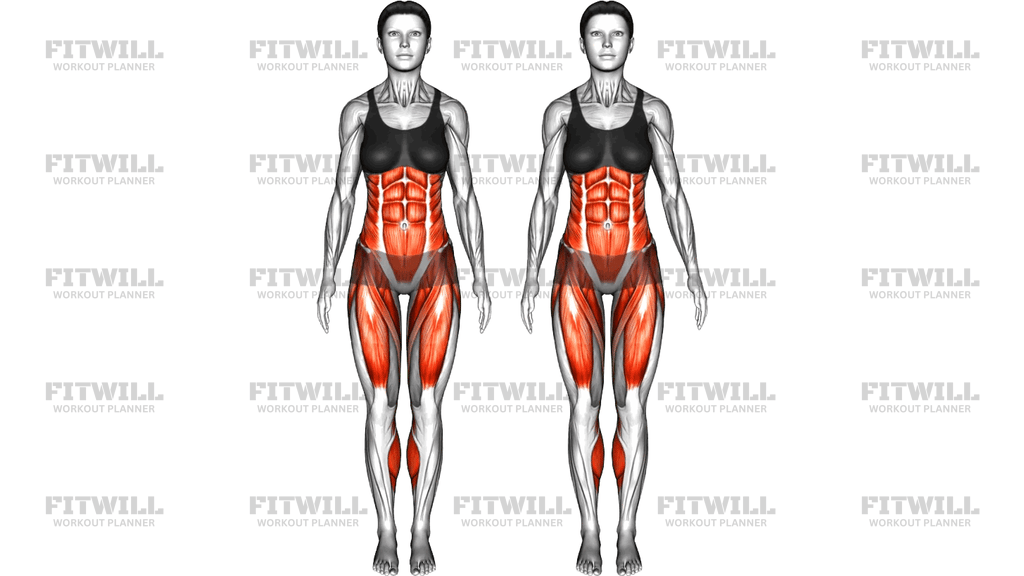
Bodyweight Calf Raise And Front Squat
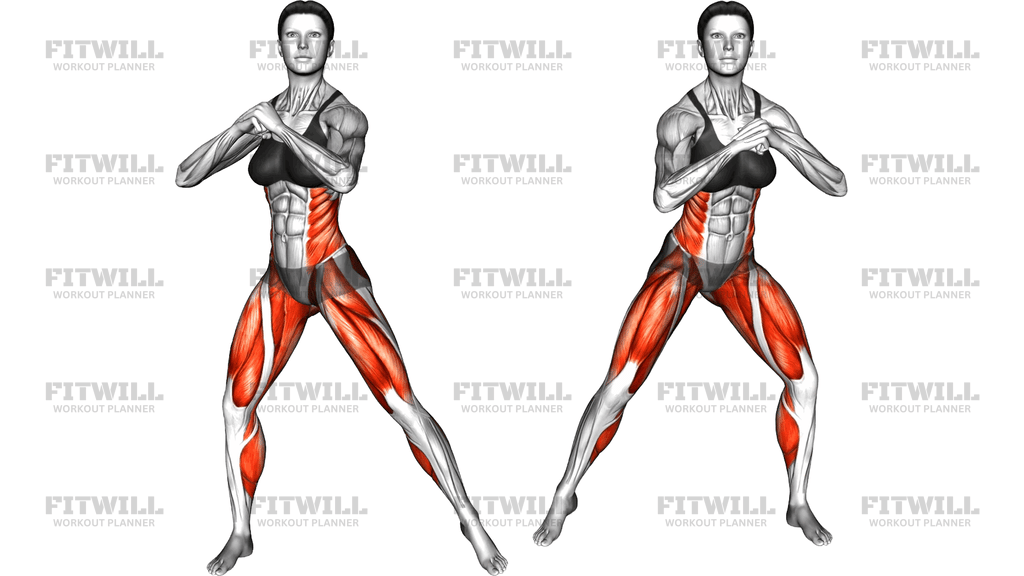
The Bodyweight Calf Raise And Front Squat is a two-part lower body movement that chains a bodyweight front squat together with a calf raise at the top. You hold your hands clasped in front of your chest in a front-squat arm position, sink into a squat, stand back up, and then finish by pressing up onto the balls of your feet before lowering your heels and repeating. Because everything happens on one continuous rhythm, your legs never fully rest between reps.
This combination is useful for anyone training at home or traveling without equipment, since it needs nothing but floor space and a bit of ankle mobility. It suits beginners learning squat mechanics, intermediate lifters looking for a higher-rep burnout, and anyone who wants to condition the whole lower body in a single drill. The front-squat hand position also nudges you toward a more upright torso than a relaxed bodyweight squat, which makes it easier to feel your quads working.
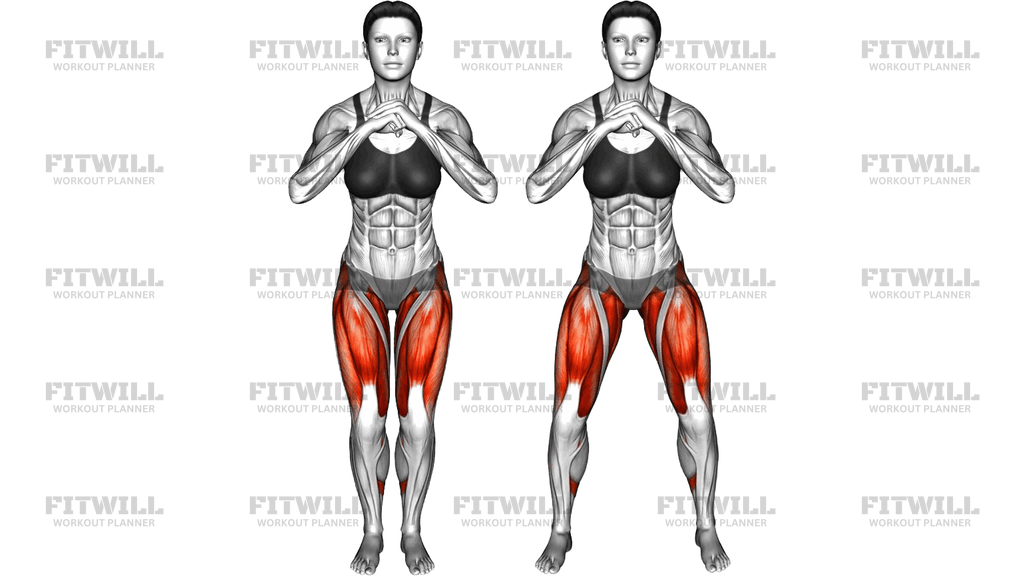
The main muscles involved are the quadriceps during the squat portion, the glutes as you drive out of the bottom, and the calves—both the gastrocnemius and soleus—during the raise at the top. Your core works the whole time to keep your chest tall and your torso from collapsing forward, and the ankle stabilizers get plenty of work as you balance on the balls of your feet rep after rep.
Setup matters more than it looks. Feet roughly shoulder-width apart with toes turned slightly out, weight spread across the whole foot, and hands clasped at chest height with elbows tucked down all set you up to squat cleanly and rise onto your toes without wobbling. If your stance is too narrow or your heels lift during the squat, the calf raise portion at the top will feel shaky and uncontrolled.
Execution is a matter of separating the two phases clearly. Squat down until your thighs are at least parallel or as deep as your hips and ankles comfortably allow, drive back up to a full stand, and only then perform the calf raise—pressing through the big toe and ball of the foot, squeezing the calves at the top, and lowering the heels with control. Treat it as squat, then raise, rather than one blended bounce.
Common use cases include warm-up circuits, metabolic finishers, and high-volume calf and quad work for people who cannot load a barbell. Keep the reps smooth and stay near a support if balance is an issue, and stop the set when you can no longer control the descent or keep your heels down during the squat portion.
[ Workout Log & Planner ]
Put your next workout in Fitwill
Keep your plan and training log ready when you are.


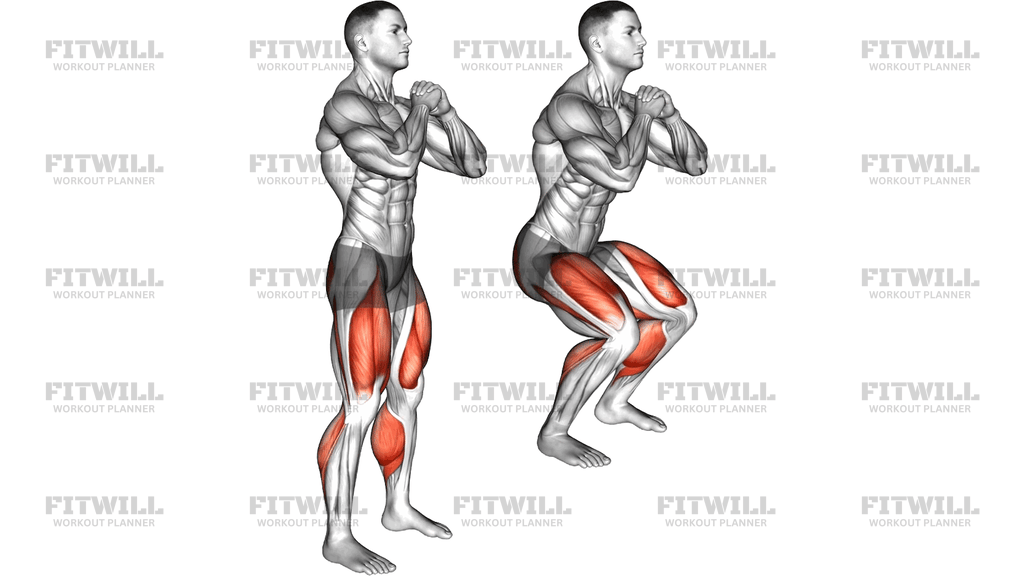
Instructions
- Stand with your feet about shoulder-width apart, toes turned out slightly, and your weight spread evenly across both feet.
- Clasp your hands together in front of your chest with elbows pointing down, mimicking the arm position of a front squat.
- Brace your abs lightly, lift your chest, and look straight ahead so your torso stays upright.
- Push your hips back and bend your knees to squat down, keeping your heels flat on the floor and your knees tracking over your toes.
- Descend until your thighs are at least parallel to the floor, or as deep as you can go without your heels lifting or lower back rounding.
- Drive through your heels and mid-foot to stand back up to a full, tall standing position.
- Once standing, press through the balls of your feet and big toes to lift your heels as high as possible, squeezing your calves at the top.
- Lower your heels back to the floor under control, let them briefly touch down, and begin the next squat.
- Exhale as you rise from the squat and during the calf raise, and inhale as you lower into the next rep.
- Complete your set, then shake out your ankles and calves before resting or repeating.
Tips & Tricks
- Do the squat and the calf raise as two distinct phases—if you bounce straight from the squat into the raise, the calves stop doing the work.
- If you rock forward onto your toes during the squat, widen your stance a touch and consciously keep your heels glued down until you are fully standing.
- Pause for a half-second at the top of the calf raise; a rushed up-and-down at the ankles is the most common way to waste this exercise.
- Keep your elbows down and chest up in the front-squat position—letting the elbows drift up usually pulls your torso forward and shifts stress to your lower back.
- Turn your toes out only slightly; an exaggerated turnout makes it hard to press straight up through the big toe on the calf raise.
- If balance is shaky on the raise, stand near a wall and let one hand hover lightly against it rather than shortening the range.
- Push mainly through the big toe and ball of the foot on the raise—rolling onto the outside of the foot reduces calf involvement and can strain the ankle.
- Control the squat descent instead of dropping fast; catching the bounce at the bottom hides weak points in your knees and hips.
- Start with modest reps like 10 to 15 and build up—because the legs never fully rest between the squat and the raise, this exercise fatigues faster than it looks.
Frequently Asked Questions
What muscles does the Bodyweight Calf Raise And Front Squat work?
The quadriceps and glutes do most of the work during the squat, and the gastrocnemius and soleus drive the calf raise at the top. Your core and ankle stabilizers work throughout to keep you upright and balanced.
Why does the Bodyweight Calf Raise And Front Squat use the hands-clasped front squat position?
Holding your hands at your chest with elbows down encourages an upright torso and a more quad-focused squat. It also keeps your arms out of the way so they do not swing or assist during the movement.
Is the Bodyweight Calf Raise And Front Squat good for beginners?
Yes, it is a low-load way to practice squat depth, heel position, and ankle control at the same time. Beginners should start with a partial range and reduce depth if their heels lift or balance suffers.
Should my heels stay down during the squat part of the Bodyweight Calf Raise And Front Squat?
Yes—heels stay flat for the entire squat and only rise during the dedicated calf raise once you are fully standing. If your heels lift in the bottom, your stance may be too narrow or your ankle mobility may need work.
How many reps should I do of the Bodyweight Calf Raise And Front Squat?
Because it is an endurance-style combination, sets of 10 to 20 reps work well for most people. Build volume gradually, since the continuous rhythm makes the calves and quads fatigue quicker than either exercise alone.
What is the most common mistake in the Bodyweight Calf Raise And Front Squat?
Blending the two phases into a single bounce off the floor, which turns the calf raise into a hop. Squat, stand fully tall, then perform a deliberate, squeezed calf raise before descending again.
Can I do the Bodyweight Calf Raise And Front Squat if I have balance issues?
Yes—stand within arm's reach of a wall or sturdy chair and touch it lightly with one hand when you rise onto your toes. Keep the weight on both feet evenly and avoid rushing the transition between standing and the raise.
What can I use instead of the Bodyweight Calf Raise And Front Squat?
You can perform bodyweight front squats and standing calf raises as separate exercises, or add a light dumbbell held at the chest (a goblet hold) for extra load. Splitting them apart is a good fallback if coordinating the two phases feels awkward.
Is it safe to do the Bodyweight Calf Raise And Front Squat every day?
For most healthy trainees, daily practice at moderate reps is fine because the load is low. If your calves or knees feel consistently sore or your squat depth deteriorates, take a rest day and let the volume come back up gradually.