Side Swing Skater Stepback
The Side Swing Skater Stepback is a bodyweight, rhythm-based movement that combines a lateral skater-style step with a leg reaching back behind the body and an arcing side swing of both arms. Instead of the explosive bound you'd use in a classic skater jump, this version stays grounded: you step one leg behind and across your standing leg, sweep the arms in the same direction, then switch sides in a continuous, flowing pattern. The result is a low-impact drill that raises your heart rate while challenging balance, hip control, and coordination.
This movement is a great fit for warm-ups, circuit training, and low-impact conditioning days. Because one foot always stays close to the floor, it's approachable for beginners and for anyone who wants the lateral conditioning benefits of skaters without the joint stress of jumping. More advanced trainees can speed up the tempo or deepen the stepback to make it genuinely demanding.
The work is spread across the whole lower body. The standing leg's glutes and quads absorb and control your weight on every repetition, while the outer hip muscles keep your pelvis level as the other leg sweeps behind you. The calves and ankle stabilizers work constantly because you're shifting side to side on one foot. The swinging arms and the rotation through each stepback pull the obliques and deep core into the mix, which is what separates this from a plain side-to-side step.
Setup matters more than it looks. You need clear space to each side, feet starting about hip-width apart, and a tall chest with a soft bend in the knees. If your torso collapses forward or your arms swing randomly, you lose the rotational core demand and the rhythm falls apart. Keep the arm swing deliberate — both arms travel out to the same side as the stepping leg, then trade sides with each rep.
To execute it well, think of the pattern as reach, load, switch. Step one leg behind and slightly past the other, let both arms arc out to that side, briefly load the front leg, then push off and immediately repeat on the other side. The transition is where most people struggle, so slow the tempo down until the cross-behind step feels automatic before picking up speed.
You'll see this drill in functional fitness circuits, at-home cardio workouts, and athletic warm-ups that need lateral preparation. Stay on a flat, non-slip surface, keep the stepping foot light rather than slamming it down, and stop the set as soon as your balance gets sloppy — controlled, rhythmic reps beat fast, wobbly ones every time.
[ Workout Log & Planner ]
Put your next workout in Fitwill
Keep your plan and training log ready when you are.


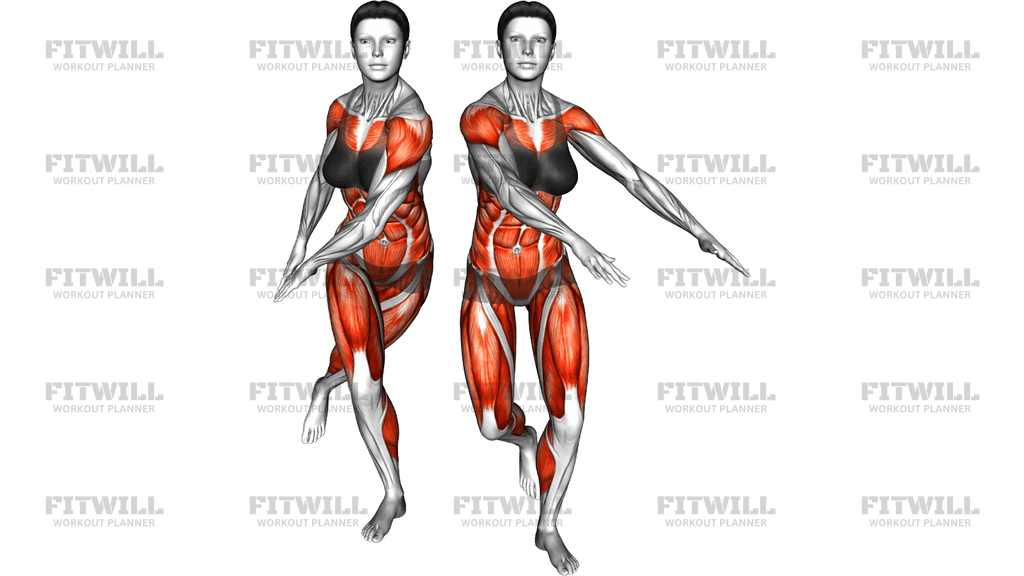
Instructions
- Stand tall with your feet hip-width apart on a flat, non-slip surface and enough clear space to move a few feet to each side.
- Let your arms hang relaxed at your sides, brace your core lightly, and soften your knees so you're ready to shift weight laterally.
- Shift your weight onto your right leg, then step your left leg behind and slightly across your body, placing the ball of the left foot on the floor behind your right heel.
- As the left leg steps back, swing both arms out to the left side in a smooth arc, keeping your chest tall and your eyes forward.
- Briefly load your weight between the front (right) leg and the back toe, feeling the right glute and thigh support your torso.
- Push off the left foot, bring it back through, and immediately step your right leg behind and across while swinging both arms out to the right side.
- Continue alternating sides in a steady rhythm, keeping each stepback controlled rather than rushed.
- Exhale on each stepback and arm swing, and inhale during the brief transition as your weight returns to center.
- Keep your hips level and facing forward as much as possible — let the legs and arms do the crossing, not your pelvis.
- To finish, slow the tempo, let the final step return to center, and stand with both feet hip-width apart before resting.
Tips & Tricks
- The most common mistake is turning this into a shallow side tap instead of a true cross-behind step — the back foot should land behind and past the standing heel, not just out to the side.
- If you keep losing balance, shorten the distance of the stepback before anything else. A small, precise cross-behind with quiet feet beats a long, wobbly one.
- Watch for the standing knee caving inward on each load. Think about pressing that knee out over your pinky toe so the hip, not the joint, absorbs the shift.
- Keep the arm swing connected to the leg — both arms arc to the same side as the stepping leg. Independent, floppy arm movement kills the rotational core benefit.
- Stay low and athletic. Many people rise up tall as they tire, which turns a glute-and-thigh drill into a stiff shuffle. Reset your soft knee bend whenever you feel yourself standing up.
- Land the moving foot toe-first and quietly. Heavy heel slams usually mean you're rushing the transition instead of controlling it.
- Your hips will want to rotate with the leg. Hold them square and forward — the crossing happens at the hip and the arm swing, not through a twisting pelvis.
- Once the pattern is smooth, add tempo in short bursts of 15-20 seconds rather than going fast for the whole set, so your footwork stays clean.
- If your ankles feel unstable, do the first set near a wall or rail. The support is only for confidence — keep the actual movement free-standing.
Frequently Asked Questions
What muscles does the Side Swing Skater Stepback work?
The glutes and quads of the standing leg do most of the support work, with the hamstrings and calves assisting on each step. The cross-behind arm swing adds the obliques and deep core, so the movement trains the whole body at a moderate intensity.
Is the Side Swing Skater Stepback suitable for beginners?
Yes. Because it stays grounded with no jumping, beginners can start with a short, slow stepback and gradually lengthen and speed it up. Practicing near a wall for balance on the first few sessions is a reasonable option.
How is the Side Swing Skater Stepback different from regular skater jumps?
Regular skaters use an explosive lateral bound with a landing on one foot, while this version steps the back leg behind and across the body with the arms swinging sideways. That makes it lower impact and places more emphasis on rhythm, hip control, and the rotational arm pattern.
Why do the arms swing to the side instead of staying at my chest?
The side swing is what recruits the obliques and ties the upper body into the cross-behind pattern. Keeping the arms moving with the stepping leg also helps you keep balance and timing as you alternate sides.
How far behind my body should the stepping foot go?
Aim for the ball of the foot to land behind and slightly past your standing heel — far enough that you feel a load in the front leg's glute and thigh, but not so far that your torso pitches forward. Control matters more than distance.
How many reps should I do?
Count each side-to-side cycle as one rep and start with 20-30 continuous reps, or work in timed sets of 30-45 seconds. Since this is also a conditioning drill, longer sets at a steady rhythm are perfectly appropriate.
My lower back feels the movement — is that normal?
Some core involvement is expected, but sharp lower back stress usually means your hips are rotating too much or your torso is leaning forward. Square your hips, keep your chest tall, and reduce the stepback distance until the strain settles into your hips and thighs.
What can I substitute if I need an easier version?
Try a simple side step-back without the full cross-behind, letting the moving foot tap out wide instead of traveling behind the standing leg. Once that feels stable, progress back to the full Side Swing Skater Stepback.
Can I use this exercise in a warm-up?
Absolutely — it's an effective way to prepare the hips, ankles, and lateral movement patterns before running, lifting, or sport. Use a slower tempo and a shorter range for warm-ups, saving faster sets for conditioning work.