Dumbbell Leaning Forward Shrug
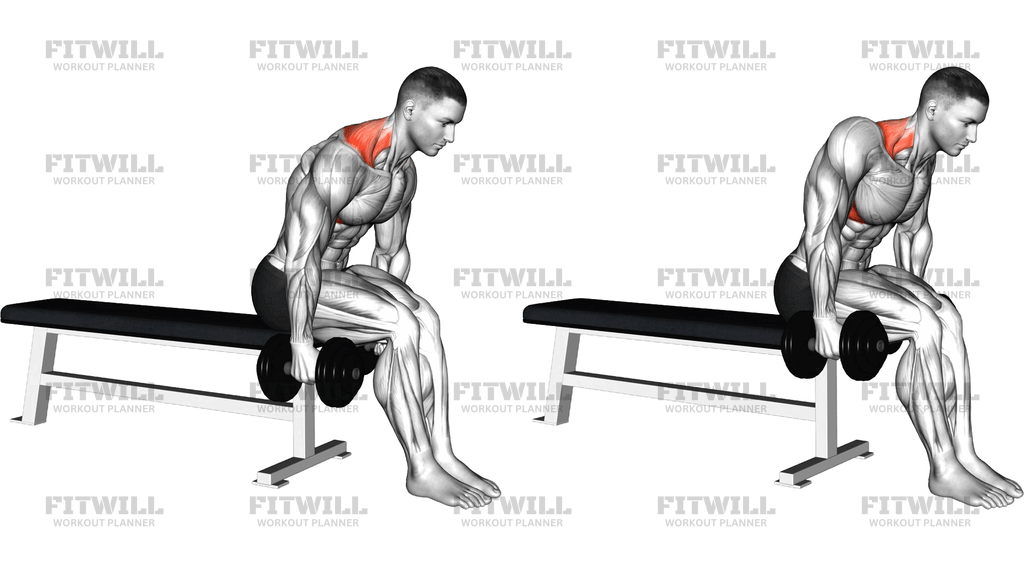
The Dumbbell Leaning Forward Shrug is a seated trap builder performed while leaning your chest forward over your thighs. You sit on a flat bench with a dumbbell in each hand, hinge forward so your torso angles down toward your knees, and let the weights hang beside your calves. From there you shrug your shoulders straight up toward your ears and lower them under control. The forward lean changes the angle of pull compared with a standing or upright shrug, loading the upper traps through a slightly different line while the arms stay relaxed and passive.
This version is useful for lifters who want more trap work without standing under heavy spinal compression. Because you are seated and hinged, the lower back is far less loaded than in a heavy standing shrug, and the bench removes any momentum from your legs and hips. That makes it a good choice for people who feel standing shrugs mostly in their lower back, or for anyone who tends to bounce and cheat the weight up when standing.
The primary muscle at work is the upper trapezius, the diamond-shaped muscle running from the base of your skull and along the top of your spine out to your shoulders. The middle traps and levator scapulae assist, and your forearms and grip work hard to simply hold onto the dumbbells for the duration of the set. Because the arms hang completely vertical and stay relaxed, nothing but the shrugging action moves the load.
The setup matters more than it looks. The forward lean needs to come from a hinge at the hips with a flat, braced back, not from rounding or slumping into the bench. If your torso collapses, your shoulders roll forward and the shrug turns into a partial, ineffective lift. Keeping the chest angled down while the spine stays long is what gives this exercise its distinct angle on the traps.
Execution is simple but easy to rush. Lift the dumbbells by driving your shoulders straight up toward your ears, pause briefly at the top, and lower them slowly until you feel a full stretch at the bottom. The arms should never bend and the elbows should never pull. The weights travel only a few inches, so heavy weights with small, sloppy reps are far less productive than moderate weights with a clean pause and a controlled negative.
You will see this movement used as an accessory after rows or presses, as a second shrug variation in a trap-focused day, or in rehab-friendly programs where limited spinal loading is preferred. It also pairs well with face pulls and rear delt work since it trains the upper back from a different angle than most rowing patterns.
[ Workout Log & Planner ]
Put your next workout in Fitwill
Keep your plan and training log ready when you are.


Instructions
- Sit on a flat bench with your feet flat on the floor about hip-width apart and a dumbbell in each hand.
- Hinge forward at the hips until your chest is angled down over your thighs, keeping your back flat and letting the dumbbells hang straight down outside your legs.
- Let your shoulders drop fully so the upper traps are in a stretched position before the first rep.
- Brace your core lightly and keep your neck in line with your spine rather than jutting your chin forward.
- Exhale as you shrug both shoulders straight up toward your ears, keeping your arms straight and passive the whole time.
- Pause for a beat at the top with the shoulders as high as they will go without rolling backward.
- Inhale as you lower the dumbbells slowly, letting the shoulders sink until you feel the traps lengthen fully.
- Complete all reps with the same hinge angle, and resist the urge to sit upright or bounce out of the bottom.
- When the set is finished, set the dumbbells on the floor one at a time before you sit back up.
Tips & Tricks
- Do not turn this into a row. If your elbows bend or the dumbbells drift toward your hips, the arms are taking over and the traps are no longer driving the lift.
- Avoid rolling your shoulders backward at the top. A straight vertical shrug keeps the tension on the upper traps, while circling adds nothing and can irritate the neck.
- The forward lean is the whole point of the exercise, but it must come from the hips. If your lower back rounds to reach the angle, hinge less and keep the spine long.
- If your grip gives out before your traps fatigue, use straps or choose a weight you can hold for all reps rather than cutting the set short.
- Keep the range honest at the bottom. Half the value of this exercise is the loaded stretch when the shoulders sink, so do not shorten the rep by stopping early.
- A brief pause at the top separates a real shrug from momentum. If you cannot pause, the weight is too heavy.
- Keep your chin tucked and neck neutral. Craning your head up to watch yourself shifts work to the levator scapulae and can leave your neck stiff the next day.
- If you feel this mostly behind the shoulder instead of the top of the trap, check that your shoulders are shrugging straight up and not being pulled back and down.
Frequently Asked Questions
Which muscles does the Dumbbell Leaning Forward Shrug work?
The upper trapezius is the primary mover, with help from the middle traps and levator scapulae. Your forearms and grip work isometrically to hold the dumbbells throughout the set.
Why lean forward instead of doing a regular standing shrug?
The forward lean changes the angle of resistance and lets the traps work through a slightly different line than an upright shrug. Sitting and hinging also takes leg drive and lower back loading out of the equation, which keeps the work on the traps.
Is the Dumbbell Leaning Forward Shrug suitable for beginners?
Yes, and it is actually a good first shrug variation because the bench prevents cheating with momentum. Start with light dumbbells and focus on the straight up-and-down path before adding load.
How far forward should I lean on the bench?
Lean until your chest is angled down over your thighs while your back stays flat and your arms hang straight down outside your legs. If you have to round your back to get there, you are hinging too far.
Why do I feel this in my neck instead of my traps?
This usually means you are lifting your head or shrugging with tension up into the jaw. Keep your chin tucked and think about pulling the shoulder blades themselves toward your ears rather than reaching with your head.
Can I substitute another exercise if I have no bench?
A standing dumbbell shrug works the same basic muscles, or you can sit on a sturdy box while hinging forward. The key elements to keep are the arms hanging straight down and a controlled vertical shrug.
How heavy should I go on the Dumbbell Leaning Forward Shrug?
Choose a weight you can hold, shrug fully, pause at the top, and lower slowly for all planned reps. If your grip fails early or your torso starts to pump up and down with each rep, drop the weight.
Is it safe for people with lower back issues?
The seated, hinged position places far less load on the spine than heavy standing shrugs, which is why many lifters prefer it. Still, keep the back flat throughout the hinge and stop if the position itself causes discomfort.
Should my elbows bend during the movement?
No. The elbows stay locked out and the arms act only as hooks holding the dumbbells. Any pulling with the arms turns the exercise into a row and steals work from the traps.
How does this fit into a back workout?
It works well as a finisher after rows or pulldowns when the upper back is already warm, or paired with rear delt and face pull work. One to three sets of eight to fifteen reps with a pause at the top is a solid starting point.