Dumbbell Hang Clean And Press
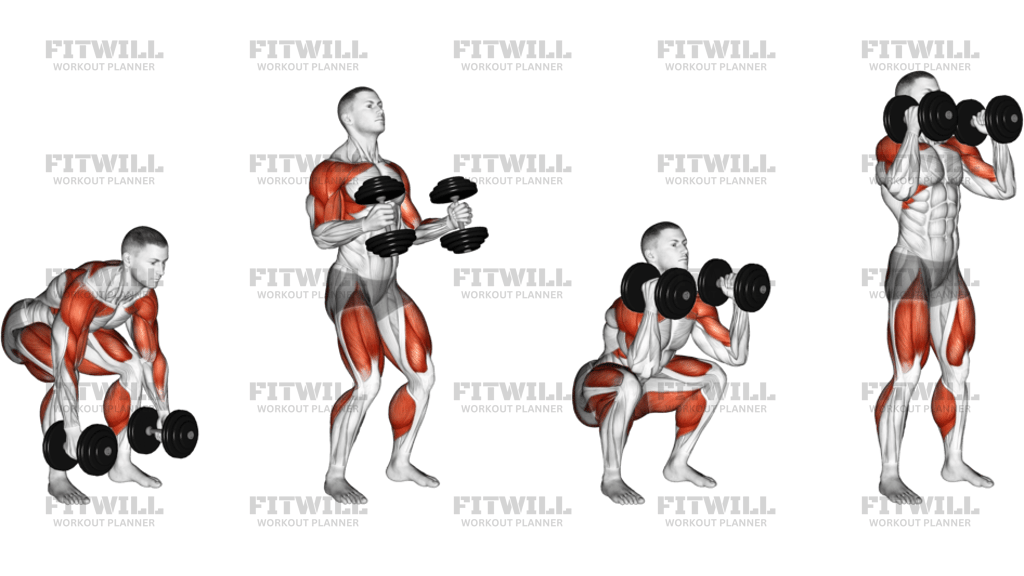
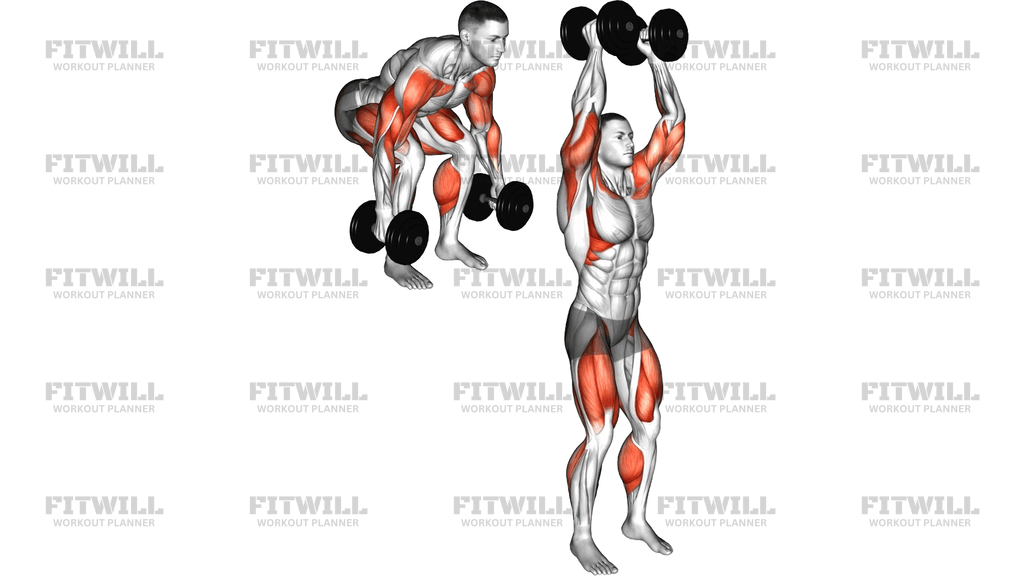
The Dumbbell Hang Clean And Press is a two-part full-body lift: you pull a pair of dumbbells from around thigh height up to your shoulders in one explosive motion, then press them straight overhead to a locked-out standing position. Because the dumbbells move independently, the lift demands more from your stabilizers and coordination than a barbell version, while staying friendlier to your wrists and shoulders since your arms can rotate naturally as you press.
This lift rewards athletes and general lifters who want power and conditioning in the same set. The clean portion trains hip and knee extension — the same triple-extension pattern behind sprinting and jumping — while the press builds overhead strength through the shoulders, triceps, and upper back. Your grip and forearms work hard the entire time, and your core ties the whole chain together as force travels from the floor through your hips to your hands.
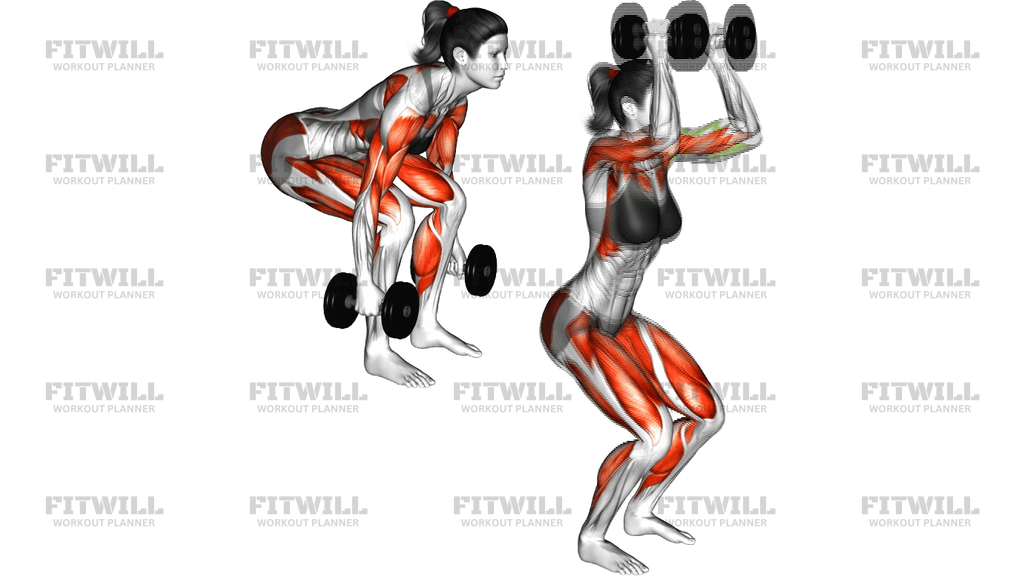
Setup matters here because the lift is fast. Your feet stay planted about hip-width apart, your torso hinges forward with a flat lower back, and the dumbbells hang just above knee level. If your starting posture is loose, the pull turns into an arm curl and you lose the snap that makes this lift work. Think of the hang position as a loaded spring: hips back, knees bent, chest tall enough to keep the spine neutral.
Execution has three beats: pull, catch, press. Pull by driving your hips forward hard and letting the dumbbells travel up your body, then drop your elbows quickly so the weights land at your shoulders with your knees slightly bent to absorb the catch. From there, brace and press both dumbbells overhead until your arms are straight and stacked over your ears, then lower them back to the hang position under control to start the next rep.
Common use cases include strength and conditioning circuits, power development blocks, and time-efficient training days when you want one lift that covers legs, back, shoulders, and grip at once. Start lighter than you think you need. The goal is a crisp, fluid rep, not a grind — once the weight forces you to muscle it up with your arms or round your back on the reset, the lift stops being a clean and press and becomes an injury risk.
[ Workout Log & Planner ]
Put your next workout in Fitwill
Keep your plan and training log ready when you are.


Instructions
- Stand with your feet about hip-width apart, holding a dumbbell in each hand at your sides with a firm overhand grip.
- Hinge at the hips and bend your knees to lower the dumbbells until they hang just above knee level, arms straight, back flat, and chest angled toward the floor.
- Brace your core and pull your shoulders back slightly so your spine is neutral before initiating the lift.
- Explode upward by driving your hips forward and extending your knees, letting the momentum carry the dumbbells up along your thighs and torso while your elbows stay high and outside.
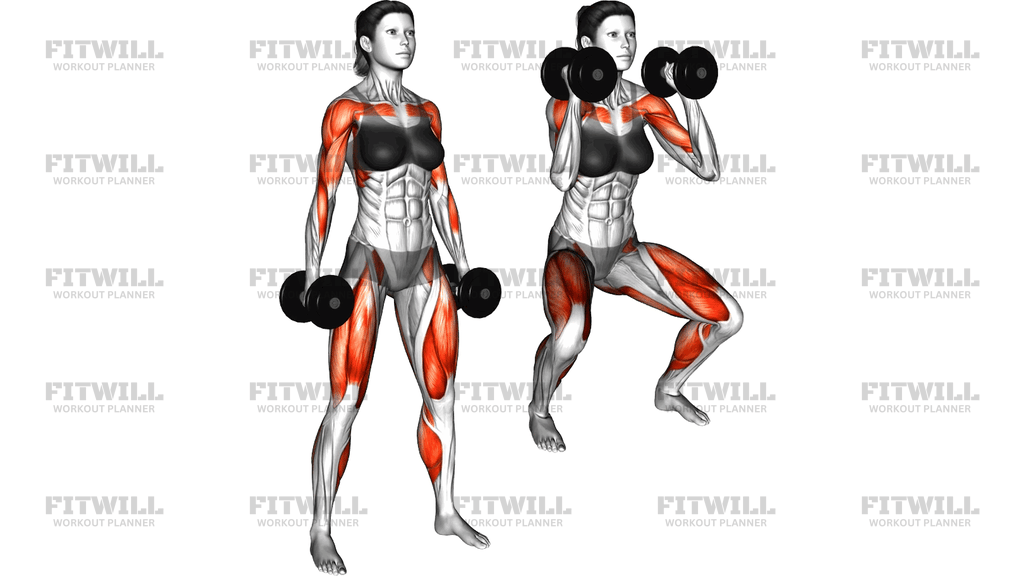
- At the top of the pull, quickly bend your elbows and rotate your hands under the dumbbells so they land at your shoulders, palms facing forward, with a small knee dip to absorb the catch.
- Stand tall, squeeze your glutes, and press both dumbbells directly overhead until your arms are fully extended and the weights are stacked over your shoulders and hips.
- Lower the dumbbells under control back to your shoulders, then hinge and lower them back to the hang position at knee level to reset for the next rep.
- Exhale forcefully as you drive and press; inhale during the reset at the hang position.
- Keep your feet planted throughout the set — if your stance drifts or you catch off balance, stop and reset rather than grinding a sloppy rep.
Tips & Tricks
- Let the hips do the lifting: if you find yourself curling the dumbbells to your shoulders, the weight is likely too heavy or your hip drive is too soft — drop the load and snap your hips faster.
- Do not let the dumbbells swing away from your body during the pull; keep them tracking close along your thighs so the force travels vertically instead of stressing your lower back.
- During the catch, aim your elbows slightly forward of the dumbbells rather than straight down — catching with elbows low and behind turns the rack into a shoulder strain.
- Keep your ribs stacked over your pelvis on the press; arching your lower back to finish the lockout means your core is no longer braced.
- If you feel the dumbbells colliding at your shoulders, angle your palms slightly inward at the catch so the plates clear each other.
- Reset deliberately between reps: flat back, straight arms, dumbbells still. Rushing the hang position is where most back rounding happens.
- Breathe out sharply on the drive, not at the top of the press — holding your breath through the whole rep makes the catch and press feel far heavier.
- On the lockout, squeeze your glutes and pull your chin back slightly so the bar path stays vertical instead of arcing around your head.
- Use a light pair to drill the timing — a clean and press that looks strong but feels jerky usually means the pull, catch, and press are being performed as three separate lifts instead of one continuous rep.
Frequently Asked Questions
What muscles does the Dumbbell Hang Clean And Press work?
It is a genuine full-body lift: the quads, glutes, and hamstrings generate the pull, the traps and upper back lift the dumbbells, and the shoulders and triceps finish the overhead press. Your forearms and grip work throughout because the dumbbells must be held securely through every phase.
Is the Dumbbell Hang Clean And Press good for beginners?
It can be, provided a beginner starts with light dumbbells and drills the pull-and-catch timing before adding load. The dumbbell version is often easier to learn than the barbell clean because the arms can rotate freely and the weights are easier to bail on.
Why does the lift start from the hang position instead of the floor?
Starting just above the knees removes the slow floor pull and puts you directly in the powerful mid-thigh pulling zone. It emphasizes hip drive and makes the rep faster and more repeatable, which is ideal for power and conditioning work.
How heavy should the dumbbells be for the Dumbbell Hang Clean And Press?
Choose a weight you can pull crisply to your shoulders and press for clean lockouts without swinging or rounding your back. If you have to muscle the dumbbells up with your arms, the load is interfering with the timing the lift is meant to train.
Should I do a full squat on the catch?
No — a small knee dip is enough to absorb the dumbbells at your shoulders. Dropping into a deep squat on the catch usually means the pull was too low, and adding it needlessly fatigues your legs before the press.
My dumbbells hit each other at my shoulders during the catch. How do I fix it?
Angle your palms slightly inward as you rotate your elbows under, so the plates sit just outside your shoulders instead of colliding. Keeping the pull close to your body also stops the dumbbells from drifting inward at the top.
Can I use kettlebells instead of dumbbells?
Kettlebells work, but the balance point sits differently in the hand and the catch feels heavier at the rack. Dumbbells are the closest match to the movement as written because the plates stay neutral alongside your body during the hang and pull.
How is the Dumbbell Hang Clean And Press different from a dumbbell thruster?
A thruster links the front squat and press into one motion from a racked position every rep. The hang clean and press starts from hanging dumbbells and includes an explosive pull and catch before each press, so it trains hip power in addition to the squat-and-press pattern.
How many reps should I do?
Because the lift is explosive, quality fades fast: sets of 3 to 6 reps work well for power, while sets of 8 to 12 with a lighter pair suit conditioning. Stop the set once the pull starts feeling slow or the catch becomes sloppy.
Is it safe for my lower back?
It is safe when your back stays flat through the hang and pull and the dumbbells track close to your body. The risky habit is resetting fast and loose at the bottom of each rep, so treat every reset like a fresh, deliberate hinge.