Seated Single Leg Curl On Chair
The Seated Single Leg Curl On Chair is a bodyweight hamstring exercise performed sideways on a sturdy chair. One leg stays planted on the floor with the knee bent, while the working leg extends behind you so the knee hovers just below the seat. From there, you curl your foot up toward your glutes by bending the knee, then lower it back down under control. The chair acts as a fixed point of support, letting you isolate one hamstring at a time without any additional load.
This movement is especially useful for people training at home with minimal equipment, beginners learning to feel their hamstrings work, or lifters who want extra volume for the legs without loading the spine. Because each side works independently, it also reveals and helps correct left-to-right strength differences, which is common in the hamstrings after injury or years of favoring one leg.
The main muscles at work are the hamstrings on the back of the thigh, particularly the biceps femoris on the outer portion, with the calf muscles assisting as the foot travels through the arc. The planted leg, along with your trunk, works statically to keep you balanced and upright on the seat, so you will also feel some gentle engagement through the hips and core as stabilizers.
Setup matters more than it might seem. Sit far enough onto the chair that your support foot is firmly planted, but keep your weight slightly toward the side of the working leg so the knee can move freely below the seat line. If your thigh presses hard into the chair, the range of motion gets cut short and the hip starts doing work the knee should be doing.
To execute it well, think about pulling your heel toward your buttock rather than just swinging the foot up. The contraction should come from the back of the thigh, and the lowering phase should take about twice as long as the lift. Rushing the descent turns the exercise into a leg swing and removes most of the training effect.
Common use cases include home leg training, warm-up or activation before squats and deadlifts, rehabilitation-style hamstring work when machines are unavailable, and as a finishing movement to fatigue the hamstrings with a controlled, joint-friendly range. Stop short of any position that pinches the knee, and keep the movement smooth rather than explosive.
[ Workout Log & Planner ]
Put your next workout in Fitwill
Keep your plan and training log ready when you are.


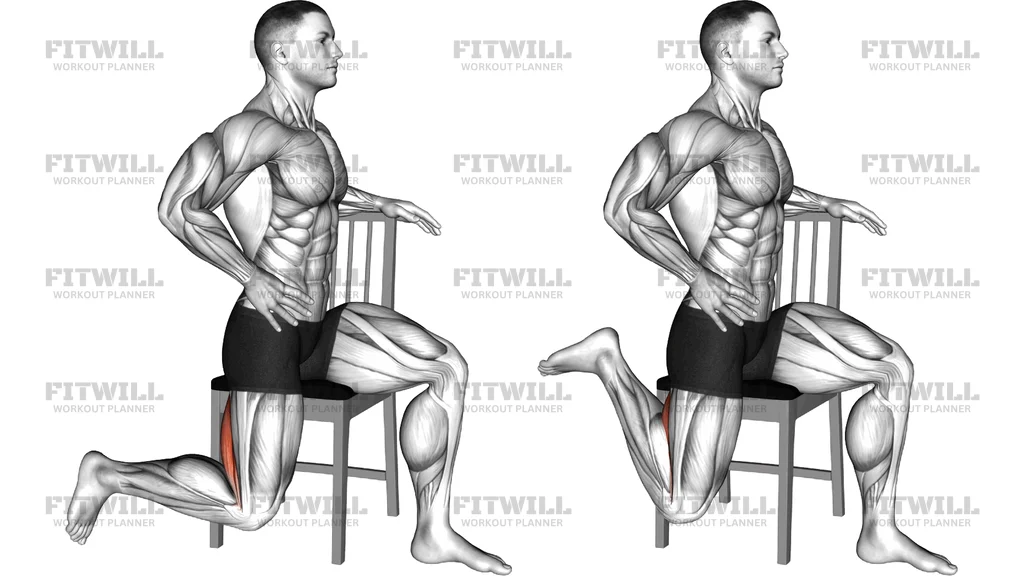
Instructions
- Place a sturdy chair on a non-slip floor and sit sideways on the front half of the seat with your torso tall.
- Plant your support foot flat on the floor with the knee bent to roughly 90 degrees, and let your working leg extend behind you so the knee sits just below the edge of the seat.
- Rest one hand on your hip or the back of the chair and the other hand lightly on your thigh for balance.
- Brace your core and keep your torso upright so your hips stay square and do not rotate as the leg moves.
- Bend the working knee and curl your foot up toward your glutes, squeezing the back of the thigh at the top.
- Pause briefly at the top of the curl with the heel close to your buttock.
- Lower the foot back toward the floor slowly, taking about two to three seconds, until the knee is nearly straight but not locked.
- Exhale as you curl the foot up and inhale as you lower it back down.
- Complete all repetitions on one leg, then switch sides so your support foot becomes the working leg.
- Between sets, stand up and reset your seated position so both sides start from the same setup.
Tips & Tricks
- If your thigh catches on the chair edge, shift slightly forward on the seat so the knee of the working leg can travel through its full arc below the seat line.
- A common mistake is swinging the foot up using momentum from the hip; fix it by slowing the rep down and thinking about dragging your heel toward your glutes.
- Keep your hips facing forward. If your pelvis rotates to help the leg up, the range is too long or you are fatigued, so shorten the range instead.
- Do not let the working knee drift forward under the chair. Keep it roughly in line with your hip so the hamstring, not the hip, drives the movement.
- Squeeze at the top for a full second before lowering. The seated position removes load, so the pause is what makes the contraction meaningful.
- Keep the toes relaxed rather than pointed hard. Aggressive pointing shifts tension toward the calf and away from the hamstring.
- If you cannot feel the back of the thigh working, straighten the support leg slightly and lean a little more weight onto the working-side hip to increase the demand.
- Use a chair without wheels or a folding mechanism, and check that it does not tip as you shift your weight toward the working side.
- Stop the set if you feel pinching at the front or inside of the knee; that usually means the leg is extending too far back at the bottom of the rep.
Frequently Asked Questions
Which muscles does the Seated Single Leg Curl On Chair target?
The primary muscle is the hamstring group on the back of the thigh, with the biceps femoris doing much of the visible work. The calves assist during the curl, and the planted leg plus core stabilize you on the seat.
Is the Seated Single Leg Curl On Chair suitable for beginners?
Yes. Because it uses only your leg's own weight and a chair for support, the resistance is modest and easy to control, making it a good first hamstring exercise before progressing to bands or machines.
Why should I sit sideways on the chair instead of facing forward?
Sitting sideways lets the knee of the working leg hang below the seat edge so it can flex fully without the thigh pressing into the chair. Facing forward would block the leg's path and shorten the range.
How does this compare to a machine leg curl?
The movement pattern at the knee is similar, but the resistance here is limited to the weight of your lower leg. Machines allow progressive loading, so this exercise works best as an activation, rehabilitation-style, or high-rep finisher movement.
How many repetitions should I do?
Since the load is light, higher rep ranges work well, typically 12 to 20 controlled repetitions per leg. Focus on a slow lowering phase and a clear squeeze at the top rather than chasing a low rep count.
What is the most common mistake in this exercise?
Swinging the foot up with momentum and letting the hips rotate to help. Both take work away from the hamstring. Slow the tempo down and keep your pelvis square to the front throughout each rep.
Can I do the Seated Single Leg Curl On Chair if I have knee discomfort?
The knee-only flexion pattern is generally gentle on the joint, but you should limit the range to pain-free portions and consult a healthcare professional if discomfort persists or worsens.
What can I use if I do not have a suitable chair?
Any stable, knee-height seat such as a bench or sturdy ottoman works, as long as it will not slide or tip and the working knee can hang free past the edge. Avoid soft sofas that shift under you.
How should I breathe during the movement?
Exhale as you curl your foot up toward your glutes and inhale as you lower it back down. Keep the breathing steady rather than holding your breath through the set.