Table Top Stretch On Chair
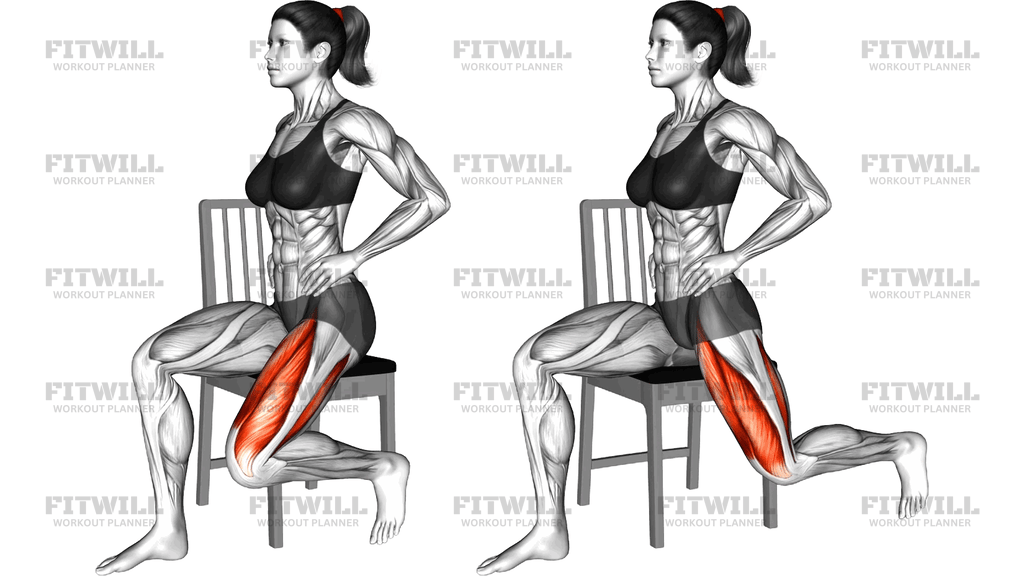
The Table Top Stretch On Chair is a supported front-of-body stretch that uses an ordinary sturdy chair as the anchor point. You start seated on the front edge of the seat with your hands gripping the edge beside your hips, then press through your arms and slide your hips forward off the seat so your body lowers into a long, arched line — something like a reverse tabletop with the chair behind you. The end position opens the front of the hips and abdomen while the arms take your weight behind you.
The stretch targets the hip flexors at the front of the hip, the abdominal wall, and the front of the shoulders and chest, which all get lengthened together in the arched position. At the same time, the triceps and shoulders work isometrically to hold your weight on the chair, so you get light upper-body engagement for free. Because the hips stay supported by the arms rather than hanging in open space, this version is more accessible than a floor-based backbend for people with stiff hips or tight quads.
This movement is particularly useful for anyone who spends long hours sitting. Prolonged sitting keeps the hip flexors in a shortened position all day, which often contributes to that pulled-forward, slouched posture. Extending the hips over the edge of the chair with the spine arching backward puts that tissue through the exact opposite range. It also fits nicely into a desk-break routine, a warm-up before lower-body training, or a cool-down after squats, cycling, or running.
Setup quality matters more here than in most stretches. The chair must be stable and positioned so it cannot slide backward when you load your hands on its edge — a chair against a wall is the safest option. Your hand placement on the seat edge, roughly under your shoulders, determines how comfortably your wrists and shoulders handle your body weight, so take a moment to get it right before you shift your hips off the seat.
To execute it well, move into the stretch gradually. Press down through your palms, let the hips drift forward past the front edge of the seat, and allow the chest to rise as the spine extends. Keep the feet planted so the legs stay involved, and let the head follow the arc of the spine rather than snapping back first. You should feel a broad stretch along the front of the hips and torso, not a pinching sensation in the lower back or the front of the shoulders.
A few practical points will keep this safe. Never use a chair with wheels or a lightweight folding chair for this. If your wrists complain, grip the sides of the seat or reduce the amount of weight you transfer through your arms. Ease out of the position by bending your knees and lowering your hips back onto the seat before releasing your hands — dropping straight down from the arch is the most common way people irritate their lower back with this stretch.
[ Workout Log & Planner ]
Put your next workout in Fitwill
Keep your plan and training log ready when you are.


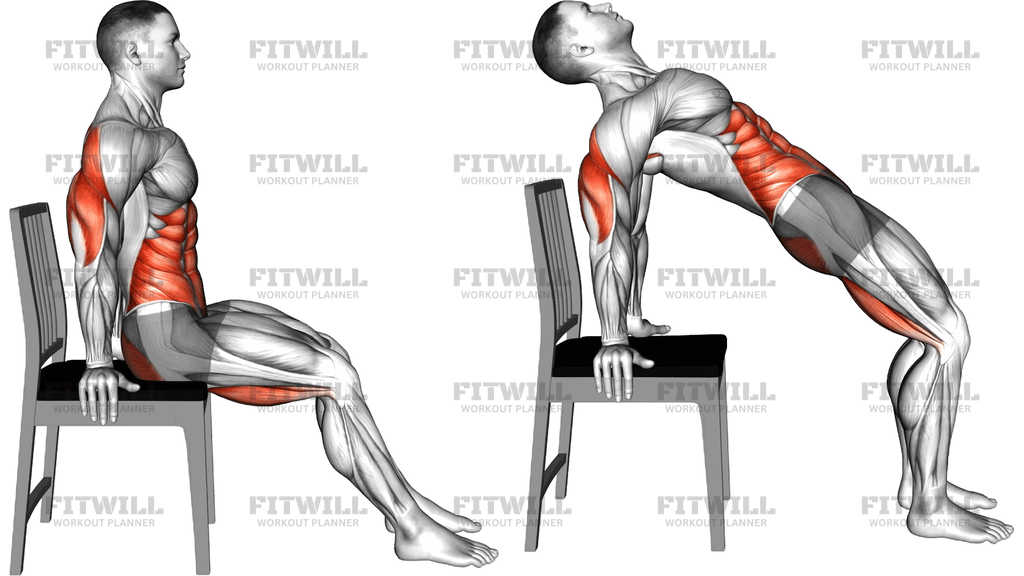
Instructions
- Place a sturdy chair against a wall so it cannot slide, and sit on the front edge with your feet flat on the floor about hip-width apart.
- Grip the front edge of the seat with both hands, fingers pointing forward or slightly outward, hands roughly under your shoulders.
- Sit tall and brace your midsection lightly before you start to move, keeping your feet planted where they are.
- Press down through your palms to take some weight off your seat and begin sliding your hips forward off the front edge of the chair.
- Continue moving the hips forward and down as your chest lifts, letting your spine arch backward so your body forms a long, extended line behind the chair.
- Let your head follow the arc of the spine and tilt back gently, keeping the neck relaxed rather than craned.
- Hold the arched position and breathe steadily through your nose, sinking slightly deeper with each exhale if the stretch feels comfortable.
- To come out, bend your knees and lower your hips back onto the seat first, then release your grip on the chair and sit upright.
- Rest for a few breaths with a neutral spine before repeating, or move on to your next stretch.
Tips & Tricks
- Test the chair before every set: push down hard on the seat edge with both hands while still seated. If it shifts, rocks, or squeaks under load, find a heavier chair.
- If your wrists ache in the stretched position, turn your fingers slightly outward or grip the sides of the seat instead of the front edge — the goal is a hip and torso stretch, not a wrist stretch.
- Avoid shrugging your shoulders up toward your ears as your arms take your weight; actively press the shoulder blades down your back to keep the shoulder joints comfortable.
- The most common mistake is pushing the hips forward but keeping the chest collapsed, which turns it into a hip shove instead of a full front-body stretch — think about lifting your sternum toward the ceiling as you slide off the seat.
- Bending your knees more reduces the pull on the quads and hip flexors; straighter legs make it stronger. Adjust leg position to find the intensity that lets you breathe freely.
- Do not force extra arch into the lower back by dumping weight into it. If you feel a sharp or pinching sensation in the lumbar spine, come out slightly and shorten the range.
- Let the head tilt back last, and only as far as feels easy. Leading with the head often causes neck strain before the hips have even reached their end range.
- Because the arms support your body weight here, this stretch doubles as light triceps and shoulder work — keep your elbows from locking out hard, a soft bend is friendlier to the joint.
- Hold for 20 to 40 seconds and repeat two to three times; the front of the hip usually opens a little more on the second hold than the first.
Frequently Asked Questions
Which muscles does the Table Top Stretch On Chair target?
It primarily lengthens the hip flexors at the front of the hip, along with the abdominal wall and the front of the chest and shoulders. The triceps and shoulders work statically to hold your weight on the chair.
Is the Table Top Stretch On Chair suitable for beginners?
Yes, as long as the chair is stable and the range is added gradually. Beginners can keep the knees bent and only partially slide the hips off the seat, which shortens the lever and reduces the intensity considerably.
Why do my wrists hurt during the Table Top Stretch On Chair?
Your wrists are extended under body weight, which is demanding if they are not used to it. Try angling the fingers slightly outward, gripping the sides of the seat, or shifting a little less weight into your hands.
Can I feel the Table Top Stretch On Chair in my quads instead of my hips?
That is normal, especially with straighter legs, since the rectus femoris crosses both the hip and the knee. If you want more of a pure hip flexor stretch, bend the knees and focus on letting the pelvis drop below the seat line.
What kind of chair should I use for the Table Top Stretch On Chair?
A heavy, four-legged chair with no wheels, placed against a wall so it cannot slide. Rolling office chairs and lightweight folding chairs are unsafe because they can move out from under your hands.
How long should I hold the Table Top Stretch On Chair?
Twenty to forty seconds per hold works well for most people, repeated two to three times. Come out slowly by bending the knees and lowering the hips back onto the seat before releasing your hands.
Why does my lower back pinch instead of stretching when I do the Table Top Stretch On Chair?
The arch may be collapsing into one small segment of the lumbar spine. Reduce the range, keep the ribs from flaring too far up, and think of spreading the extension across the whole front of the body rather than pushing the low back to its limit.
What can I substitute if I don't have a suitable chair for the Table Top Stretch On Chair?
A sturdy bench, the edge of a stable couch, or a low bed can work the same way as long as it will not slide. Without any support, a low lunge with a backward reach or a floor-based bridge stretch covers similar territory.
When is the best time to use the Table Top Stretch On Chair?
It works well as a mid-day break from sitting, as part of a warm-up before leg training, or after activities like cycling and running that keep the hips in a shortened position. Avoid doing it right after eating, since the stretched abdominal area can feel uncomfortable.
Should I hold my breath or breathe normally during the Table Top Stretch On Chair?
Breathe normally throughout. Slow nasal breathing helps the front of the body relax into the stretch, while holding your breath usually creates tension that works against the position.