V Leg Raise
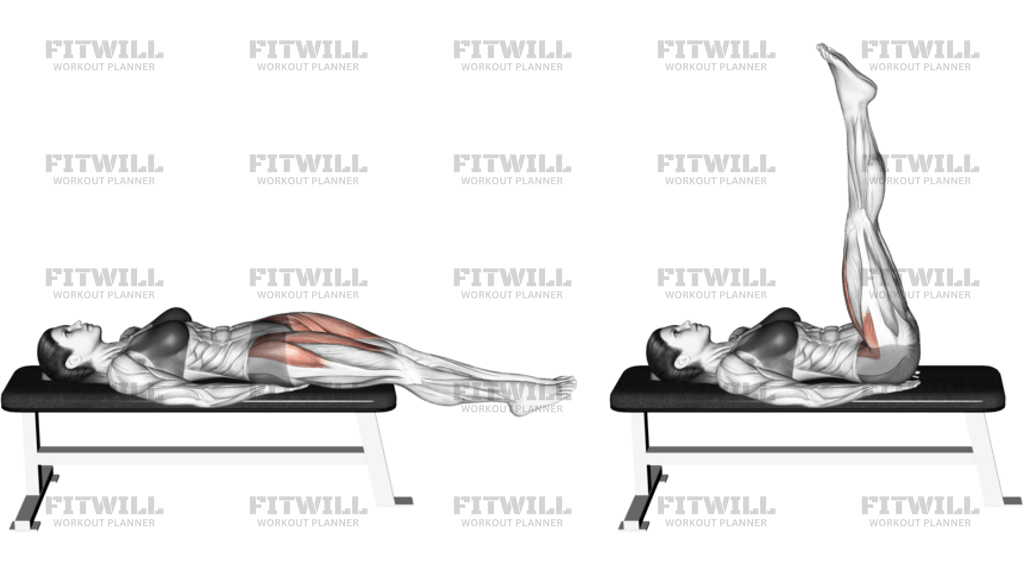
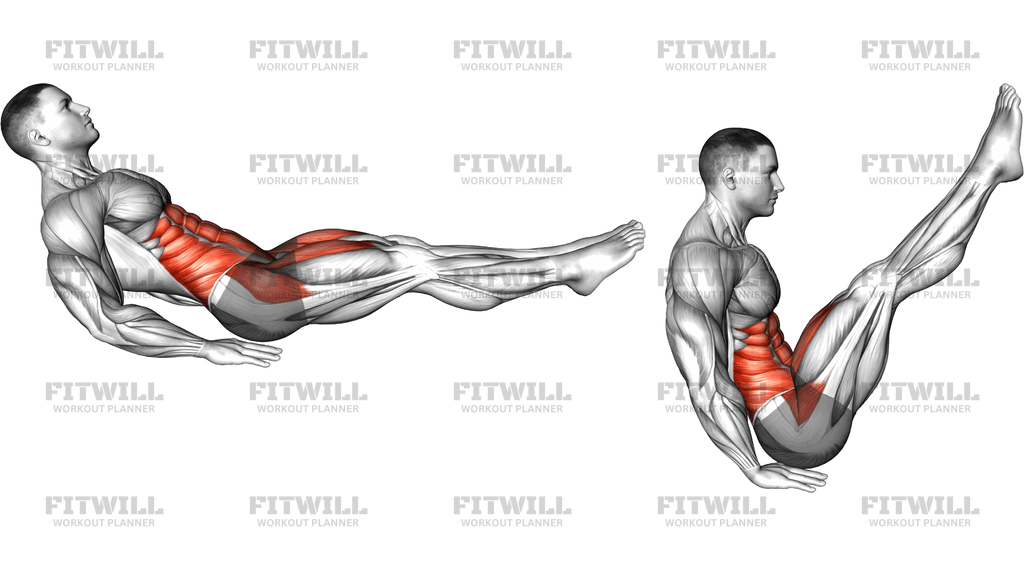
The V Leg Raise is a seated bodyweight movement where you lift your straightened legs from a low, extended position up in front of your body until your torso and legs form a wide V shape. You support yourself on your hands placed on the floor or a bench beside your hips, which makes this a hybrid of a leg raise and a support hold rather than a pure lying abdominal drill. Because the legs stay straight throughout, the movement places a long lever on the hip flexors while the abdominal muscles work hard to hold your torso steady and control the descent.
The main workers here are the hip flexors at the front of the hip, especially the iliopsoas and rectus femoris, which drive the legs upward. The abdominals, particularly the lower portion of the rectus abdominis, act as stabilizers and control the return, and the quadriceps stay engaged to keep the knees locked out. The shoulders and triceps also contribute isometrically, since your arms are pressing into the floor to hold your torso upright as your legs travel.
This exercise suits lifters who already tolerate lying leg raises well and want a harder variation that loads the hip flexors through a longer range. It is common in calisthenics and gymnastics-style conditioning, martial arts preparation where strong hip flexion matters for kicking, and general core training for people who find hanging leg raises too grip-demanding. Because it requires no equipment beyond a mat or a stable seat, it fits easily into home workouts.
Setup matters a lot in this movement. Your hand position determines whether your torso stays tall or collapses, and the height of the surface you sit on changes how much your legs can swing before they touch the floor. Sit near the edge with your palms planted firmly beside your hips, fingers pointing forward, and lean your torso back only enough to let your legs extend without dragging. Starting each rep from the same supported position keeps the effort on your hips and abs rather than on momentum.
To perform it well, lift your legs by hinging at the hips, not by jerking your torso backward. Raise them to roughly head height or as high as your flexibility allows, pause briefly at the top, then lower under control until your heels are just above the floor. Moving slowly on the way down is where most of the abdominal work happens, so resist the urge to drop the legs between reps. If you cannot keep your knees straight or your lower back rounds sharply, reduce the range and build up gradually.
A few practical points keep this exercise safe and productive. Keep your shoulders down and away from your ears instead of shrugging into your neck, and avoid locking your elbows so the joints are not bearing your full weight stiff-armed. If the movement bothers your lower back, elevate your hands on a bench, bend your knees slightly, or limit how low the legs travel. As with any straight-leg hip flexion drill, controlled tempo matters more than height.
[ Workout Log & Planner ]
Put your next workout in Fitwill
Keep your plan and training log ready when you are.


Instructions
- Sit on a mat or the edge of a stable bench with your legs extended straight in front of you and your heels hovering just above the floor.
- Plant your palms on the floor or grip the edge of the bench directly beside your hips, fingers pointing forward, with your elbows soft rather than locked.
- Lean your torso back slightly and lift your chest so your shoulders stay down and back away from your ears.
- Brace your abdominals and pull your ribs down before the legs move, as if setting your trunk into a solid block.
- Keeping your knees locked out and toes pointed forward, raise both legs up in front of you by folding at the hips until your torso and legs form a V.
- Pause for a beat at the top with your legs at or near head height and your torso tall.
- Lower your legs slowly and evenly back toward the start, keeping tension so your heels stop just above the floor rather than touching down.
- Exhale as you lift the legs and inhale as you lower them, keeping your breath steady instead of holding it.
- Reset your brace and shoulder position at the bottom of each rep, then continue for your target repetitions before standing up slowly to release the support position.
Tips & Tricks
- If your torso rocks backward every time the legs rise, you are using momentum instead of hip flexion — slow the lift down and think about bringing your chest slightly toward your thighs at the top.
- Bent knees are the most common cheat on this drill; if you cannot keep the legs straight for all reps, shorten the range or do fewer reps rather than softening the knees.
- Shrugging into your shoulders is a telltale sign of fatigue in the support position — press the floor away slightly and keep space between your ears and shoulders.
- Letting the heels touch the floor between reps removes the constant tension that makes the V Leg Raise effective; cap the descent just above the ground.
- Raising your hands onto a low bench or set of blocks shifts the angle and can ease lower back discomfort without changing the movement pattern.
- Pointing your toes and actively squeezing your quads makes the leg lever longer and stiffer, which improves both the training effect and the control of the rep.
- If your hip flexors cramp early in the set, that usually means they are doing more than your abs — add a brief pause at the top and keep the brace tight so the trunk shares the load.
- Do not swing the legs down and use the rebound to start the next rep; each lift should begin from a dead stop with the heels hovering.
- Keep your weight spread evenly across both palms; dumping weight onto one side twists the hips and makes the top position harder to hold square.
Frequently Asked Questions
What muscles does the V Leg Raise work?
The primary movers are the hip flexors at the front of the hip, mainly the iliopsoas and rectus femoris. The lower abdominals stabilize your trunk and control the descent, while the quads keep the knees straight and the shoulders and triceps hold your torso up.
Is the V Leg Raise suitable for beginners?
It is best treated as an intermediate step between lying leg raises and hanging leg raises. Beginners can start with bent knees, a smaller range of motion, or hands elevated on a low bench to reduce the load on the hips and lower back.
Why do my hip flexors cramp during the V Leg Raise?
Straight-leg hip flexion places a long lever on the iliopsoas, and cramping is common when the muscle is undertrained for that position. Reduce the range, add a brief pause at the top, and build volume gradually over several weeks.
How high should my legs go in the V Leg Raise?
Aim to lift your feet to about head height so your torso and legs form a clear V, but only as high as you can go without your knees bending or your lower back rounding. Controlled height beats forced range every time.
Should my legs touch the floor between reps?
No — letting your heels tap down releases tension and turns each rep into a fresh swing. Stop the descent with your heels hovering just above the floor so your abs and hip flexors stay loaded throughout the set.
Can I do the V Leg Raise on a bench instead of the floor?
Yes, sitting on a bench with your hands gripping the edge beside your hips works well and gives your legs clearance to travel. A bench also raises your hands, which can make the position more comfortable for the shoulders and lower back.
My lower back rounds and aches when I do this exercise. What should I change?
Limit how low your legs travel at the bottom, keep your ribs pulled down and abdominals braced before each rep, and consider elevating your hands on a bench. If discomfort persists, switch to a bent-knee version and rebuild control first.
How is the V Leg Raise different from a hanging leg raise?
The V Leg Raise supports your torso with your hands instead of hanging, so grip strength and shoulder endurance are not limiting factors. The trade-off is that your arms take some of your bodyweight, and the seated angle changes where the legs start and finish.
Can I add weight to the V Leg Raise?
Yes, once you can complete your target reps with straight knees and no heel contact, ankle weights are the simplest way to progress. Pause reps at the top are another good way to increase difficulty without adding load.
How many sets and reps of the V Leg Raise should I do?
Two to four sets of 8 to 15 controlled reps is a sensible range for core conditioning. Prioritize straight knees and a slow lowering phase over reaching a high rep count.