Lying Woodchopper Crunch
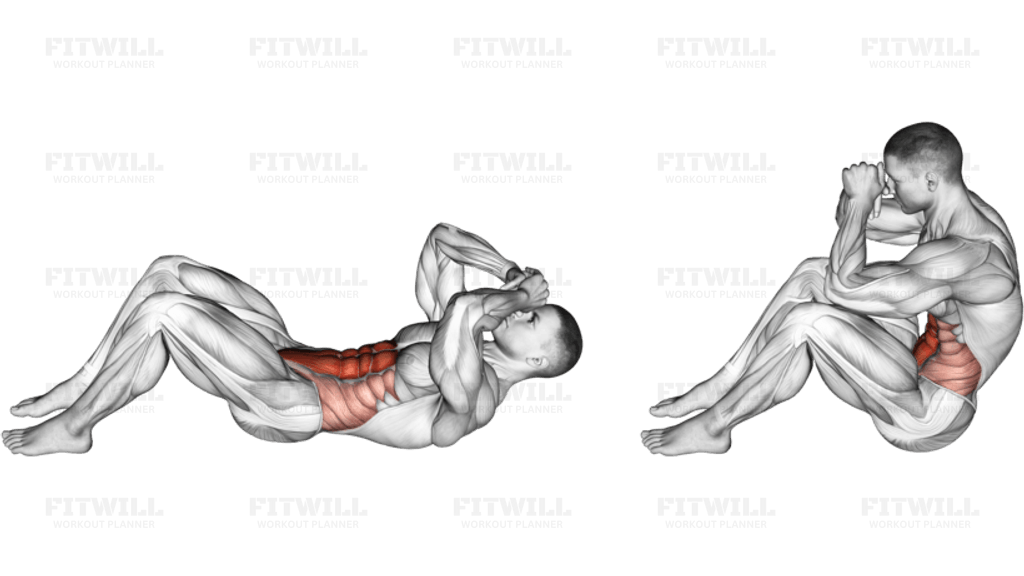
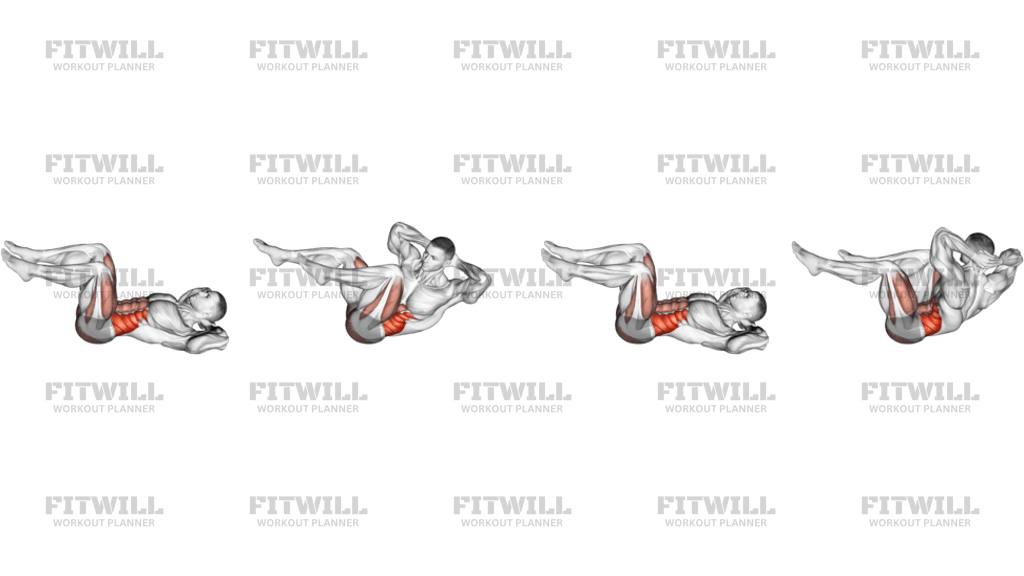
The Lying Woodchopper Crunch is a bodyweight core exercise performed on the floor that combines a strong abdominal crunch with a sweeping, chopping arc of the arms. You start flat on your back with your legs pointed straight up toward the ceiling and your arms extended overhead behind you. From there, you curl your upper body off the floor while swinging your arms down and forward between your knees, mimicking the path of swinging an axe down through a log. The result is a movement that trains spinal flexion and the chopping pattern at the same time.
This exercise is useful for anyone who wants to train the abs through a full, dynamic range without equipment. Because the arms travel from overhead to between the knees, the rectus abdominis works through a longer range than in a standard crunch, and the obliques contribute as they guide the diagonal, cross-body path of the hands. The straight-leg position also places demand on the hip flexors and requires the lower abs to control leg position throughout, so the whole anterior core is working rather than just the surface layer.
The setup matters more than it might seem. Lying flat with the legs stacked vertically and the arms reaching back overhead puts the torso in a stretched position before the rep even begins. That stretch is part of the value, but it also means the lower back should stay in contact with the floor. If your hamstrings are tight and your legs drift forward, or if your ribcage flares up as you reach overhead, you lose the braced position and the crunch becomes less effective. Adjusting the leg angle slightly is a fair trade for keeping the low back down.
To execute it well, think of the movement as one coordinated exhale: peel your shoulder blades off the floor, exhale hard as your arms swing down, and reach your hands past the outside of your legs at the top. The arms are the chopper, but the abs are the engine. Avoid yanking yourself up with momentum or letting your head lead the motion. On the way back, resist the return just as deliberately, letting the arms travel back overhead and the torso lower one vertebra at a time before the next rep.
You will see this style of crunch in athletic conditioning circuits, boxing and combat sports preparation, and general core training where rotational and diagonal patterns are prioritized. It also pairs naturally with planks, leg raises, and rotational cable work in a complete core session. Because it requires no equipment, it travels well, but the floor-to-overhead reach and rapid curl make it moderately demanding, so beginners should master basic crunches and lying leg raises first.
The main safety point is spinal control. The combination of straight legs, an overhead reach, and a forceful curl can pull the low back off the ground if you rush. Keep the movement smooth, keep your breathing steady, and stop the set when your form starts to shorten rather than when your abs simply feel tired.
Fitwill
Log Workouts, Track Progress & Build Strength.
Achieve more with Fitwill: explore over 9600 exercises with images and videos, access built-in and custom workouts, perfect for both gym and home sessions, and see real results.
Start your journey. Download today!




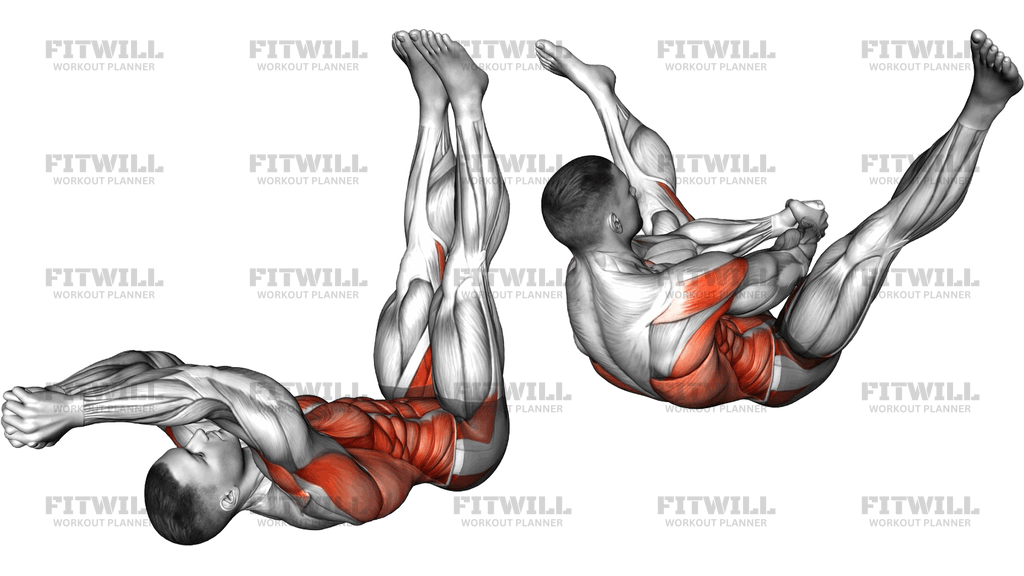
Instructions
- Lie flat on your back on an exercise mat with your legs together and raised straight up so they are roughly perpendicular to the floor.
- Extend both arms straight overhead behind you with your hands clasped or stacked, keeping them close to your ears, and press your lower back gently into the floor.
- Brace your core and take a breath in while holding this stretched starting position.
- Exhale forcefully as you curl your shoulder blades off the floor and swing your arms down in a wide arc toward your feet, like swinging an axe downward.
- Keep your legs pointing up as you chop, letting the hands sweep down and forward toward or just past the outside of your knees.
- At the top of the crunch, reach your hands as far forward as your range allows and squeeze your abs hard for a brief moment.
- Reverse the arc in a controlled manner, letting the arms travel back overhead as your upper back and head lower to the floor.
- Reset your starting position completely so the arms are extended behind you and the legs are vertical before starting the next rep.
- Breathe in on the way down and out on every chop, maintaining a steady rhythm across the set.
Tips & Tricks
- If your lower back lifts when you reach overhead, bend your knees slightly or lower your legs to a less vertical angle until flexibility improves.
- Do not let your chin jam toward your chest; keep a fist-sized gap and let the shoulders do the curling, not the neck.
- The chopping arc should follow a smooth curve from overhead to between or beside the knees. If your hands stop short at chest height, you are losing the bottom half of the range.
- Speed is not the goal here. A controlled chop with a hard squeeze at the top beats fast, bouncy reps that use momentum instead of the abs.
- Watch for your legs drifting forward over the course of the set. Straight legs that wander toward your torso reduce the hip flexor and lower ab demand.
- Keep your arms relatively straight but with soft elbows. Locked elbows make the swing feel jerky, and heavily bent elbows turn it into a pull instead of a chop.
- Exhale sharply on the way up. This is not just breathing etiquette, it helps the abs contract fully at the top of the crunch.
- If you feel strain in your neck, place your tongue on the roof of your mouth and imagine leading with your sternum rather than your head.
Frequently Asked Questions
What muscles does the Lying Woodchopper Crunch work?
The primary movers are the abs, especially the rectus abdominis, which curls the trunk against the overhead reach. The obliques assist through the diagonal chop, while the hip flexors and lats support the arm and leg paths.
Is the Lying Woodchopper Crunch good for beginners?
It can be, but it is more demanding than a basic crunch because of the straight legs and overhead start. Beginners should first build comfort with standard crunches and lying leg raises, then use a slightly bent-knee version of this movement.
Why do my arms start overhead behind my head in the Lying Woodchopper Crunch?
The overhead start stretches the lats and abs before each rep, which lengthens the range the trunk has to curl through. It also creates the full downward arc that gives the exercise its woodchopping character.
Should my legs stay vertical the whole time?
Yes, the legs should remain pointing roughly straight up with minimal drift. If tight hamstrings pull them forward or your lower back arches, lower the leg angle slightly rather than letting the back lift off the floor.
What is the most common mistake in the Lying Woodchopper Crunch?
Rushing the rep and using momentum to throw the arms down, which lets the abs off the hook. A second frequent error is stopping the chop early at chest height instead of driving the hands down toward the legs.
Can I do the Lying Woodchopper Crunch without a mat?
Yes, any firm, comfortable surface works since your entire back and arms stay in contact with the floor. A mat simply cushions the spine and shoulder blades during the overhead reach.
How is the Lying Woodchopper Crunch different from a regular crunch?
A regular crunch keeps the arms and torso in a shorter, mostly vertical path. This version starts from a fully stretched overhead position and adds a long diagonal arm swing, training the abs through a larger range with more oblique involvement.
What can I substitute if the movement bothers my lower back?
Bend your knees and keep your feet flat or crossed at the ankles to shorten the lever, or perform the chop with your legs bent toward your chest. Both options keep the arm arc while reducing strain on the lumbar area.
How many reps of the Lying Woodchopper Crunch should I do?
Two to four sets of 10 to 15 controlled reps is a reasonable range. Because the exercise rewards a full arc and a hard top-position squeeze, prioritize quality over chasing high numbers.
Is it safe to do this exercise every day?
Daily practice is possible for many people since it is bodyweight-only, but your abs still need recovery like any muscle. Two to four focused sessions per week with rest days between is a smarter long-term approach.