Crossover Heel Touch Squat
The Crossover Heel Touch Squat is a body weight squat variation that adds a diagonal reach across the body at the bottom of each rep. From a standing position, you squat down and reach one hand toward the heel on the opposite side of your body, then stand back up and alternate sides on the next repetition. The crossover element turns a straightforward squat into a movement that also challenges rotation through the trunk and stability through the hips.
The primary workload lands on the quads and glutes, which drive you down and back up out of the squat. The reach toward the opposite heel loads the obliques and deep core muscles as they control the slight twist of your torso, while the crossed stance position asks the inner thighs and hip stabilizers to keep your knees tracking cleanly. Because you are working one side at a time through the reach, you also get a mild side-to-side weight shift that exposes and corrects left-right imbalances.
This movement works well as a warm-up before lower body training, as a conditioning drill in circuit workouts, or as a low-impact strength exercise for people training at home without equipment. It is also useful for lifters who spend most of their squatting in a perfectly symmetrical stance and want to add some rotational and lateral control work without loading a barbell.
Setup matters more than it looks. Your feet should be set slightly wider than hip width so the crossover reach has room to happen, and your weight should stay distributed across the whole foot rather than rolling toward the toes. If your stance is too narrow, the reach pulls you off balance; too wide, and the squat itself becomes shallow and awkward.
To execute it well, sit your hips back and down like a normal squat, keep your chest tall, and only add the reach once you are near the bottom of the squat. The hand travels across your body toward the opposite heel, which means the rotation should come from your trunk and hips working together, not from your shoulder swinging. Press through the floor to stand, switch sides, and keep the rhythm smooth rather than rushed.
The most common fault is letting the knee on the reaching side collapse inward as the torso rotates. Keep that knee stacked over the foot throughout, and if the reach forces your chest to slump, simply shorten the range until your torso control catches up. Done consistently and with control, the Crossover Heel Touch Squat builds squat strength, hip stability, and rotational core control in one efficient pattern.
[ Workout Log & Planner ]
Put your next workout in Fitwill
Keep your plan and training log ready when you are.


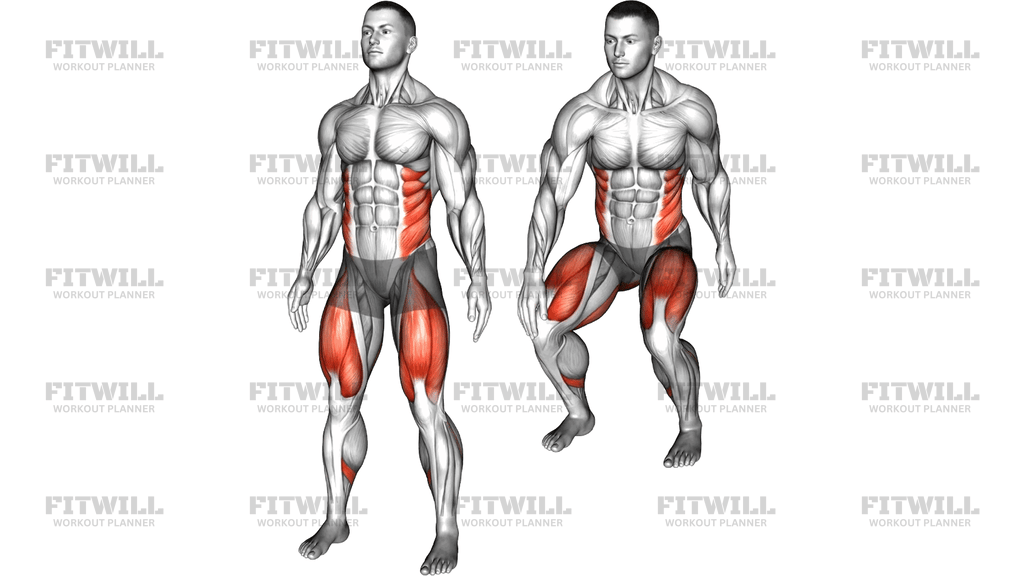
Instructions
- Stand with your feet slightly wider than hip width, toes turned out a few degrees, and let your arms hang relaxed at your sides.
- Shift your weight evenly across both feet, then brace your core and pull your shoulders back so your chest is tall before you move.
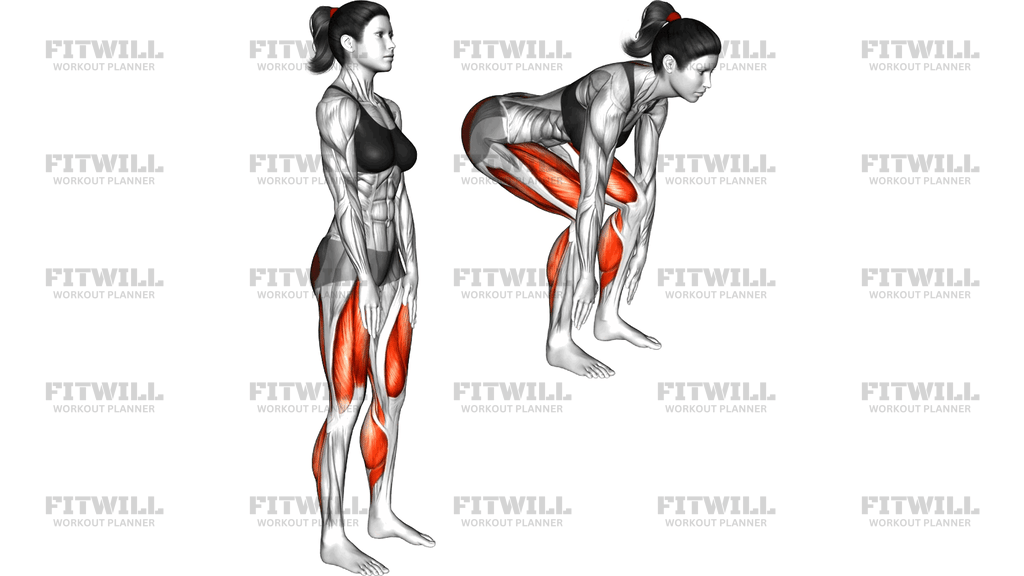
- Inhale, then push your hips back and bend your knees to lower into a squat, keeping your weight over your whole foot and your heels grounded.
- As you approach the bottom of the squat, reach your right hand across your body down toward your left heel, letting your trunk rotate slightly with the reach.
- Pause briefly at the bottom with the hand near or touching the opposite heel, keeping the knee on the reaching side stacked over its foot.
- Exhale and press through the floor to stand back up, bringing your torso square again as you rise and returning your arms to your sides.
- Repeat the squat on the next rep reaching your left hand toward your right heel, alternating sides each repetition.
- Keep the descent controlled for about two counts and avoid bouncing out of the bottom position.
- Complete your planned repetitions, then reset your stance and brace before the next set if you feel your posture drifting.
Tips & Tricks
- If you lose your balance during the crossover reach, widen your stance slightly — a narrow base is the most common reason the torso tips toward the reaching side.
- Reach with the intent of moving your shoulder and trunk together; flicking just the arm across the body turns the rep into a shoulder swing and takes the obliques out of it.
- Watch the knee on the same side as your reaching arm. The rotation naturally pulls it inward, so cue yourself to press that knee out over the pinky side of the foot.
- If your chest collapses when you reach low, touch higher on the lower leg or shin for a few sessions rather than rounding your back to chase the heel.
- Keep your heels glued to the floor. Rolling onto the toes during the crossover is a sign the hips are not sitting back far enough in the squat.
- Move slower than feels necessary for the first set. The alternating reach makes it easy to rush, and speed hides both knee tracking errors and weak-side imbalances.
- Breathe in on the way down and out on the way up rather than holding your breath through the reach, especially as the set gets tiring.
- If one side feels noticeably weaker or tighter, start each set with that side and match the reps with your stronger side instead of doing extra work on it.
Frequently Asked Questions
What muscles does the Crossover Heel Touch Squat work?
The quads and glutes do most of the squatting work, while the obliques and deep core control the diagonal reach across the body. The inner thighs and hip stabilizers are also involved because the crossover position challenges knee tracking.
Is the Crossover Heel Touch Squat suitable for beginners?
Yes. It requires no equipment, and beginners can limit the reach to mid-shin height or reduce squat depth until their balance and mobility improve. It is actually a good early squat variation because the reach teaches hip hinge and trunk control.
Should my hand actually touch the opposite heel?
Touching the heel is the target, but not a requirement. If reaching all the way down forces your chest to round or your heel to lift, touch higher on the shin and progress the range as your mobility allows.
Why do my knees cave inward when I reach across?
The rotation of the trunk pulls the femur into internal rotation, which drags the knee inward with it. Slow the reach down, deliberately press the reaching-side knee out over the foot, and consider narrowing the reach slightly until the pattern cleans up.
How is this different from a regular body weight squat?
The regular squat trains both legs symmetrically with the torso square, while the Crossover Heel Touch Squat adds a diagonal reach that rotates the trunk, loads the obliques, and shifts weight slightly side to side on every rep.
Can I use the Crossover Heel Touch Squat in a warm-up?
It works very well as a warm-up because it takes the squat, hip rotation, and trunk control through a full range without load. Two sets of eight to ten reps per side before lower body training is a common way to use it.
How many reps should I do?
For strength and control, aim for eight to twelve reps per side with a slow, deliberate tempo. For conditioning circuits, twenty to thirty total alternating reps at a steady pace works well.
What can I substitute if the crossover reach is uncomfortable?
A standard body weight squat with a single hand reaching toward the same-side heel removes the crossover while keeping the squat and reach pattern. Once that feels comfortable, add the cross-body reach back in.
Is it safe for people with knee issues?
Because it is low load and self-paced, many people with cranky knees tolerate it well, but the crossover adds a rotational demand the standard squat does not. Keep the depth shallow, control the knee position carefully, and stop if you feel sharp pain rather than normal muscle effort.